People who drink tea regularly appear less likely to develop heart and vascular disease than people who don’t, according to a new study published today in the Journal of Internal Medicine.
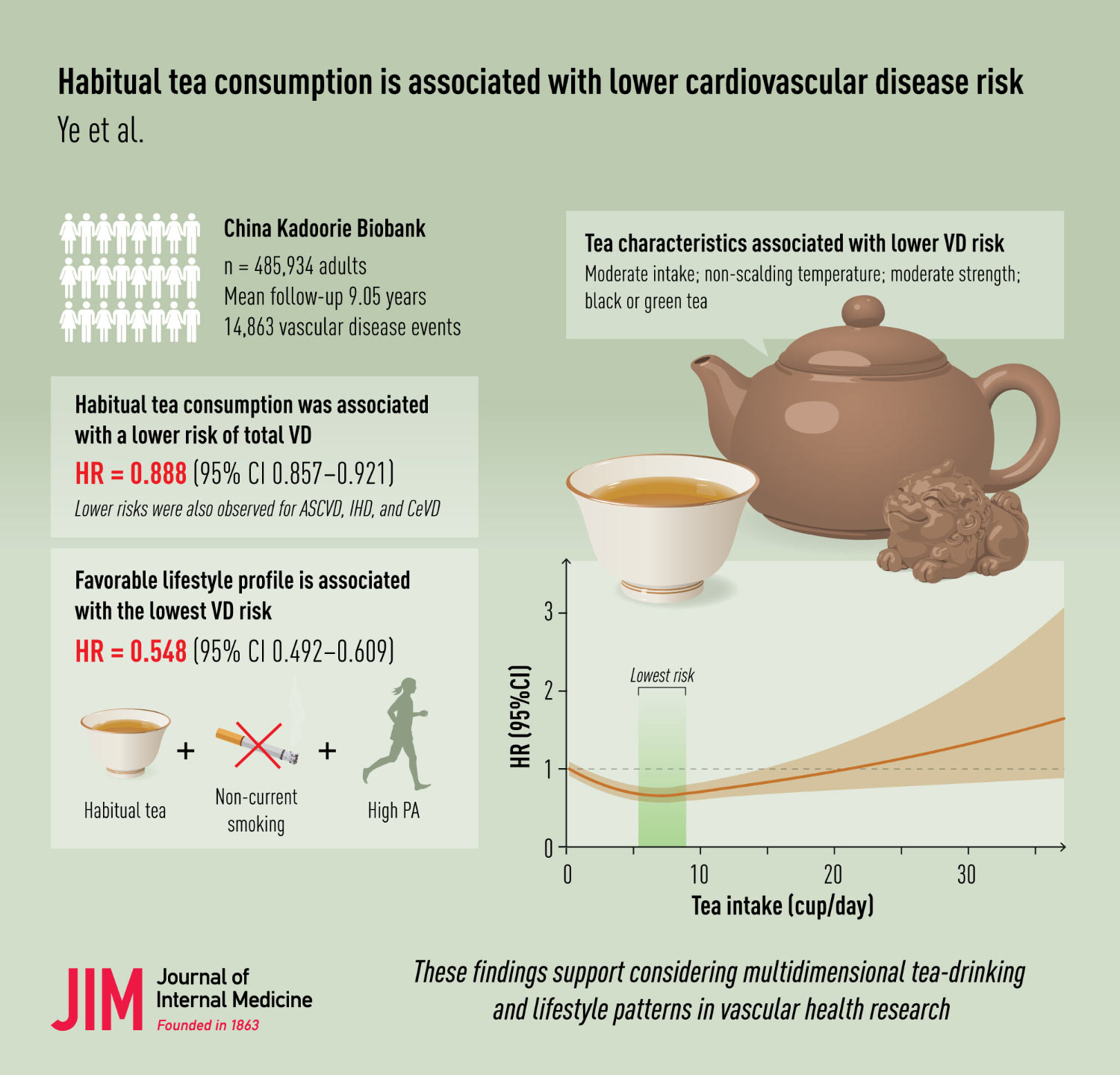
Ye et al. found an 11% lower risk of vascular disease among regular tea drinkers. Image credit: Ye et al., doi: 10.1111/joim.70172.
“This large study adds to existing observational evidence linking regular tea drinking with lower cardiovascular risk,” said Dr. Charalampos Rallis, a researcher with Queen Mary University of London who was not involved in the study.
“Tea drinkers differed from non-drinkers; however, the model is not fully adjusted for diet and income.”
In the study, Dr. Zichen Ye of the Peking Union Medical College and colleagues followed 485,934 adults in China for a median of about nine years.
During this time, 14,863 participants developed cardiovascular disease, cerebrovascular disease (which includes stroke), pulmonary heart disease or peripheral artery disease.
Habitual tea drinkers had an 11% lower risk of these conditions than those who did not drink tea regularly.
The benefit appeared to peak among people who drank tea weekly at about 6 to 8 cups a day.
Black tea showed more consistent links to lower risk than green tea.
Tea of moderate strength was associated with the lowest risk, while tea described as ‘burning hot’ was associated with a higher risk.
Tea drinking, not smoking and high levels of physical activity together were associated with the lowest vascular risk.
“The reported risk reduction is relative, and the authors caution that the ‘6-8 cups a day’ should not be read as a recommended intake,” Dr. Rallis said.
“The authors tested many comparisons and some of the more striking findings, such as those on black tea and ‘burning hot’ tea, should be treated as exploratory.”
The study is observational, which means it can show an association but cannot establish that tea itself protects the heart.
People who drink tea may differ from those who don’t in diet, income, lifestyle or other ways that are hard to fully account for.
The findings also come from a Chinese population, where tea habits and types may differ from those elsewhere.
“People who regularly drank tea in this study had around an 11% lower relative risk of vascular disease, adding to evidence linking tea drinking with better cardiovascular health,” said Dr. Dell Stanford, senior dietitian at the British Heart Foundation who was not involved in the study.
“But this doesn’t prove that a daily cuppa protects your heart.”
“This was an observational study and other differences in people’s diets and lifestyles could help explain the findings.”
“Tea intake was only measured once, cup size wasn’t standardized and the study cannot prove that drinking more tea caused the lower risk.”
“Importantly, the findings point to the wider role of healthy lifestyle habits,” she added.
“The lowest risk was seen among people who drank tea, did not smoke and were physically active.”
“There’s no single food or drink that will transform our heart health; our overall diet and lifestyle matter much more.”
_____
Zichen Ye et al. Habitual tea consumption is associated with lower cardiovascular disease risk. Journal of Internal Medicine, published online October 21, 2026; doi: 10.1111/joim.70172