The ‘love hormone’ oxytocin may rise and fall in tandem in cats and the people who live with them, according to a new study published in the journal iScience.
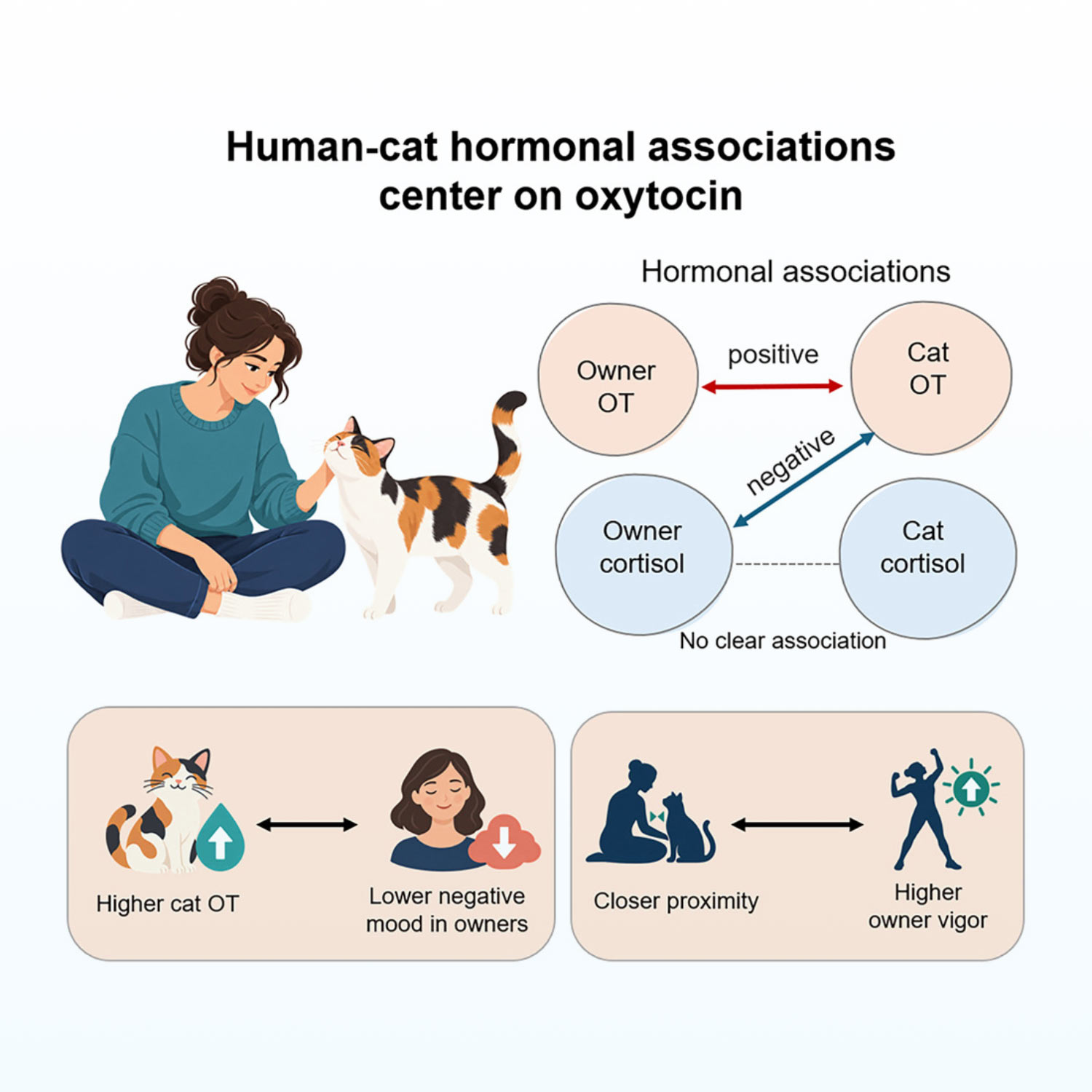
Higher cat oxytocin linked to lower owner cortisol and negative mood. Image credit: Takagi et al., doi: 10.1016/j.isci.2026.117934.
“I think many cat owners are familiar with the sense of comfort and peace they feel when their cat climbs onto their lap seeking affection, they start to pet it, and the cat begins purring contentedly,” said Dr. Saho Takagi, a researcher with Kyoto University and Azabu University.
“Our findings suggest that this feeling may be partly reflected in the hormonal connection between cats and their owners, particularly through oxytocin, a hormone involved in the formation of parent-child bonds and social relationships.”
For the study, the study authors collected urine from 19 cat owners and their 29 pets over one month.
Each person and cat provided up to three samples, which were tested for oxytocin, a hormone tied to social bonding, and cortisol, a marker of stress.
Urine could not be collected from five of the cats, so the hormone comparisons covered 24 owner-cat pairs.
Owners with higher oxytocin tended to live with cats that also had higher oxytocin. Owners with higher cortisol tended to live with cats that had lower oxytocin.
Cortisol levels in owners and cats showed little connection. This contrasts with research on dogs and their owners, where cortisol levels have been reported to move together.
The researchers suggest that the human-cat bond may revolve more around oxytocin, possibly reflecting the different histories of cat and dog domestication.
They also looked at owners’ moods using a standard questionnaire.
Cats with higher oxytocin tended to live with owners reporting less anger, confusion, depression and anxiety. Owners with higher cortisol reported more negative moods.
To gauge how much time pairs spent close together, the team fitted the cats with small Bluetooth beacons that tracked signal strength to the owners’ smartphones.
Owners whose cats stayed closer scored higher on a measure of vigor.
The length of time a person had lived with a cat was linked to more negative mood in an initial analysis, but the link disappeared when the scientists accounted for owners who had more than one cat.
In an exploratory test, cats with higher oxytocin were more likely to approach and enter a marked circle around either their owner or an unfamiliar person.
Cats with higher cortisol tended to spend less time near the stranger, although that result was not statistically clear.
“The present findings provide preliminary evidence that owner and cat hormonal states are associated primarily through oxytocin-related processes, whereas evidence for an association between their cortisol concentrations was limited,” the authors said.
“Although the mood-enhancing effects of cat ownership may diminish over time, daily interaction and physical proximity with cats may help sustain positive psychological states in owners — suggesting that cats serve not merely as passive companions but as active social partners capable of participating in bidirectional physiological and emotional interactions with humans.”
_____
Saho Takagi et al. Cats and humans show correlated affiliative physiological states. iScience, published online October 13, 2026; doi: 10.1016/j.isci.2026.117934