A previously unrecognized species of the fruit-eating pigeon genus Ducula inhabits the remote island of Tawi-Tawi in the Philippines’ Sulu Archipelago, according to Delaware Museum of Nature & Science’s Dr. Matthew Halley.
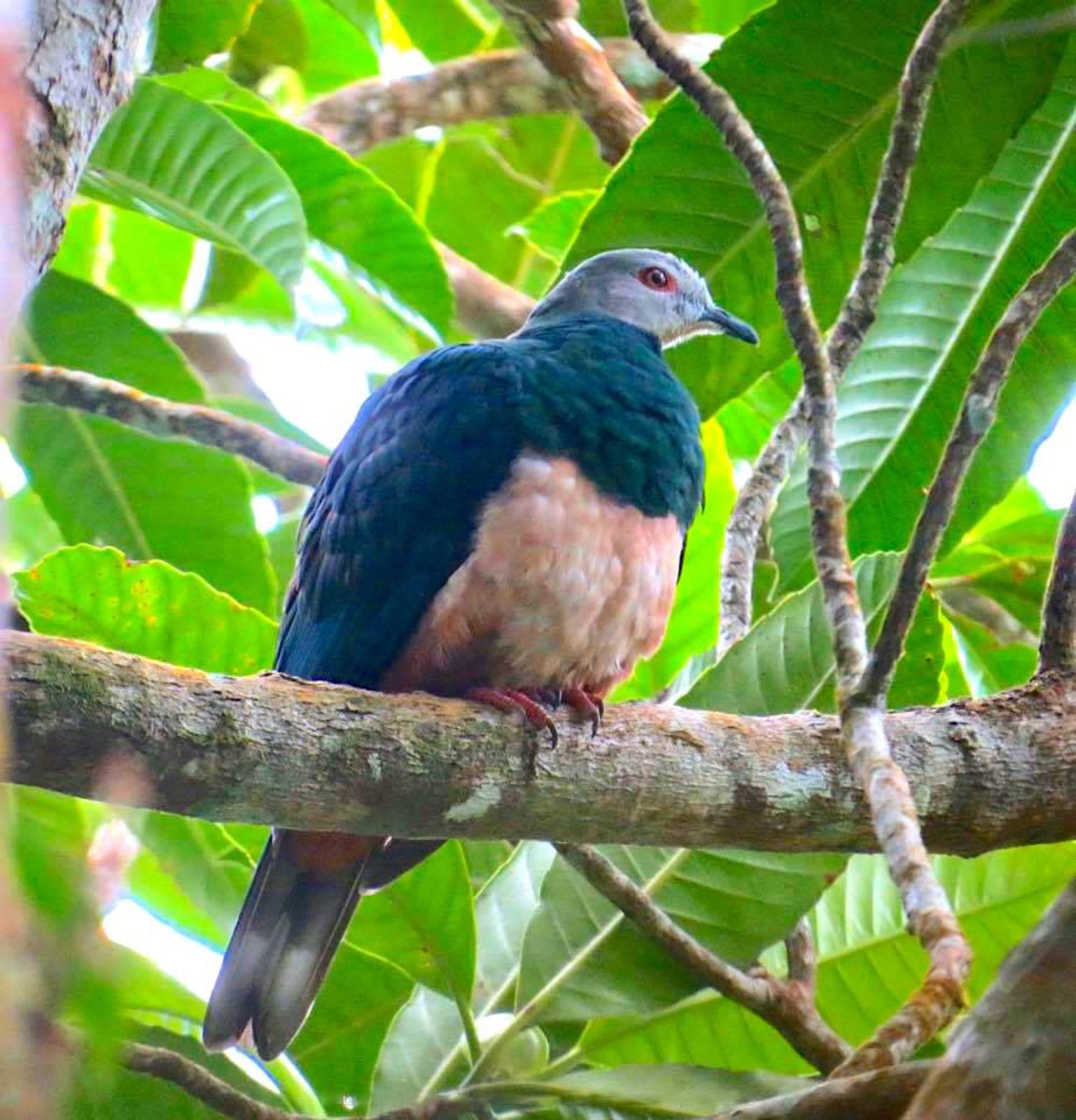
The pink-bellied imperial pigeon (Ducula poliocephala). Image credit: Gwen So / CC BY-SA 4.0.
Ducula is a genus of generally large, heavy-bodied pigeons within the family Columbidae.
Collectively known as imperial pigeons, these birds live in the rainforest canopy throughout the Indo-Pacific region, and can reach considerable sizes (35 to 45 cm, or 14 to 18 inches).
Because their diet primarily consists of fruit, they likely play an important role as seed dispersers in tropical forests.
“Modern checklists recognize 42 species in the genus Ducula, a clade of large ‘imperial pigeons’ that inhabits the Indo-Pacific region,” Dr. Halley wrote in his paper in the Bulletin of the British Ornithologists’ Club.
“This paper concerns a poorly known group (putative clade) of four species that occurs in the Philippines and Sulawesi, Indonesia, on opposite sides of Wallace’s Line.”
The newly described Ducula species is endemic to Tawi-Tawi Island in the Sulu Archipelago of the Philippines.
Named Ducula tawitawi, or the Tawi-Tawi imperial pigeon, the bird has a white throat, unlike the brown throat of the widespread pink-bellied imperial pigeon (Ducula poliocephala), a related species found throughout the Philippines.
Its calls are also distinct, providing a second major clue that the isolated population represents a separate species.
“Since the late 19th century, it has been assumed that the isolated population of Ducula poliocephala on Tawi-Tawi Island, Sulu Archipelago, Philippines, is phenotypically indistinguishable from other Ducula poliocephala in the Philippines, but this hypothesis has apparently not been examined critically,” Dr. Halley wrote.
Only three specimens of the new species exist in scientific collections, and no photographs of a living bird are known to exist.
Two of these specimens were collected in 1891 during the Menage Expedition and are now held at the National Museum of Natural History of the Smithsonian Institution.
A third was collected in 1971 by the Filipino ornithologist Dioscoro S. Rabor and is preserved at the Delaware Museum of Nature & Science.
According to Dr. Halley, the Ducula tawitawi population is likely far smaller than that of its mainland relatives and will probably meet the criteria for Threatened status once formally assessed.
“The wide-ranging Ducula poliocephala is uncommon on almost every island it inhabits, and its estimated global population of 5,000-10,000 individuals is inferred to be declining due to forest loss and hunting pressures,” he wrote in the paper.
“The size of the Ducula tawitawi population must be far smaller because the species is restricted to a diminishing habitat (dipterocarp forest) on a single island.”
_____
Matthew R. Halley et al. 2026. A new species of imperial pigeon (Columbidae: Ducula) from Tawi-Tawi, Philippines. Bulletin of the British Ornithologists’ Club 146 (3): 295-310; doi: 10.25226/bboc.v146i3.2026.a7