Paleontologists have identified a new species of ancient, distant mammal relative from two fossil specimens found decades apart in the Manda Beds of Tanzania. The discovery suggests that rocks linked to some of the earliest potential dinosaur fossils may be younger than long assumed.
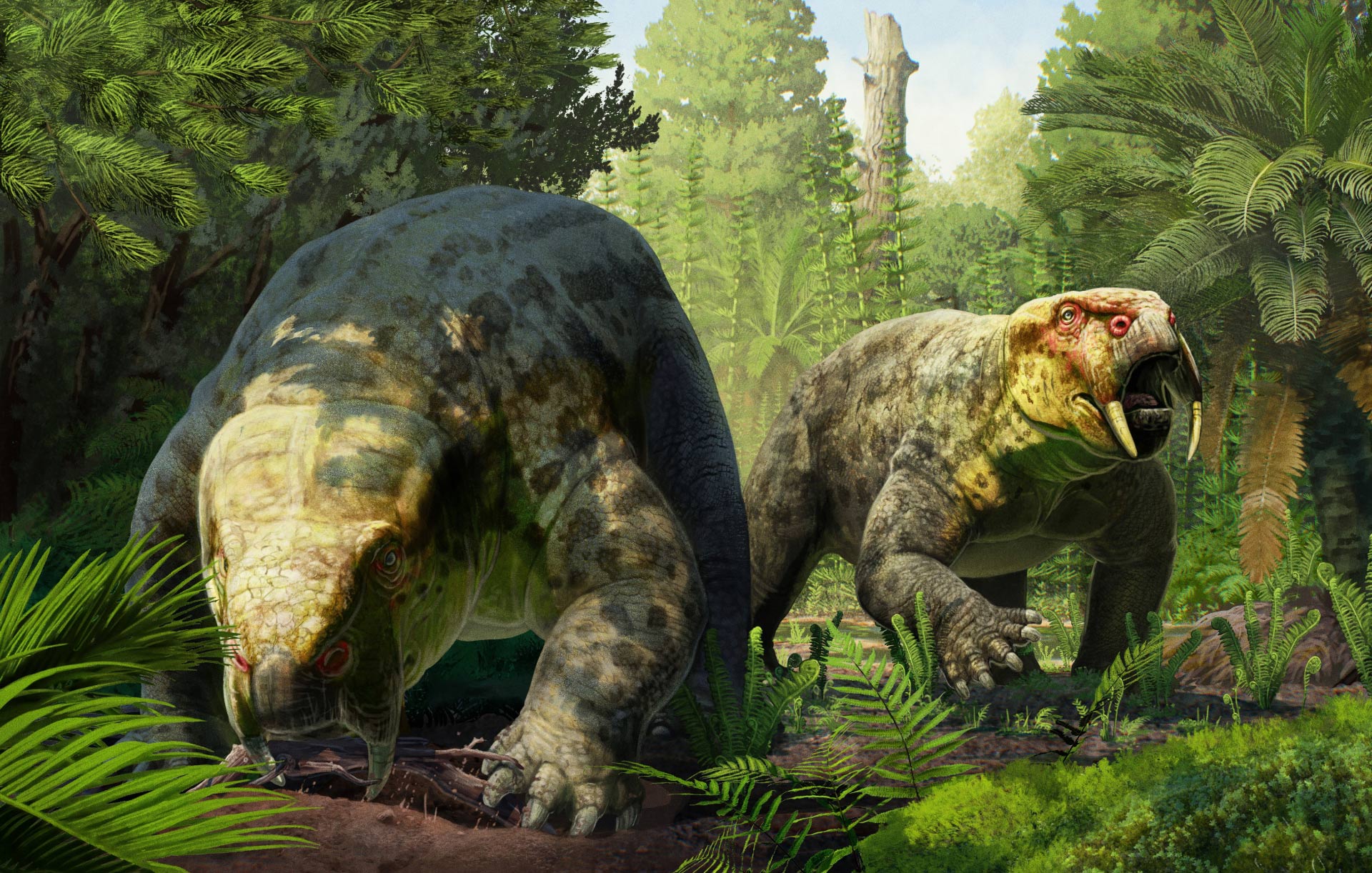
Life reconstruction of Dinodontosaurus isiyavamanda. Image credit: Gabriel Ugueto.
Named Dinodontosaurus isiyavamanda, the new species lived around 240 million years ago during the Triassic period.
The animal was a plant-eating dicynodont, a group of tusked, beaked synapsids distantly related to modern mammals.
It belonged to Dinodontosaurus, a dicynodont genus previously known only from South America.
“Our discovery marks the first confirmed record of the genus Dinodontosaurus outside South America,” said lead author Hady George, a Ph.D. student at the University of Bristol.
“The finding links the Tanzanian and South American fossil-bearing rocks, showing they are of equivalent age.”
A skull and partial skeleton of Dinodontosaurus isiyavamanda were collected in 1963 from the Lifua Member of Tanzania’s Manda Beds; a second specimen was recovered in 2012.
Using CT scanning and 3D surface imaging, the paleontologists examined the fossils in detail.
They then ran phylogenetic analyses placing the new species alongside its South American relatives.
“This fossil specimen from Tanzania has been in our care for over 60 years, and it’s wonderful that its identity has now been brought to light,” said Dr. Mike Day, curator of non-mammalian tetrapods at the Natural History Museum, London.
“By revealing that Dinodontosaurus lived in South America and eastern Africa, it offers a glimpse of our planet 240 million years ago.”
“It goes to show how revisiting museum collections can change our understanding of the past just as much as finding new fossils in the field, showing the importance of looking after these invaluable records of life on Earth.”
Because Dinodontosaurus is also known from securely dated rock sequences in Brazil and Argentina, its presence in Tanzania allows the researchers to argue that the Manda Beds’ fossil-rich mid-to-upper layer is considerably younger than long assumed.
It has yielded what may be the oldest known dinosaur, Nyasasaurus parringtoni, along with other early dinosaur relatives, so a younger date for the rocks would mean those animals appeared later in Earth’s history than some previous estimates suggested.
“The presence of the otherwise South American Dinodontosaurus in Tanzania indicates that the mid-upper Lifua Member was likely deposited at around the same time as the Dinodontosaurus Assemblage Zone of Brazil and the Chañares Formation of Argentina,” the scientists said.
“This strongly suggests the mid-to-upper Lifua Member is likely late Ladinian (242-237 million years ago) to Carnian (237-227 million years ago) in age, contra to the Anisian (247-242 million years ago) age it has historically been thought to be.”
“Future work should consider this younger age for the mid-to-upper Lifua Member when investigating the origins of major Mesozoic clades, including the Dinosauria.”
The discovery is described in paper published in the Journal of Vertebrate Palaeontology.
_____
Hady George et al. 2026. Craniomandibular osteology of Dinodontosaurus isiyavamanda sp. nov. (Therapsida: Anomodontia) from the Manda Beds of Tanzania and new support for a younger age for the alleged oldest dinosaurs. Journal of Vertebrate Palaeontology, in press; doi: 10.1080/02724634.2026.2692542