A single female specimen, collected 1,773 m below the surface near Darwin Island, has been described as a new species of deep-sea octopus, and it doesn’t fit neatly into the Megaleledonidae family it belongs to, forcing a revision of the textbook definition.
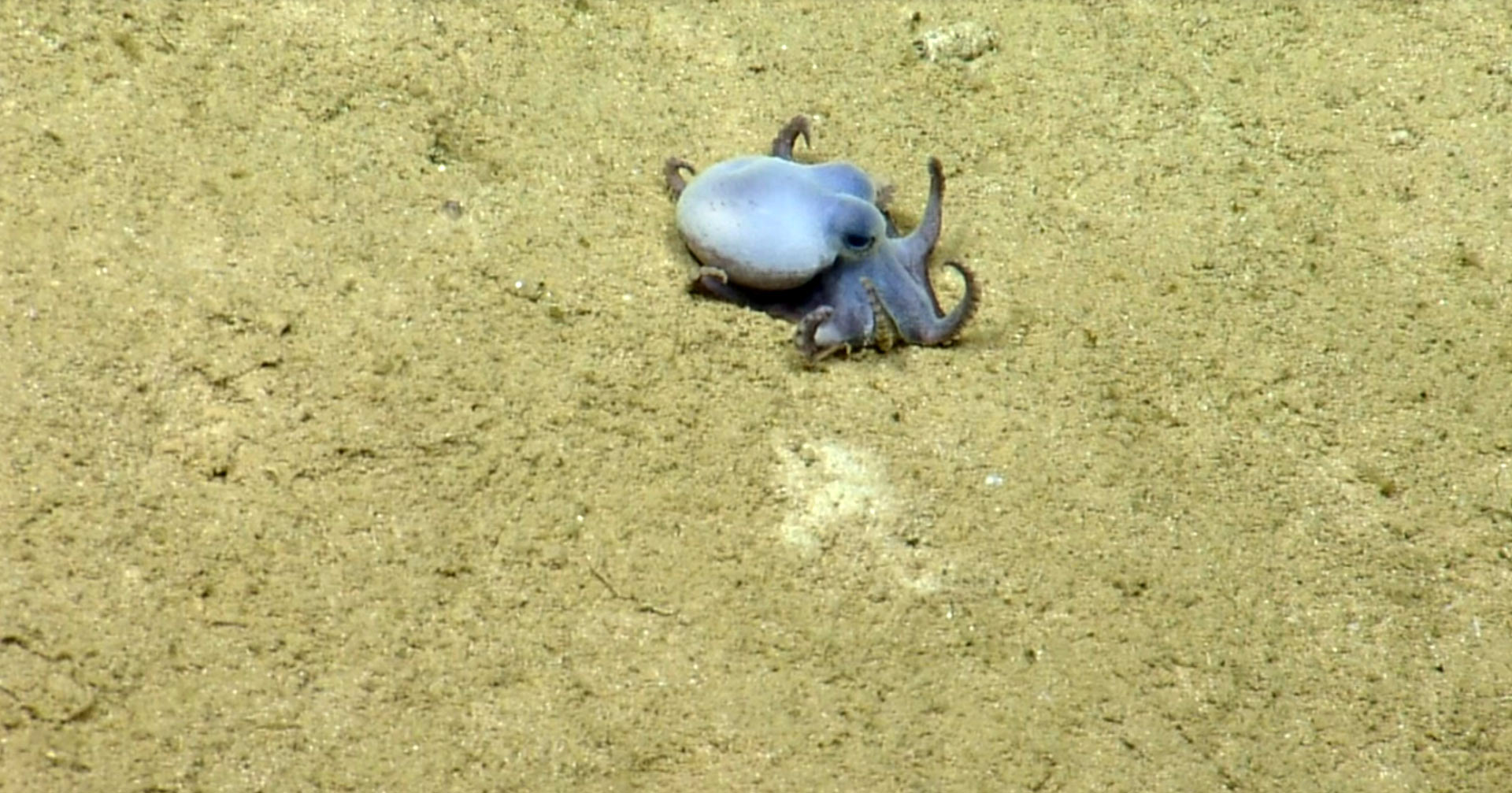
Microeledone galapagensis. Image credit: Voight et al., doi: 10.11646/zootaxa.5814.4.5.
The Megaleledonidae had long been defined as a family of large-bodied octopuses living exclusively in the cold, remote waters of the Southern Ocean.
The newly-described member of the family, named Microeledone galapagensis, fits neither description.
“Incirrate octopods of the deep eastern tropical Pacific Ocean remain virtually unstudied,” said Dr. Janet Voight, curator emerita of invertebrates at the Field Museum of Natural History and her colleagues.
“Subsea vehicles that provide exceptional but all too rare opportunities to see these animals have, however, revealed unexpected taxa.”
“Among the most surprising of these may be small tropical octopods of the Megaleledonidae.”
“This family was originally diagnosed as following the characters of the very large, Antarctic Megaleledone setebos, and more recently diagnosed as ‘uniserial suckers; large-bodied taxon endemic to the cold and deep waters of the Southern Ocean.”
The single specimen (a mature female) of Microeledone galapagensis was collected during a 2015 research cruise aboard the exploration vessel Nautilus near Darwin Island, an island at the northern edge of the Galapagos archipelago named after the biologist whose work there helped him formulate the theory of evolution.
Because securing a second specimen in the deep sea is extraordinarily difficult, the biologists turned to micro-computed tomography to peer inside the animal without cutting it open.
“When you describe a new species of octopus, you have to look at all the parts, including the mouth, the beak, and the teeth. And to see those things, you have to cut the specimen open. We only had the one specimen, so I didn’t want to take it apart,” Dr. Voight said.
“Because CT imaging is non-destructive, it’s especially important for type specimens like this one.”
“And that’s great for me because people are often bringing me these incredibly rare and stunningly beautiful specimens that I get the privilege of virtually opening up,” said Dr. Stephanie Smith, also from the Field Museum of Natural History.
“There’s nothing like spending the day looking at something no other human has ever seen.”
The CT scans revealed Microeledone galapagensis’ internal organs in remarkable detail, from its bipartite stomach to its eggs still nestled inside its body.
“What really struck me was that the scan of the little octopus revealed so much information on its internal organ systems — usually, soft-part imaging using micro CT requires the use of heavy-metal-based contrast agents whose use would not be desirable with such a rare specimen,” said Dr. Alexander Ziegler, a researcher at the University of Bonn.
“This made the 3D modeling of relevant organs really an easy task.”
During the same dive, the researchers spotted two additional octopuses that appeared to be the same species, suggesting their specimen is not a lone wanderer but part of a local population.
“These are little octopuses that live in the deep sea, and hardly anybody on Earth has ever gotten to see them. I just feel lucky that I got to work with them,” Dr. Voight said.
“If you took all the land on Earth and pieced it together, you would not cover the Pacific Ocean. The oceans are so big, and there’s so much left to explore.”
The discovery of Microeledone galapagensis is described in a paper in the journal Zootaxa.
_____
Janet R. Voight et al. 2026. A new species of Microeledone from Galápagos Islands and an amended diagnosis of the Megaleledonidae (Octopoda: Incirrata). Zootaxa 5814 (4): 533-549; doi: 10.11646/zootaxa.5814.4.5