Roughly 660 million years after the Big Bang, a strange bright red spot has been hiding in plain sight in one of the deepest fields ever imaged by the NASA/ESA/CSA James Webb Space Telescope. Astronomers at MIT now believe it may be the first confirmed example of an entirely new class of object: a black hole star.
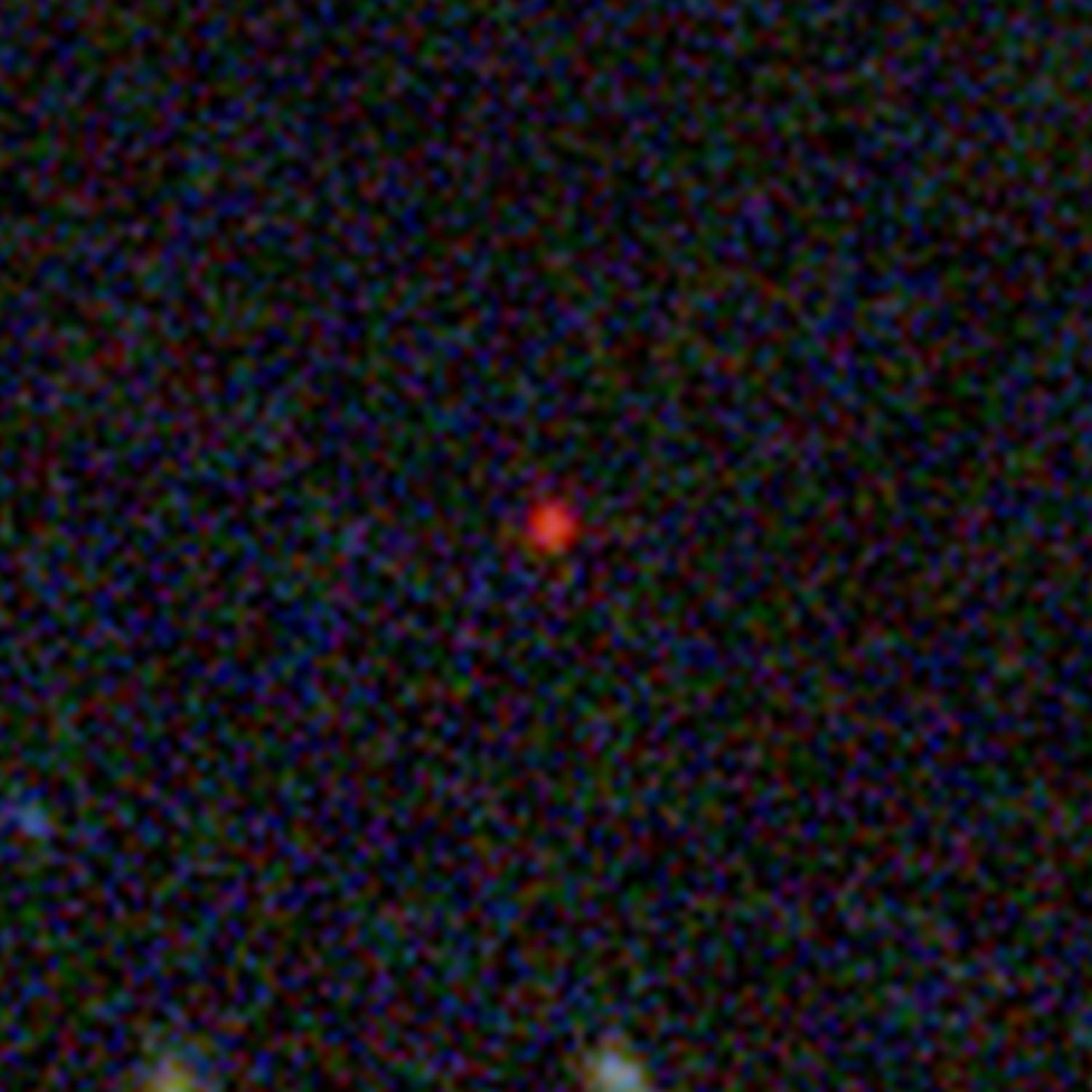
This Webb image shows the MoM-BH*-1 object. Image credit: NASA / ESA / CSA / Webb / Naidu et al., doi: 10.1038/s41586-026-10846-4.
MIT astronomer Rohan Naidu and colleagues spotted the object while hunting for some of the earliest galaxies in the Universe, as part of Webb’s Mirage or Miracle survey.
Labeled MoM-BH*-1, the source was essentially invisible in Webb’s bluer filters but blazed in the redder ones, giving it one of the most extreme colors ever recorded in a distant object.
Follow-up spectroscopy revealed why: the object shows the strongest ‘Balmer break’ ever measured at any redshift, a sharp drop in brightness at a wavelength normally associated with dense gas in the outer layers of stars.
Ordinary starlight simply can’t produce a break this severe; even the reddest known stellar populations top out at less than a third of the strength seen here.
The spectrum of MoM-BH*-1 also showed unusually broad emission from hydrogen gas, along with deep absorption features cutting through that emission — a combination that points to gas far denser than anything found in a typical star.
“The break we observed in this object is the deepest break we have ever observed in any object, ruling out ‘ordinary’ stars as the source,” Dr. Naidu said.
“But it made us wonder if we were seeing a new kind of ‘stellar atmosphere,’ but on a spectacular scale.”
“What’s more, the red dot’s light contained almost no signature of metals or any elements other than hydrogen and helium. It was truly singular in so many ways.”
To explain the pattern, the researchers modeled the object as a massive black hole, with a mass on the order of 100,000 to 10 million times that of the Sun, wrapped in an extraordinarily dense, turbulent envelope of hydrogen gas roughly 10 to 100 astronomical units across — about the scale of our Solar System.
Radiation from the black hole’s accretion disk filters through this gas cocoon, which absorbs and scatters the light to produce the object’s odd spectral fingerprint, while essentially no dust is needed to explain its redness.
Notably, MoM-BH*-1’s light output vastly exceeds what nuclear fusion could generate at that size, ruling out a normal star as the source and instead implicating an actively feeding black hole, possibly growing at or above the Eddington limit — the theoretical cap on how fast a black hole can accrete matter while still being pushed outward by its own radiation.
The scientists also detected tentative evidence the object brightened by around 30% over roughly two months, another hallmark of active black hole feeding.
“Our picture of this object is evolving very rapidly,” Dr. Naidu said.
“We think there is a central black hole that is 100,000 times as massive as the Sun.”
“And around this black hole, there would be this very extended envelope of gas that looks like a star the size of the Solar System. It’s huge.”
“These little red dots seem to be everywhere in the early Universe but essentially disappear by the present day.”
“What exactly these objects are has been one of the most debated topics of the Webb era.”
The discovery is described in a paper published today in the journal Nature.
_____
R.P. Naidu et al. 2026. A gas-enshrouded and gas-reddened black hole at cosmic dawn. Nature 656, 329-333; doi: 10.1038/s41586-026-10846-4