Physicists with the ATLAS Collaboration at CERN’s Large Hadron Collider (LHC) have observed the Bc*+ meson, an excited version of the Bc+ meson — both consist of a charm quark and a bottom antiquark.
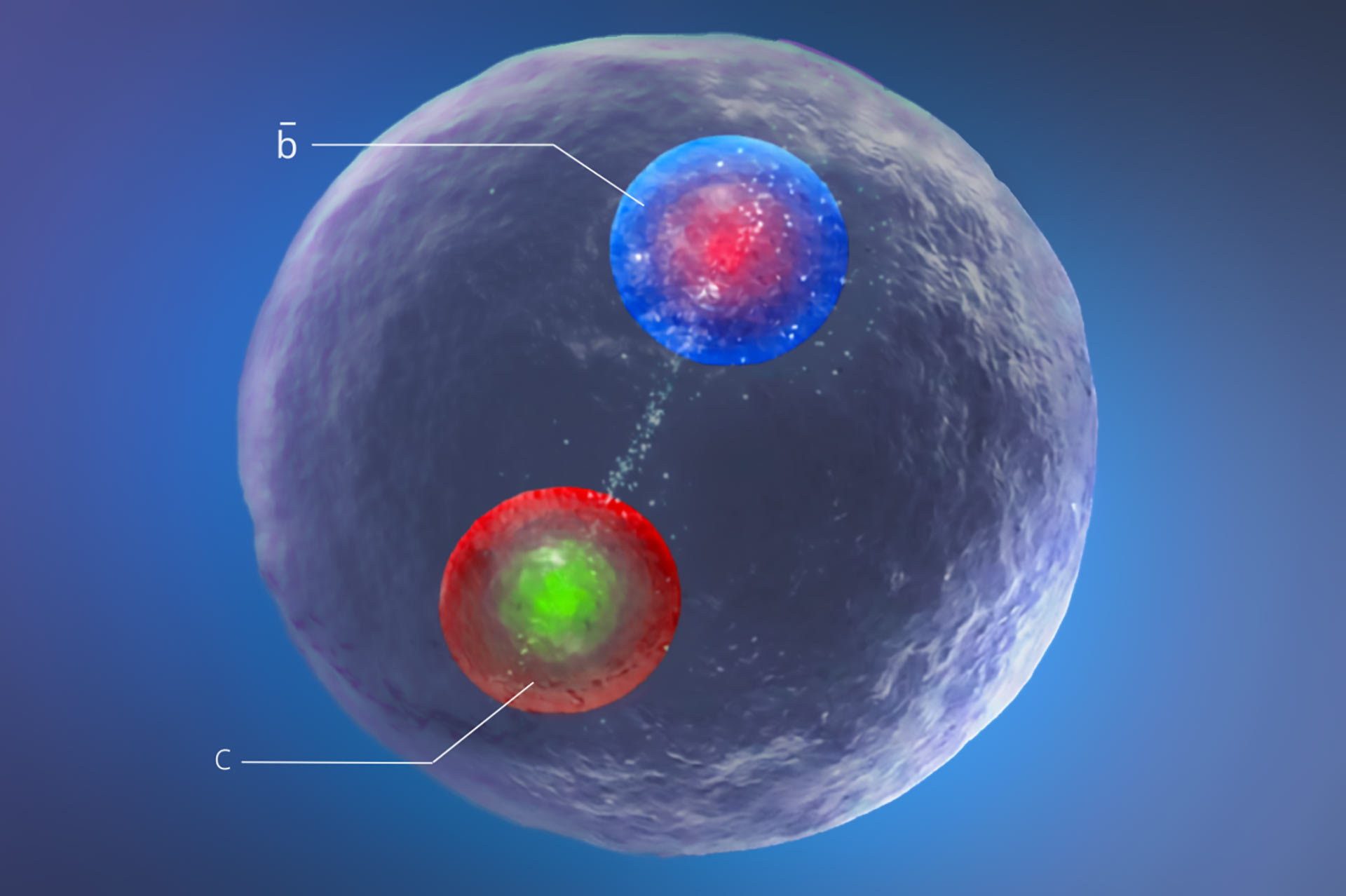
An artist’s impression of the Bc*+ meson. Image credit: Daniel Dominguez / CERN.
Protons and neutrons — the building blocks of matter — belong to a huge class of particles called hadrons. Hadrons are composite particles made of quarks that are bound together by the strong force.
They are classified into two groups: baryons, which consist of three quarks (like protons and neutrons), and mesons, which are formed by a quark-antiquark pair.
Despite decades of study, many aspects of the strong force remain poorly understood, particularly the way it binds quarks together inside hadrons.
Mesons made of heavy quarks — such as charm or bottom quarks — can provide an important laboratory for testing theoretical descriptions of these effects.
Of particular interest to physicists are Bc+ mesons, as they contain two types of heavy quarks: a charm quark and a bottom antiquark.
The ATLAS physicists produced the excited version of the Bc+ meson in high-energy proton-proton collisions at the LHC.
According to the team, Bc*+ quickly decays into a Bc+ meson and a photon.
Detecting this photon along with the decay products of the Bc+ meson would provide the researchers with the ‘smoking gun’ demonstrating the presence of the Bc*+ meson.
However, the main challenge is that the expected mass of the Bc+ meson is only slightly larger than that of the Bc+ meson, which means the photon produced in the decay carries very little energy
In fact, the energy is so low that it cannot be easily detected through the normal approach.
Rather than using standard photon-identification techniques, the scientists instead looked for the photon converting into an electron-positron pair within the ATLAS tracking detector, leaving behind closely spaced charged-particle tracks originating from a common point displaced from the initial proton-proton collision.
These tracks can have transverse momenta as low as 100 MeV — significantly lower than those typically studied in ATLAS analyses.
This required the authors to deploy a dedicated track-reconstruction procedure to be able to successfully reconstruct the photons and thus identify the Bc*+ meson.
The measured mass difference between the Bc*+ meson and the Bc+ meson is 64.5 ± 1.4 MeV.
“This is within the range of the available theoretical expectations, though slightly deviating from the most recent, high-precision modern calculations,” the physicists said.
“This result provides valuable new input for theoretical models describing the masses of particles containing the heavier quarks and will help to improve the understanding of the strong nuclear force.”
The team’s work will be published in the journal Physics Review Letters.
_____
ATLAS Collaboration. 2026. Observation of a Bc*+ meson with the ATLAS detector. Physics Review Letters, in press; arXiv: 2605.16228