More than 150 years after Charles Darwin first wondered whether certain sticky-leaved Saxifraga plants might be secretly carnivorous, Kunming Institute of Botany researcher Tao Deng and colleagues say they have finally confirmed it, though not in the species Darwin studied, but in a close relative found clinging to rock crevices high in the mountains of southwestern China.
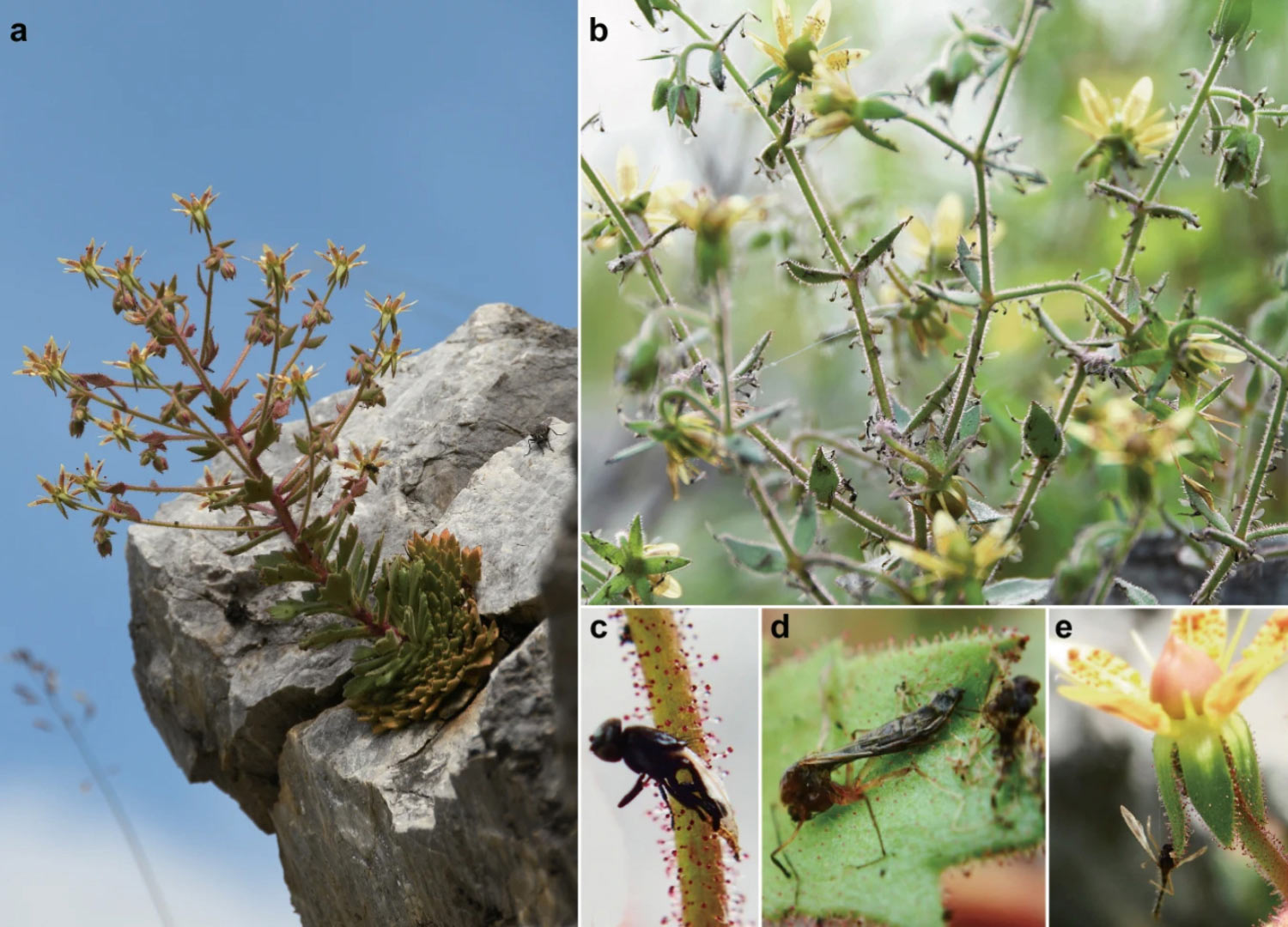
Morphology of Saxifraga candelabrum. Image credit: Zhang et al., doi: 10.1038/s41467-026-75288-y.
Carnivorous plants can obtain nutrients (mainly nitrogen) by actively attracting, capturing, and ultimately digesting a diverse array of small animals.
Understanding how carnivory has independently arisen under physiological and ecological constraints has long fascinated biologists.
Carnivory has evolved multiple times in flowering plants, including members of 14 families.
Carnivorous plants are mainly placed into five major categories based on their trap type, including the widely recognized pitfall trap in pitcher plants, snap trap in Venus flytraps, sticky flypaper trap in sundews, suction trap in bladderworts, and the eel-trap or lobster-trap in corkscrew plants.
In his 1875 book Insectivorous plants, Charles Darwin proposed that two European species from the genus Saxifraga might trap and use insects, based on their sticky, hair-covered leaves.
His own feeding experiments, however, were inconclusive, and the idea was largely set aside for more than a century.
“Inspired by his work on carnivory in Drosera, Darwin proposed that two Saxifraga species — Saxifraga rotundifolia and Saxifraga umbrosa — might similarly exhibit carnivorous behavior,” Dr. Deng and co-authors said.
“Darwin regarded these two species as representing one of the most intriguing cases among plants with glandular hairs.”
“Although Darwin attempted to test this hypothesis through feeding experiments, these early attempts did not yield conclusive results.”
“The lack of conclusive evidence has prevented researchers from classifying these Saxifraga species as true carnivorous plants.”
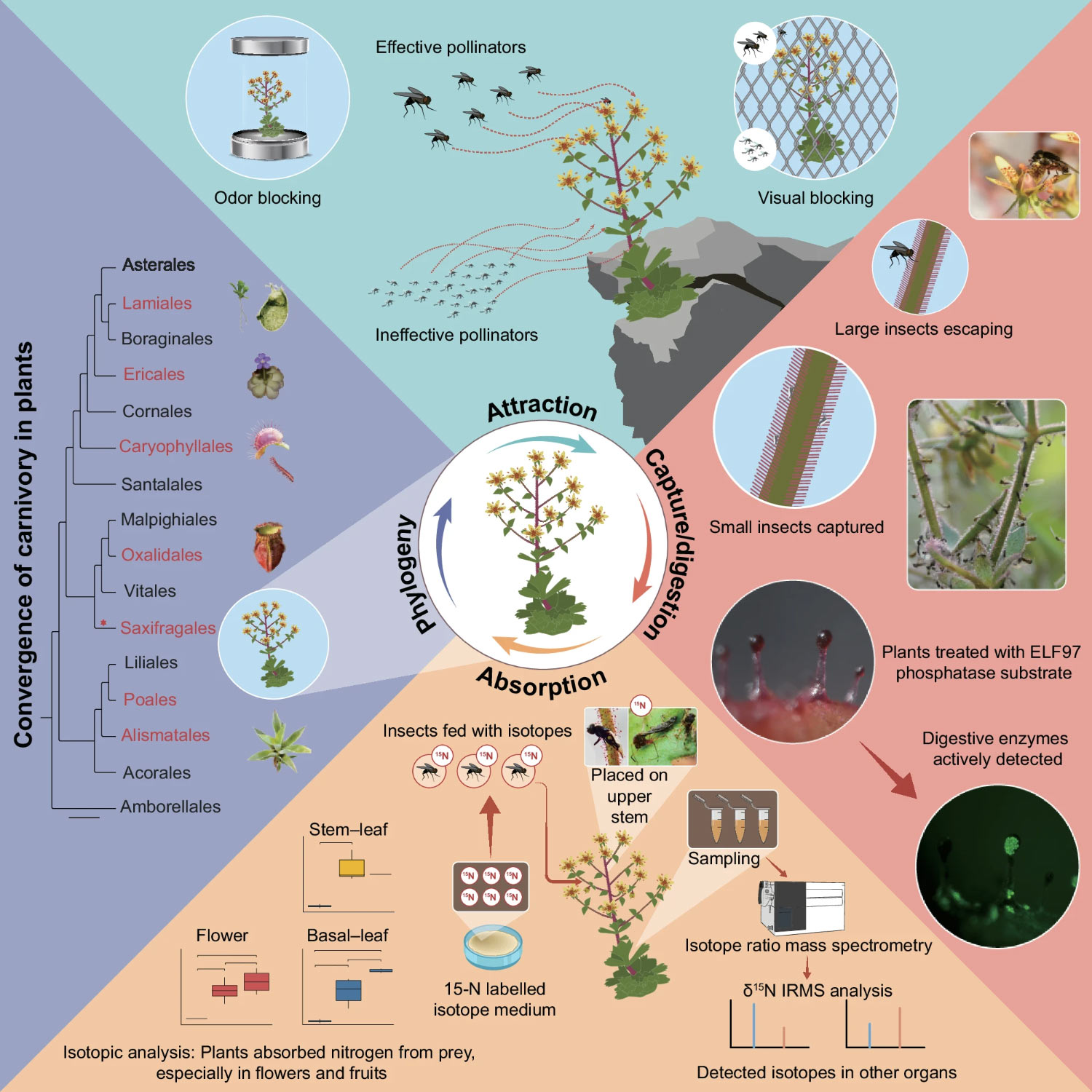
Multiple lines of evidence for carnivory in Saxifraga candelabrum. Image credit: Zhang et al., doi: 10.1038/s41467-026-75288-y.
In their research, the authors focused on another member of the genus — Saxifraga candelabrum, a small perennial herb that grows in nutrient-poor cliffs of the Qinghai-Tibet Plateau and Hengduan Mountains.
Field surveys and an examination of 45 herbarium specimens collected between 1888 and 2016 showed that trapped insects — mostly small non-biting midges — were present on the plant’s glandular hairs in the vast majority of samples, indicating the behavior is longstanding and widespread rather than incidental.
Experiments in which the plants were covered with either odor-blocking glass enclosures or sight-blocking mesh suggested the plant draws insects in partly through scent; chemical analysis of its floral volatiles identified compounds already known to attract insects in other plants.
Chemical tests using a fluorescent marker showed that Saxifraga candelabrum’s glandular hairs produce phosphatase, a digestive enzyme also found in other carnivorous species, while a related, non-trapping Saxifraga species showed no such activity.
Most striking, the researchers fed fruit flies a diet enriched with a heavy isotope of nitrogen, nitrogen-15 (15N), and placed the labeled insects on the plants.
Nitrogen from the insects later turned up inside Saxifraga candelabrum’s tissues — especially in its flowers — while two non-carnivorous control plants placed nearby showed no such uptake.
The finding indicates that nitrogen is being absorbed directly from prey rather than picked up incidentally from decomposing insects in the soil.
Interestingly, the plant appeared to spare the larger flies that pollinate it, trapping mostly smaller, non-pollinating insects instead.
The scientists also sequenced the plant’s genome and compared it with those of other carnivorous species that evolved traps independently, including sundews and the South African shrub Roridula.
They found shared patterns of gene expansion and accelerated evolution in genes tied to prey attraction, digestion and nutrient absorption.
“Our findings provide definitive evidence of carnivory in Saxifraga, addressing Charles Darwin’s long-standing hypothesis that some Saxifraga species may be capable of carnivory, and further suggest that carnivory may be more widespread among angiosperms than previously recognized,” the authors concluded.
Their paper was published this week in the journal Nature Communications.
_____
XJ. Zhang et al. 2026. Identification of carnivory in the flowering plant Saxifraga via multidisciplinary evidence. Nat Commun 17, 7557; doi: 10.1038/s41467-026-75288-y