Paleontologists studying the La Brea Tar Pits, one of the world’s richest Ice Age fossil sites, have identified a previously unknown species of spadefoot toad that lived in what is now California during the latest Ice Age, adding a scientifically significant creature to a fossil record long dominated by mammoths, saber-toothed cats and dire wolves.
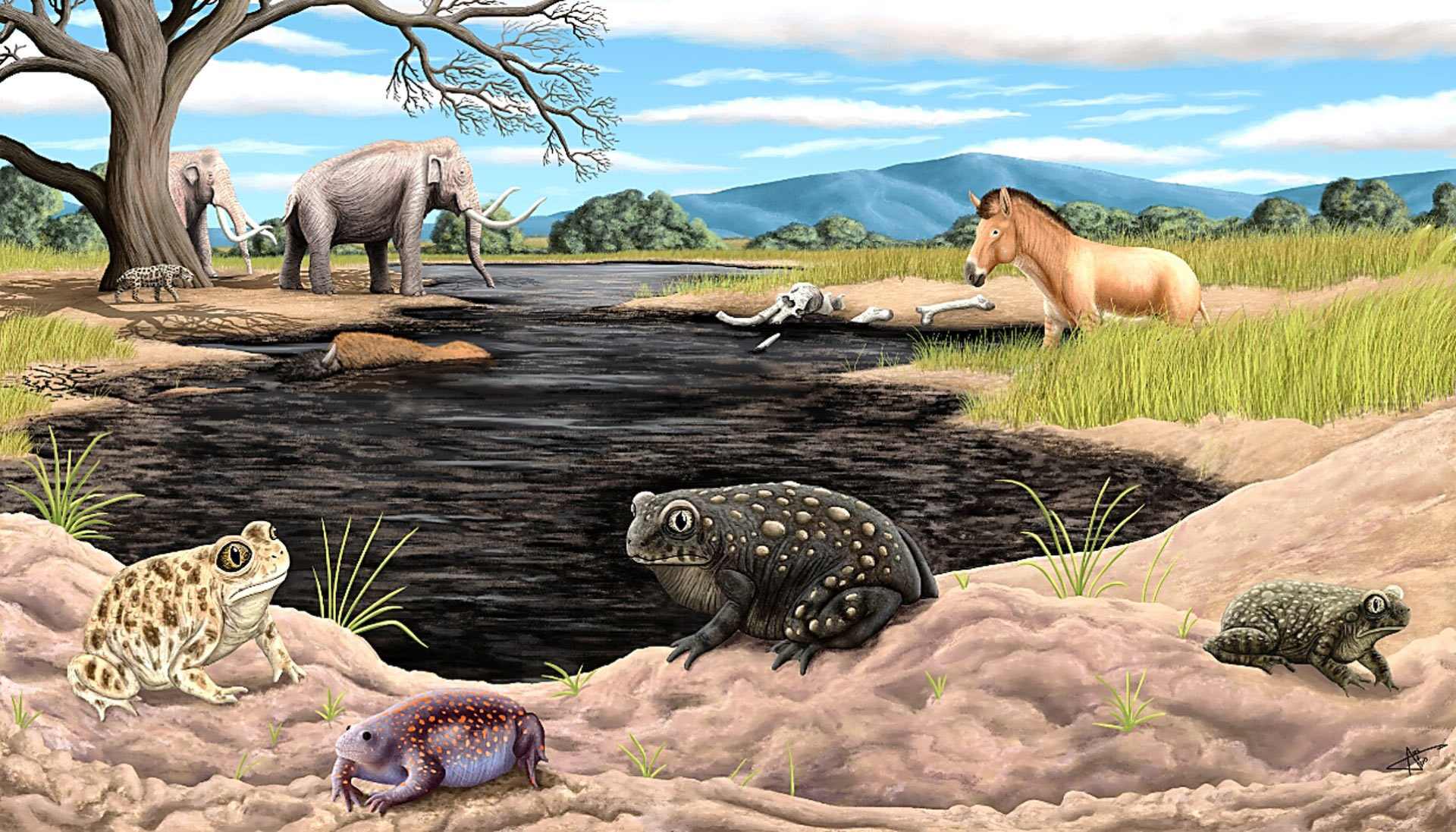
Reconstruction of Spea labreae (center and right) in La Brea Tar Pits compared with Spea hammondii (left), the species currently present in the area, and the presence of the Mexican burrowing toad (bottom). Image credit: Arturo Dávalos.
Named Spea labreae, the new species is only the second Ice Age amphibian ever identified in North America, the other being a tree frog found in Florida.
“Due to their fragile skeletons, amphibians like frogs, toads, and salamanders rarely make it into fossil records outside of asphaltic sites like the Tar Pits,” said paleontologists Dr. Alberto Cruz and Dr. Emily Lindsey.
“The discovery of a new species is an extraordinary find at the Tar Pits.”
The specimens of Spea labreae dated back to excavations from the 1950s, underscoring how much scientific value remains locked in museum archives even decades after collection.
“It’s a great example of how we’re still finding new things at La Brea Tar Pits, even after a century of ongoing excavation and research. There’s definitely more to come,” Dr. Lindsey said.
Beyond Spea labreae, Dr. Cruz and Dr. Lindsey also confirmed the first evidence that the Mexican burrowing toad (Rhinophrynus dorsalis) once lived in the southwestern United States.
This living species has since vanished from the region entirely and its nearest populations are now found roughly 2,500 km (1,500 miles) away in southern Mexico.
Because toads and other amphibians rarely travel far and are highly sensitive to shifts in temperature and moisture, their presence or disappearance in the fossil record serves as a precise gauge of ancient climate change.
“If you change the environment, you change the vegetation, the climate is warmer or colder, it affects these animals directly,” Dr. Cruz said.
The team’s paper appears in the Journal of Vertebrate Paleontology.
_____
J. Alberto Cruz & Emily L. Lindsey. A new extinct Pleistocene species of spadefoot toad and comments on the paleoecology and paleobiogeography of anurans from Rancho La Brea, California. Journal of Vertebrate Paleontology, published online August 4, 2026; doi: 10.1080/02724634.2026.2689465