Researchers from the National University of Singapore, the University of Naples Federico II and the Haus des Meeres aquarium in Austria have filmed the marine animals escaping through tight openings and found a consistent sequence of moves, one that could inform the design of soft robots.
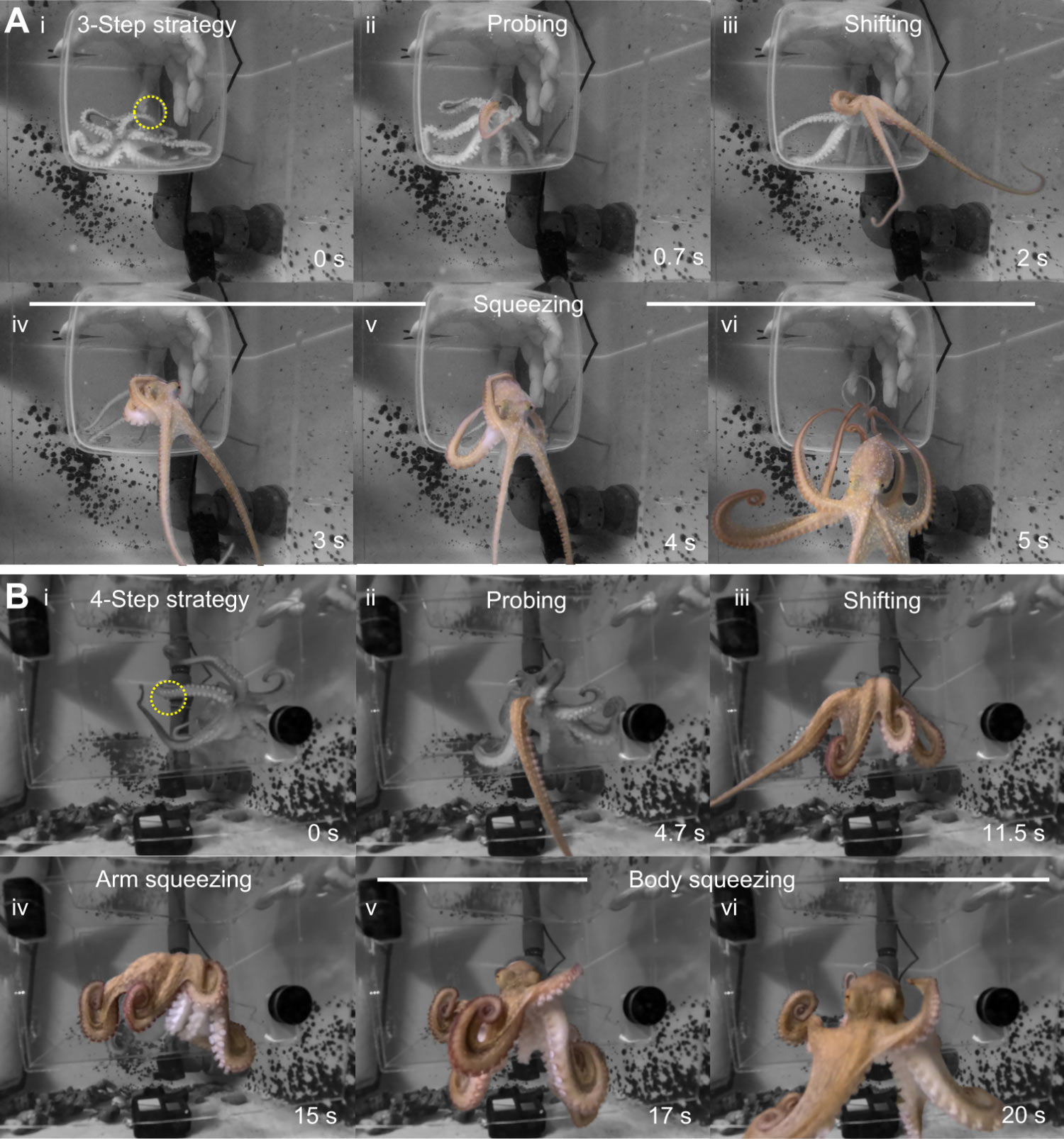
Octopus vulgaris’ three- and four-step strategies to squeeze through a larger hole. Image credit: Xin et al., doi: 10.1242/jeb.252825.
“Octopuses can change their body shape to squeeze through tiny holes, almost like water flowing through a gap, so their size doesn’t always limit where they can go,” said Dr. Wenci Xin, a researcher at the National University of Singapore.
“But no one knew exactly how octopuses manoeuvre through gaps that are smaller than their bulbous mantles.”
In the study, the scientists observed octopuses passing through a hole in a clear acrylic partition.
Three common octopuses (Octopus vulgaris) followed a consistent routine.
First, the animal probed by pushing a single arm through the hole. Then it shifted, feeding three to five more arms through. Finally, it squeezed, anchoring the inserted arms on the far side and pulling the rest of its body after them.
When the hole was larger than the distance between the animal’s eyes, the octopus pulled its remaining arms and body through in a single motion, a three-step strategy.
When the hole was smaller, it moved its remaining arms first and then, separately, its head and mantle, a four-step strategy.
The link between hole size and strategy was statistically significant: in the 30 trials analyzed, the three-step approach was used 14 times with the larger hole and once with the smaller one, while the four-step approach was used 15 times, all with the smaller hole.
The animals also favored their front arms, especially the second and first on the left, though this varied by individual.
The authors suggest the left-side bias may reflect the setup, since one side of the tank offered a clearer view outside.
Four juvenile Maya octopuses (Octopus maya) did not attempt the smallest hole in initial trials.
Two later passed through a larger hole using the three-step method.
In a test with several holes, one tried a smaller opening first, failed to get its arms through and then succeeded at a larger one. This suggests octopuses may not judge accurately whether they will fit.
The findings could help engineers build soft robots that move through tight, unpredictable spaces such as collapsed buildings, by organizing simple movements under higher-level coordination rather than controlling every limb separately.
“All existing search-and-rescue and exploration robots have slender snake-like bodies, to help them move through narrow gaps, which limits the number of sensors and manipulators that can be packed into the robot bodies, restricting their adaptability during challenging search-and-rescue missions,” Dr. Xin said.
The study was published November 5 in the Journal of Experimental Biology.
_____
Wenci Xin et al. 2026. Overcoming environmental constraints: octopus uses 3-step or 4-step strategies to squeeze through small holes. J Exp Biol 229 (21): jeb252825; doi: 10.1242/jeb.252825