A marine biologist studying the photophores of a bioluminescent fish species found needle-shaped guanine crystals that scatter and redirect light instead of merely reflecting it, a discovery that could inspire more efficient biomedical and optical devices.
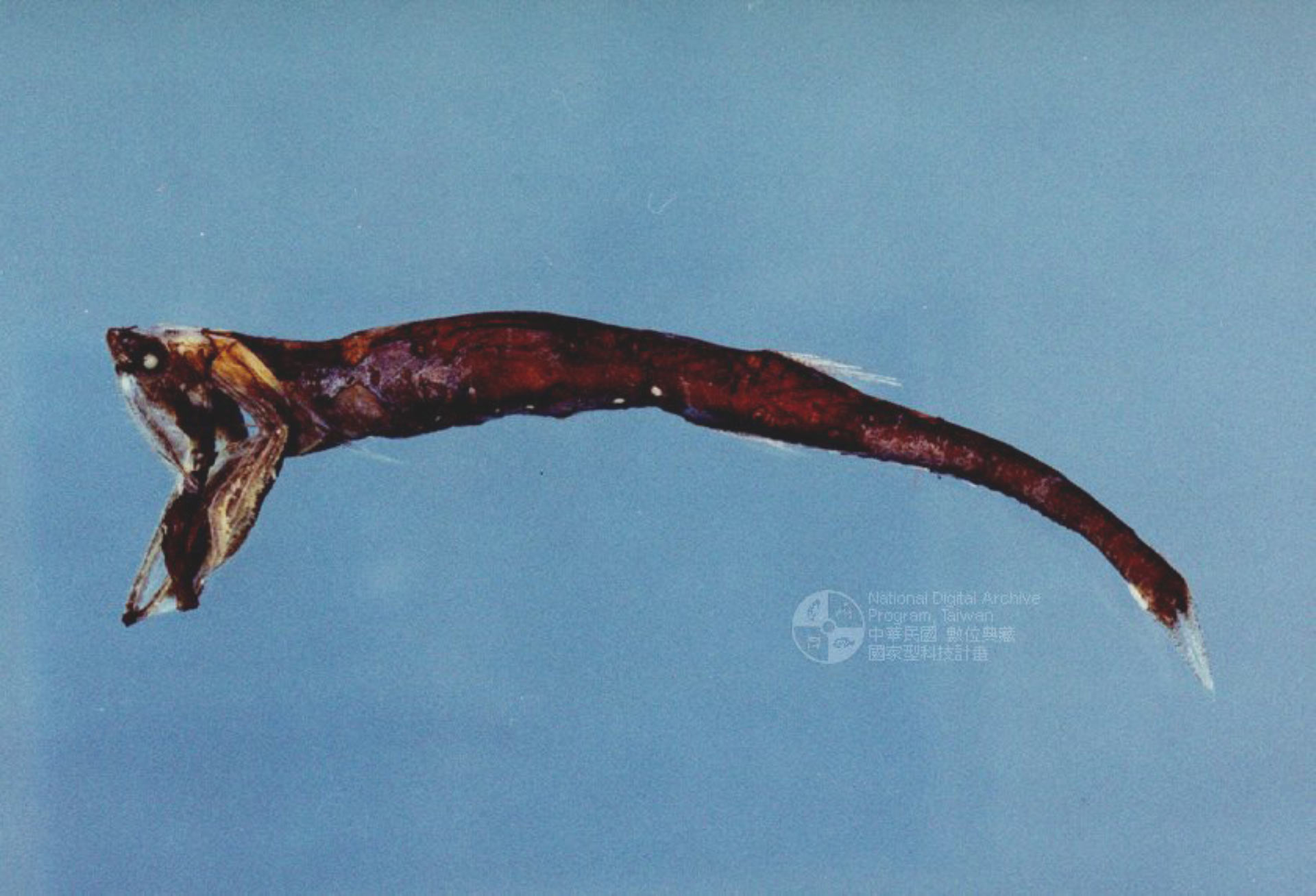
Sigmops gracilis. Image credit: Wu Quancheng / Fisheries Research Institute, Council of Agriculture, Taiwan.
Approximately 75% of marine organisms are bioluminescent, with specialized light-emitting organs called photophores.
They use the light they produce for various purposes, like attracting mates, luring prey, or confusing predators.
Bioluminescent fish also have specialized crystalline structures called guanine platelets that play a key role in how their light shines.
While all bioluminescent fish have photophores and platelets, the number, location, and shape of these biological structures vary in different fish.
In a new study, Hiroshima University researcher Masakazu Iwasaka investigated light control mechanisms in the photophores of the bioluminescent deep-sea bristlemouth Sigmops gracilis.
He found that layers of localized guanine platelets do more than just reflect the light, they scatter the light in complex ways.
“While examining deep-sea fish on board a research vessel, I realized important insights could not be obtained using only laboratory-based materials,” Dr. Iwasaka said.
“This experience led me to explore a new direction — biomimetics inspired by unknown phenomena observed in the field.”
“Both my own observations and previous studies have shown that guanine crystals can form layers on the surfaces of photophores in some fish species.”
“In this study, I confirmed strong anisotropic reflection — meaning the reflected light changes significantly depending on the direction the light comes from.”
“This suggests a previously unrecognized role guanine crystals play in controlling light direction.”
Sigmops gracilis’ guanine platelets are needle-shaped structures clustered locally around its light organs.
When light hits the guanine crystals, their shape causes light scattering.
“In earlier work, I showed that guanine crystals from goldfish act like tiny mirrors, producing anisotropic reflection due to their slightly tilted orientation,” Dr. Iwasaka said.
“In contrast, the higher-aspect-ratio crystals studied here behave more like prisms, redirecting light rather than simply reflecting it.”
“Their layered arrangement exhibits properties similar to photonic crystals.”
The layered crystalline guanine platelets provide insights into highly efficient biomimetic designs that maximize and recycle leaked light, rather than just reflecting emitted light.
The scientists used electromagnets to test different orientations of the guanine crystals and exposed them to an external light source to record the scattering results of different light angles.
Since these tiny structures perform in water, insights from the study could be useful in implanted biomedical device design.
“While deep-sea fish are difficult to obtain, the research is highly worthwhile,” Dr. Iwasaka said.
“Investigating guanine in various fish species will lead to a treasure trove of biomimetics knowledge.”
The results were published this week in the journal Biointerphases.
_____
Masakazu Iwasaka et al. 2026. Biomimetic illumination enhancement inspired by guanine platelets in the photophore surface of the deep-sea bristlemouth Sigmops gracilis. Biointerphases 21, 031003; doi: 10.1116/6.0005382