Featured News

Apr 3, 2018 by News Staff

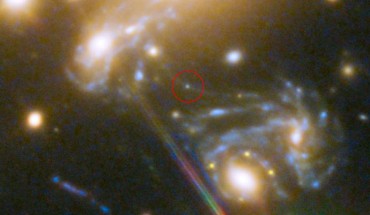
A blue supergiant star nicknamed Icarus is so far away that its light has taken 9 billion years to reach our planet. It appears to us as it did when the Universe was about 30% of its current age. This image composite shows the discovery of the Icarus star using the NASA/ESA Hubble Space Telescope. The image to the left shows a part of the deep-field observation of the galaxy cluster MACS J1149.5+2223 from the Frontier Fields program gathered in 2014....

Apr 3, 2018 by News Staff

According to a new study, Saniwa ensidens — an extinct monitor lizard that lived in what is now Wyoming 51-49 million years ago (Eocene epoch) —...

Apr 2, 2018 by News Staff

In the search for alien life, astrobiologists have turned over all sorts of rocks. For example, Mars has geological features that suggest it once had subsurface...

Mar 30, 2018 by News Staff

The high-energy impact about 100 million years after our Solar System formed, resulted in the two colliding planetary objects completely merging to create...

Mar 30, 2018 by Zvi Cramer

Researchers have created new drill-shaped nanomaterials that infiltrate cellular membrane and deliver drugs inside the cell, providing a versatile means...

Mar 29, 2018 by News Staff

Astronomers using the NASA/ESA Hubble Space Telescope have discovered a unique galaxy — the first of its kind — that appears to contain virtually...

Mar 28, 2018 by News Staff

A team of researchers from New York University School of Medicine, Mount Sinai Beth Israel Medical Center, the Feinstein Institute for Medical Research...

Mar 28, 2018 by Natali Anderson

An international team of astronomers has discovered a planetary system containing at least three massive planets, orbiting the bright late-G/early-K-type...

Mar 27, 2018 by News Staff

Physicists from the NA62 Collaboration at CERN reported today that they had observed a candidate event of an extremely rare charged kaon decay (K+ →...

Mar 27, 2018 by News Staff

Two very unusual pieces of leather have been uncovered during the excavation of a pre-Hadrianic cavalry barrack (c. 100 CE) at the Vindolanda Roman fort...

Mar 26, 2018 by News Staff

A newly-released video, captured in the waters around Portugal’s Azores islands, shows a pair of deep-sea anglerfish called the fanfin angler (Caulophryne...

Mar 23, 2018 by News Staff

An international research team led by a Princeton University scientist has found that the rise in oxygen that occurred about 2.3 billion years ago (Paleoproterozoic...

Mar 23, 2018 by News Staff

In a cosmic tug-of-war between Large and Small Magellanic Clouds — two dwarf galaxies orbiting the Milky Way — only the NASA/ESA Hubble Space...

Mar 21, 2018 by Natali Anderson

About 70,000 years ago, a binary stellar system called ‘Scholz’s star’ passed within only 52,000 astronomical units (AU) of the Sun, i.e., within...

Mar 20, 2018 by News Staff

1I/2017 U1 ‘Oumuamua, the first asteroid of extrasolar origin identified in the Solar System, likely came from a binary star system, according to new...

Mar 19, 2018 by News Staff

Two new species of dog-faced bats have been discovered in the tropical forests of Central and South America. Both new species are described in the March...

Mar 19, 2018 by Enrico de Lazaro

An international team of scientists has sequenced and assembled the genome of a venomous shrew-like insectivore called the Hispaniolan solenodon. The Hispaniolan...

Mar 16, 2018 by News Staff

A team of researchers from the University of Washington and Princeton University has found that the genomes of two groups of modern humans with Denisovan...

Mar 15, 2018 by News Staff

The long-standing mystery of why comets give off X-ray emission has been solved by a group of experimental physicists led by the University of Oxford,...

Mar 15, 2018 by News Staff

Planetary scientists have noticed that Jupiter’s most distinctive feature — the Great Red Spot (GRS) — has been getting smaller in area over...