Neuroscience News

Sep 29, 2017 by News Staff

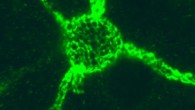
Tanycytes — cells found in part of the brain that controls energy levels — detect two key amino acids in food and tell the brain directly that we feel full, according to new research from the University of Warwick. Tanycyte cells reacting to a puff of the amino acid lysine. Scale bar – 20 μm. Image credit: Nicholas Dale / Greta Lazutkaite. “Tanycytes in the brain respond to amino acids found in foods, via the same receptors that...

Sep 5, 2017 by Zvi Cramer

Researchers have shown that financial stress may cause more migraines in individuals with variants in the circadian rhythm gene CLOCK, suggesting that...

Aug 29, 2017 by News Staff

A recent study conducted at the University of Turku, Finland, has revealed that eating leads to the widespread opioid release in the human brain, likely...

Aug 10, 2017 by News Staff

According to new research published in the journal NeuroReport, a month before they are born, fetuses can distinguish between someone speaking to them...

Aug 8, 2017 by News Staff

In the largest functional brain imaging study to date, researchers have identified specific differences between the brains of females and males. 3D surface...

Jul 13, 2017 by News Staff

An international group of researchers has created a hands-free, thought-controlled musical instrument, the encephalophone. The encephalophone is a musical...

Jun 23, 2017 by News Staff

Playing video games may cause changes in many brain regions, according to a new review of previous research. Palaus et al collected and summarized studies...

May 30, 2017 by News Staff

The human primary visual cortex — the brain’s vision-processing center that was previously thought to mature within the first few years of life...

May 11, 2017 by News Staff

Experiencing beauty requires thought, neuroscientists have found in a study that confirms a claim by the German philosopher Immanuel Kant (1724-1804),...

May 2, 2017 by News Staff

In a study published recently in the journal PLOS Biology, neuroscientists identified three gut bacteria species — Acetobacter pomorum, Lactobacillus...

Apr 27, 2017 by News Staff

In two separate studies, researchers have demonstrated that both the structure of the brain and several memory functions are linked to immune-related genes. The...

Apr 19, 2017 by News Staff

According to a study published recently in the Journals of Gerontology: Medical Sciences, drinking a beetroot juice before exercise makes the brain of...

Apr 5, 2017 by News Staff

A new neural pathway has been identified by a group of neuroscientists that could underlie our ability to make the coordinated hand movements needed to...

Feb 20, 2017 by News Staff

Researchers have found for the first time that dopamine, a vital neurotransmitter in the brain, is involved in human bonding. The results appear in the...

Feb 15, 2017 by News Staff

A team of neuroscientists at the University of Toronto in Canada has discovered a reason why we often struggle to remember small details of past experiences....

Feb 13, 2017 by News Staff

A team of researchers at Northwestern University has discovered a type of retinal ganglion cell that may cause myopia when it dysfunctions. The study is...

Feb 8, 2017 by News Staff

A research team led by Scripps Research Institute scientist Dr. Supriya Srinivasan has identified a brain hormone that appears to trigger fat burning in...

Dec 16, 2016 by News Staff

As many as 33% of autism cases could be explained by a scarcity of a protein called nSR100 in the brain, a new study in the journal Molecular Cell has...

Dec 15, 2016 by News Staff

New research published in the journal Frontiers in Human Neuroscience reveals that endurance runners’ brains have greater functional connectivity —...

Dec 13, 2016 by News Staff

A new study in mice shows that dopamine neuron activity plays a key role in judgment of time, slowing down the internal clock. Sofia Soares et al investigated...