A new genus and species of tapejarid pterosaur has been identified from a specimen in the collections of the Sedgwick Museum of Earth Sciences in Cambridge, England, first described in 1870. The discovery suggests that tapejarids, long associated with Brazil, may have deep roots in Europe.
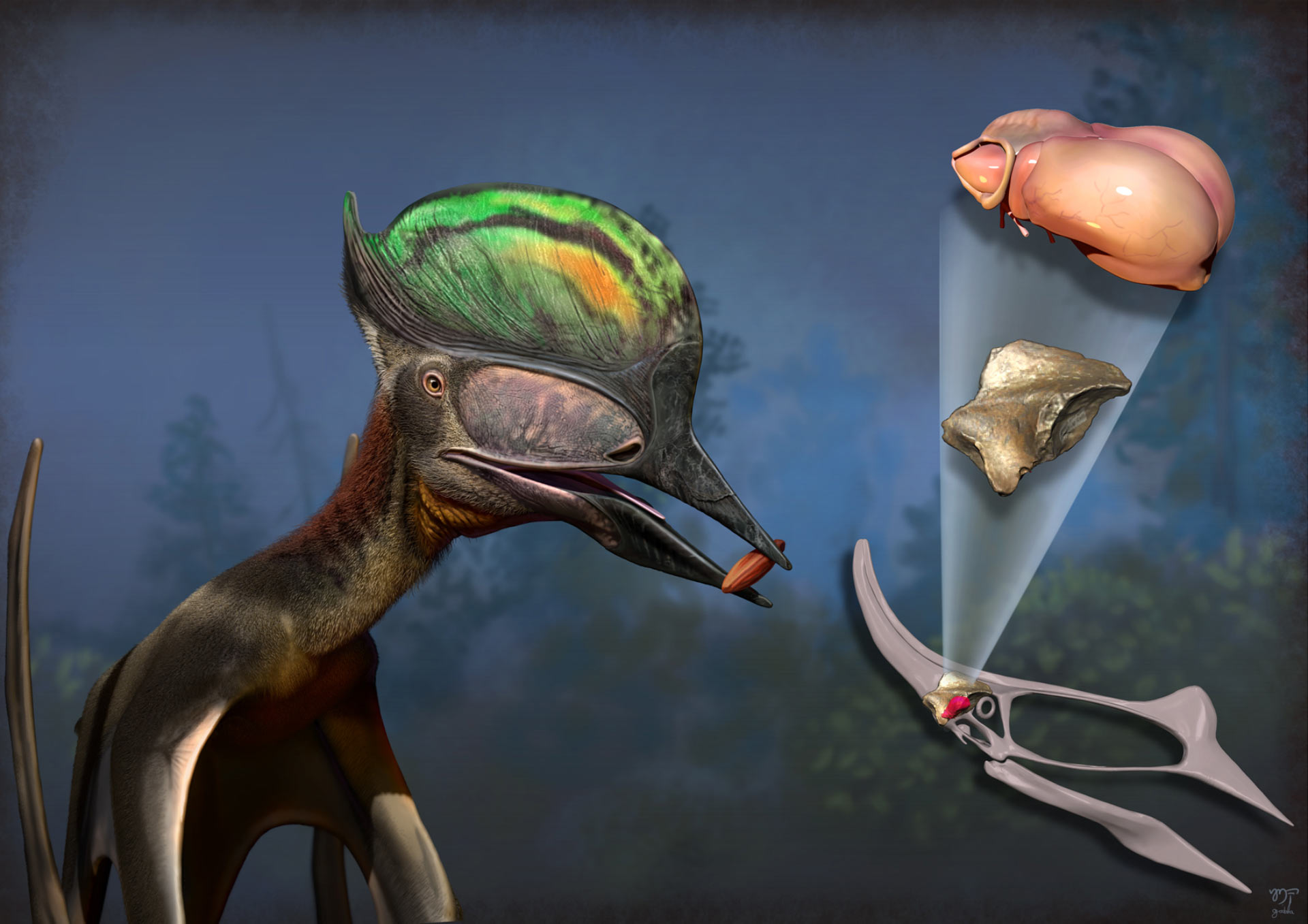
Life restoration of Hintighernia edingerae, with schematic reconstruction of its skull and encephalon. Image credit: Matheus Gadelha.
Tapejarids were pterosaurs with short, downturned snouts and, in some species, spectacular head crests.
The group has long been strongly associated with Cretaceous rocks in Brazil, where its type species was found.
“Among the most distinctive and anatomically unusual of pterosaurs are the members of the Cretaceous clade Tapejaridae, a group of azhdarchoid pterodactyloids noted for their short, downturned rostra and sometimes spectacularly prominent premaxillary crests,” said Universidade Federal do ABC paleontologist Rubi Pêgas and colleagues.
“Tapejarids might also have been ecologically atypical, there being some indication that they were likely to be omnivorous or even herbivorous/frugivorous.”
“Tapejarids are strongly associated with the Aptian-Albian deposits of Brazil owing to the finding there of the type taxon, Tapejara wellnhoferi of the Romualdo Formation, in addition to the two species of Tupandactylus from the Crato Formation and both the well-represented Caiuajara dobruskii and the recently erected Torukjara bandeirae from the Lower Cretaceous Caiuá Group.”
“The presence of the group outside of South America was first suggested in 1999 following the recognition of a Tapejara-like anterior fragment of mandible from the Cenomanian Kem Kem Group of Morocco. Additional North African finds were reported in 2020.”
Named Hintighernia edingerae, the new tapejarid species lived in what is now Britain during the Cretaceous period, 105 to 100 million years ago.
The fossil comes from the Cambridge Greensand Member of the West Melbury Marly Chalk Formation, a layer of reworked sediment that has yielded more than 2,000 pterosaur specimens.
The specimen was first described in 1870 and was later assigned to Ornithostoma sedgwicki, a species name the paleontologists argue should now be restricted to a different pterosaur.
“Our reanalysis of Ornithostoma sedgwicki leads us to regard it as a chaoyangopterid,” they explained.
“We suggest the restriction of the name Ornithostoma sedgwicki to its holotype and three referred jaw fragments.”
Using micro-CT scanning, the researchers digitally reconstructed the Hintighernia edingerae’s braincase.
The endocast, a model of the space the brain occupied, resembles that of Tapejara wellnhoferi.
According to the scientists, the similarities likely reflect close evolutionary kinship, though they caution that further phylogenetic work on pterosaur neuroanatomy is needed.
Additionally, the authors reassessed other pterosaur specimens from the Cambridge Greensand.
They identified a fragment of a snout tip as possibly belonging to the same new genus, labeling it cf. Hintighernia.
Two neck vertebrae and part of an upper arm bone were attributed more broadly to tapejarids.
A separate set of elongated neck vertebrae, together with jaw fragments, indicates that at least one other kind of azhdarchoid lived in the area.
In total, the researchers count at least three azhdarchoid species in the Cambridge Greensand, and a minimum of four distinct azhdarchoid forms when the different bone types are considered.
They suggest Europe was a hotspot of early tapejarid diversity and a potential point of origin for the sinopterines of eastern Asia and the tapejarines of South America.
Dispersal routes through North Africa, possibly via connections described by the Eurogondwana hypothesis, would be consistent with such scenario.
“Our finds suggest that Europe was an important region in the evolutionary history of this group, as an important center of early tapejarid radiation,” they concluded.
The discovery is reported in a paper in the Zoological Journal of the Linnean Society.
_____
Rubi V. Pêgas et al. 2026. A tapejarid pterosaur from the Cambridge Greensand (Cretaceous of England), with comments on its neuroanatomy and the biogeography of the group. Zoological Journal of the Linnean Society 208 (3): zlag162; doi: 10.1093/zoolinnean/zlag162