Some six million years ago (Late Miocene epoch), a pygmy sperm whale with a face unlike anything in today’s oceans may have swept its downturned snout along the shallow seabed off what is now southern Peru. Paleontologists say the animal’s skull shows the most extreme facial asymmetry documented among cetaceans, and possibly among all mammals.
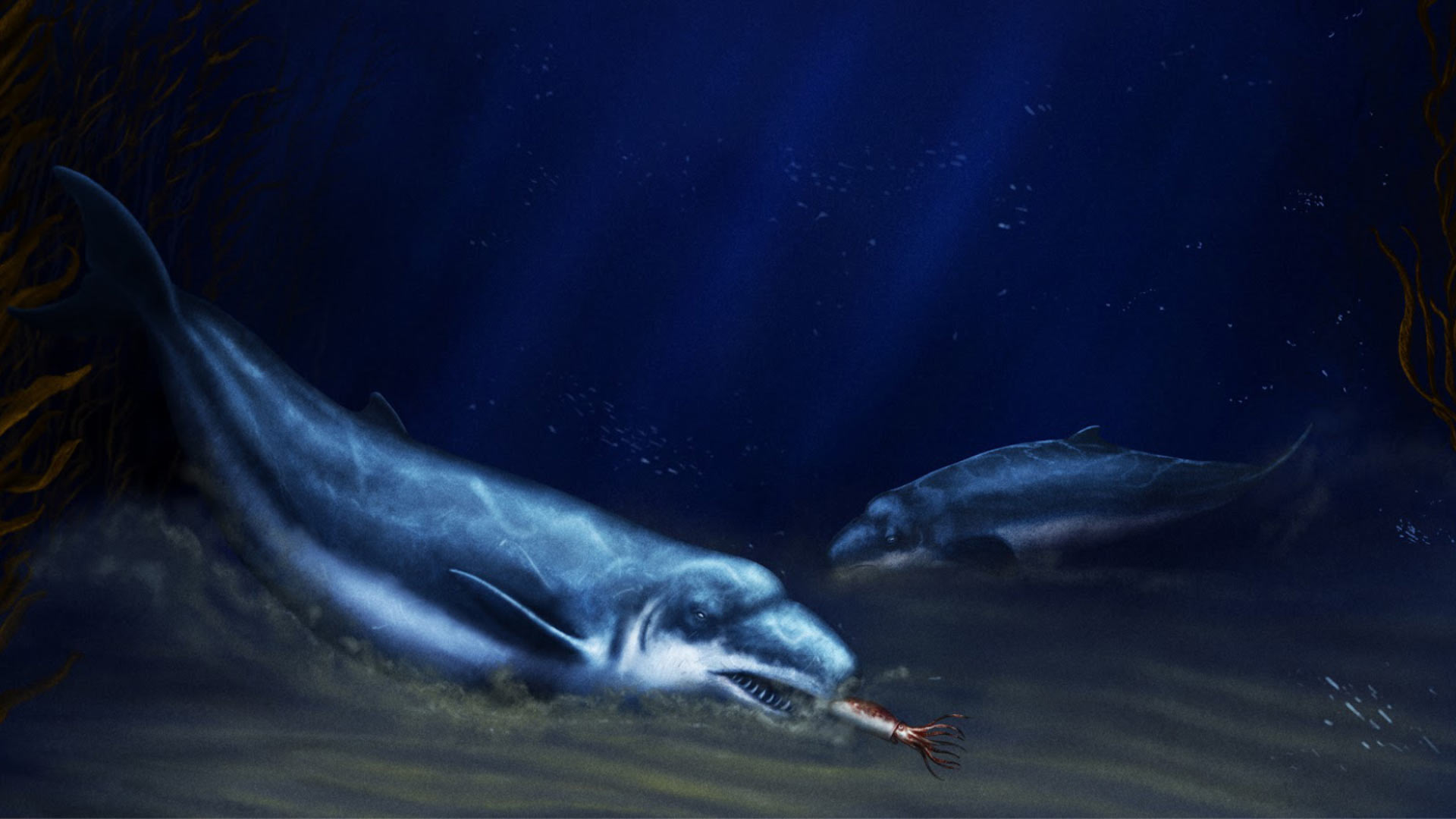
Scaphokogia huachafo was about 2.7 m (9 feet) long; the entire structure of its skull and neck was designed to point its snout directly toward the seafloor. Image credit: Jaime Bran Sarmiento.
Lopsided skulls are common among toothed whales, where asymmetry is linked to the production of sound and echolocation.
But the newly described species, named Scaphokogia huachafo, took it further: both of its external bony nostrils are shifted to the left of the skull’s midline, and the left one is considerably larger than the right; the bones around the left and right eye sockets also differ markedly in shape.
“When we looked at the proportions of this whale — with its face strongly shifted to the left and its oversized, downward-curving snout — it broke every rule of symmetry and elegance seen in living cetaceans,” said Dr. Aldo Benites-Palomino, a vertebrate paleontologist at the GeoZentrum Nordbayern.
The nearly complete skull of Scaphokogia huachafo was found in the mid-1990s at Aguada de Lomas in the Sacaco basin in Arequipa, Peru, in layers of the Pisco Formation deposited between 6.3 and 5.6 million years ago.
“The initial suspicion with skulls this distorted is always taphonomy — that the specimen may have been flattened or twisted by sediment pressure over millions of years,” Dr. Benites-Palomino said.
“But the sutures are fully closed, and there are no fractures, pathologies or deformations elsewhere on the skull. This was genuine biology, not a result of poor preservation.”
To compare Scaphokogia huachafo’s skull with those of other whales, the researchers built a new set of 3D measurements focused on the face and ran statistical analyses on 31 species.
The genus Scaphokogia, which includes the new member and two relatives, emerged as the most asymmetric group of cetaceans in the sample.
The animal’s most striking feature may be its snout: a massive, tube-shaped rostrum made of dense bone and reinforced by ossified cartilage, angled steeply downward at about 31 degrees from the skull’s main axis.
Heavy bone in the skull — a trait seen in manatees, walruses and some early whales that fed on the bottom — helps animals control their buoyancy, and that the dense snout probably shifted the whale’s center of gravity forward.
Scaphokogia huachafo’s second, related specimen preserving the first neck vertebra allowed the team to estimate how far the head could tilt.
Its neck joint appears to have allowed substantial downward flexion, and its asymmetry suggests the head moved along a curved path rather than a straight up-and-down one.
Taken together, the scientists propose that Scaphokogia huachafo was a specialized bottom feeder that foraged along the floor of shallow coastal waters.
Because the animal appears to lack the specialized facial structures that many bottom-feeding mammals use to find food, it may have relied on unusual adaptations for echolocation to detect prey in soft sediment.
“The entire cranio-cervical complex is modified to point the snout directly toward the bottom,” said Dr. Gabriel Aguirre-Fernández, a paleontologist at the University of Zurich.
“The combination of dense bone, the downward-curving snout and the flexible neck articulation allowed the animal to move directly above the seabed and feed close to the sediment.
The findings appear today in the journal Communications Biology.
_____
A. Benites-Palomino et al. 2026. Extreme cranial asymmetry in extinct benthic feeding sperm whales. Commun Biol 9, 1406; doi: 10.1038/s42003-026-11074-2