Paleontologists have identified a new species of extinct alligatorid that lived in what is now Colorado just a few hundred thousand years after the asteroid...
Long before whales ruled the oceans, dolphin-shaped marine reptiles called ichthyosaurs patrolled the same waters. New research from the Natural History...
Paleontologists in Montana have discovered remarkably preserved feathers of an ancient aquatic bird inside a fossilized dinosaur dropping, offering rare...
Paleoanthropologists have identified a trove of Denisovan fossils from a cave in China’s Yunnan province, extending the known range of the elusive human...
Paleontologists in North Dakota have unearthed a set of 66.5-million-year-old fossilized footprints that can be confidently attributed to a full-grown...
Scientists have identified the first dinosaur fossil from a remote western section of the Bayan Gobi Formation in China’s Inner Mongolia, extending the...
Paleontologists studying a fossil unearthed in southern Manitoba, Canada, have identified what they believe are two bite marks on the internal skeleton...
An incomplete fossilized skull that has sat in the collections of the Natural History Museum of Denmark since the 19th century has turned out to represent...
Using lasers, computer models and AI, researchers reconstructed the calls of 165-million-year-old relatives of modern crickets and katydids from fossilized...
Cranial fossils of a nodosaurid ankylosaur unearthed more than two decades ago on the Japanese island of Hokkaido have been recognized as belonging to...
A fossilized bone unearthed two decades ago in northeastern Japan belongs to one of the smallest iguanodontian dinosaurs ever found in the country’s...
A new genus and species of sauropterygian reptile that lived during the Triassic period, some 245 million years ago, has been identified from a nearly...
Dr. Ian Towle, a researcher with the Biomedicine Discovery Institute at Monash University, proposes folding nearly 5 million years of hominin fossils into...
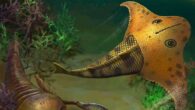
Paleontologists in China have identified a new species of armored, jawless fish from rocks around 419 million years old whose skull was shaped like the...
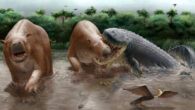
Paleontologists have uncovered the first direct physical evidence that colossal prehistoric crocodiles hunted large plant-eating mammals in what is now...
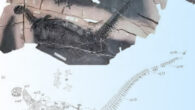
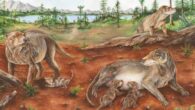
Paleontologists studying a 236-million-year-old cynodont fossil from Argentina say they have found the earliest evidence yet of viviparity (live birth)...
For more than a century, paleontologists studying the Late Jurassic seas that once covered southern Germany believed only one species of ichthyosaur, Aegirosaurus...
A new analysis of three skull fragments unearthed at the Gran Dolina cave site in Spain indicates that Homo antecessor had bone thickness closer to that...