Paleontologists have described a new genus and species of therizinosaur based on a nearly complete skeleton found in northeastern China. Named Kayrasaurus changliensis, the species is the largest therizinosaurian dinosaur known from the famed Early Cretaceous Jehol Biota.
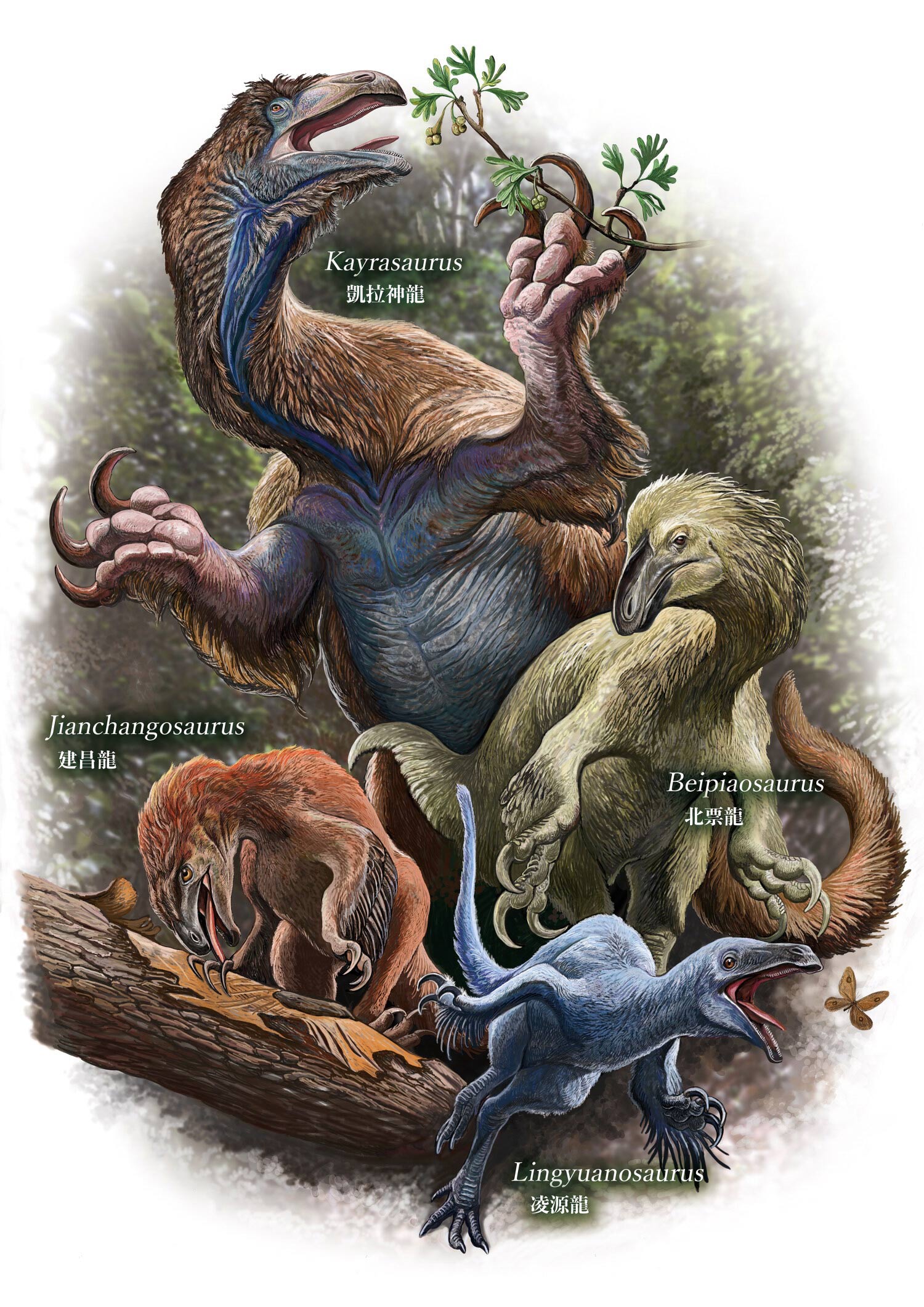
Life reconstruction of Jehol therizinosaurians, illustrating variation in body size, skeletal proportions and inferred ecological strategies among species (from bottom to top): Lingyuanosaurus sihedangensis is shown in a posture suggesting greater cursoriality; Jianchangosaurus yixianensis is depicted engaging in lingual-assisted feeding, consistent with its robust hyoid apparatus; Beipiaosaurus inexpectus exhibits a robust, less cursorial bauplan; and Kayrasaurus changliensis is reconstructed browsing on higher vegetation, reflecting its larger body size and inferred feeding strategy. Image credit: Kōhei Futaka.
Kayrasaurus changliensis lived in what is now China during the Early Cretaceous epoch, around 125 million years ago.
The species was a type of therizinosaur, a group of bizarre, herbivorous or omnivorous theropod dinosaurs known for oversized hand claws.
“Therizinosauria is an anatomically bizarre and rare group of theropod dinosaurs,” said Dr. Xing Xu, a paleontologist with the Institute of Vertebrate Paleontology and Paleoanthropology at the Chinese Academy of Sciences and Yunnan University, and colleagues.
“Late branching taxa evolved unusual traits such as a relatively small head, elongated neck, leaf-shaped teeth, rostrally downturned and edentulous dentary, enlarged manual unguals, broad and opisthopubic pelvis, shortened tibia, and a tetradactyl pes.”
“The combination of these paradoxical anatomical features on an otherwise theropod bauplan caused one of the most complicated taxonomic histories within Dinosauria.”
The paleontologists recovered a nearly complete skeleton of Kayrasaurus changliensis — including a largely complete skull — from the Yixian Formation of western Liaoning, China.
This geological formation is part of the Jehol Biota, a fossil-rich ecosystem that has yielded many feathered dinosaurs.
The researchers estimate the Kayrasaurus changliensis individual was more than 3.6 m (11 feet) long, at least 1.6 times the length of Beipiaosaurus, the second-largest Jehol therizinosaur.
They estimate its mass at roughly 117 to 274 kg (about 260 to 600 pounds).
The individual was probably a subadult, so a fully grown animal could have been larger.
Kayrasaurus changliensis’ teeth were extremely small and densely packed, with more than 45 in the lower jaw, the most of any known therizinosaur.
Its neck vertebrae were longer than those of its back, and one of its hand claws had a distinctive upward-projecting ‘lip.’
“The discovery of Kayrasaurus changliensis provides an important new data point for understanding early therizinosaurian evolution,” the scientists said.
“As the largest therizinosaurian yet known from the Jehol Biota, Kayrasaurus changliensis bridges morphological gaps between previously described taxa.”
The researchers also compared Kayrasaurus changliensis with three other therizinosaurs from the Jehol Biota: Beipiaosaurus, Jianchangosaurus and Lingyuanosaurus.
Kayrasaurus and Beipiaosaurus appear to have had sturdier bodies, jaws suited to stronger bites and less agile builds.
Jianchangosaurus and Lingyuanosaurus look more lightly built and better suited to running.
This suggests the dinosaurs may have occupied different ecological niches, though the authors call the idea provisional and say more complete fossils are needed to test it.
“The integration of morphological, biomechanical and body size data suggests the presence of at least two distinct ecological strategies among Jehol therizinosaurians: one favoring oral processing and robust body builds, and the other emphasizing agility,” the authors said.
“While these ecological interpretations remain provisional, they underscore the importance of continued fieldwork, new fossil discoveries and biomechanical analyses to further illuminate the evolutionary pathways and paleoecological diversity of this enigmatic group.”
The discovery of Kayrasaurus changliensis is reported in a paper in the Journal of Systematic Palaeontology.
_____
Chun-Chi Liao et al. 2026. A new therizinosaur from the Early Cretaceous Jehol Biota and ecomorphological patterns among early therizinosaurians. Journal of Systematic Palaeontology 24 (2); doi: 10.1080/14772019.2026.2710287