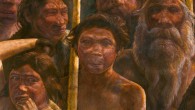
The first analysis of nuclear DNA from Sima de los Huesos hominins, conducted by Dr. Matthias Meyer of the Max Planck Institute for Evolutionary Anthropology...
A multinational group of researchers has found strong genetic evidence of an interbreeding event between Neanderthals and anatomically modern Homo sapiens...
New archaeological evidence published online in the journal Nature has pushed back the accepted earliest human occupation of Sulawesi to more than 110,000...
Interbreeding of anatomically modern Homo sapiens with Neanderthals (Homo neanderthalensis) around 40,000 years ago may have left humans with gene variants...
Wounds identified on a 430,000-year-old hominin skull from the archaeological site of Sima de los Huesos in northern Spain may indicate one of the first...
A gene that is responsible for brain size in modern Homo sapiens and their ancient relatives, Neanderthals and Denisovans, has been identified by a team...
Tibetans were able to adapt to high altitudes thanks to what is sometimes called the super-athlete gene, or more prosaically, EPAS1, they acquired when...
A comparison of the high-quality genome sequence of a 50,000-year-old Neanderthal woman with those of modern humans and Denisovans reveals a long history...
Researchers from the Max Planck Institute for Evolutionary Anthropology in Leipzig, Germany, have sequenced the mitochondrial genome of a 400,000-year-old...
Scientists from the University of Oxford and Plymouth University, both in UK, have found evidence of Neanderthal and Denisovan viruses in DNA of modern...
A broad range of evidence from linguistics, genetics, paleontology, and archaeology suggests that Neanderthals and Denisovans shared with us something...
An international team of researchers has completed the first sequencing of the Denisovan genome, shedding light on the relationships between these archaic...