During November 2025, ESA’s Jupiter Icy Moons Explorer (Juice) used five of its science instruments to observe 3I/ATLAS, the second interstellar comet ever spotted in our cosmic neighborhood. In addition, the probe captured a new image of the interstellar visitor with its Navigation Camera (NavCam).
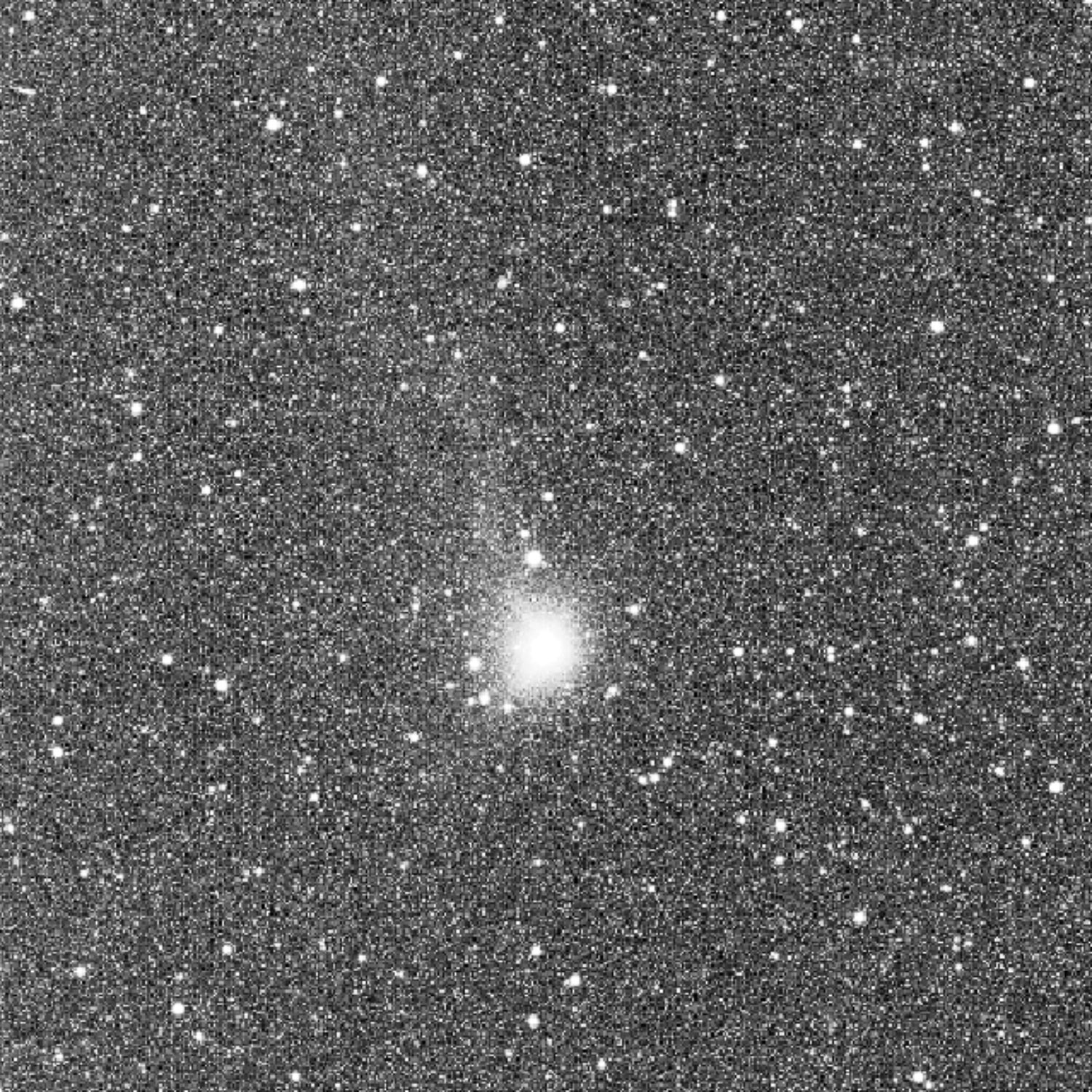
This image from ESA’s Juice spacecraft shows the interstellar comet 3I/ATLAS. Image credit: ESA / Juice / NavCam / CC BY-SA 3.0 IGO.
“Though the data from the science instruments won’t arrive on Earth until February 2026, our team couldn’t wait that long,” said members of the Juice team.
“We decided to try downloading just a quarter of a single NavCam image to see what was in store for us.”
“The very clearly visible comet, surrounded by signs of activity, surprised us.”
“Not only do we clearly see the glowing halo of gas surrounding the comet known as its coma, we also see a hint of two tails.”
“The comet’s ‘plasma tail,’ made up of electrically charged gas, stretches out towards the top of the frame.”
“We may also be able to see a fainter ‘dust tail’ — made up of tiny solid particles — stretching to the lower left of the frame.”
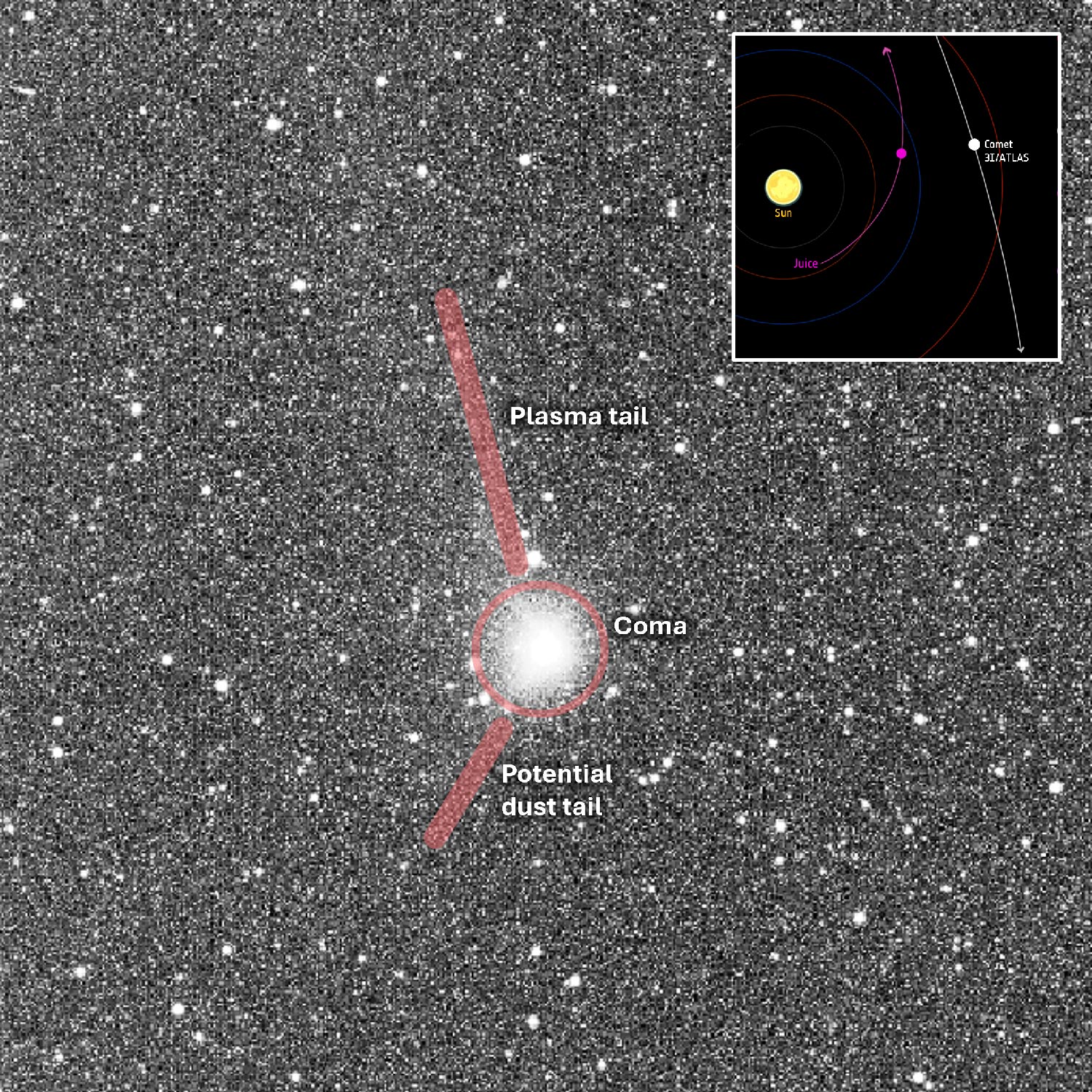
An annotated version of the Juice image of the interstellar comet 3I/ATLAS. Image credit: ESA / Juice / NavCam / CC BY-SA 3.0 IGO.
The image of 3I/ATLAS was taken on November 2 during Juice’s first slot for observing the comet.
It was two days before Juice’s closest approach to the comet, which occurred on November 4 at a distance of about 66 million km (41 million miles).
“We expect to receive the data from the five scientific instruments switched on during the observations — JANUS, MAJIS, UVS, SWI and PEP — on February 18 and 20, 2026,” the researchers said.
“The delay is because Juice is currently using its main high-gain antenna as a heat shield to protect it from the Sun, leaving its smaller medium-gain antenna to send data back to Earth at a much lower rate.”
Though Juice was further from 3I/ATLAS than ESA’s Mars orbiters were back in October, it observed 3I/ATLAS just after the comet’s closest approach to the Sun, meaning that it was in a more active state.
“We expect to see clearer signs of this activity in the data from the science instruments,” the scientists explained.
“This includes not only images from JANUS — Juice’s high-resolution optical camera — but also spectrometry data from MAJIS and UVS, composition data from SWI, and particle data from PEP.”