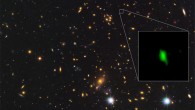
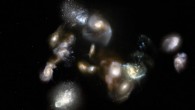
Astronomers believe that our Universe began forming the first stars when it was a few hundred million years old. Since then, the Universe has become a...
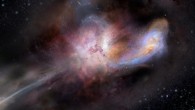
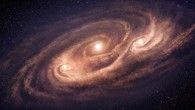
WISE J224607.55-052634.9 (W2246-0526 for short), the most luminous galaxy ever discovered, is accreting (eating) at least three of its smaller neighbors,...
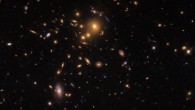
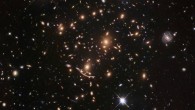
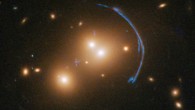
SDSS J0915+3826, a giant group of galaxies located approximately 4 billion light-years away, is so massive that its gravity bends light like a lens, making...
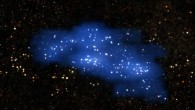
Astronomers using ESO’s Very Large Telescope have spotted a gigantic galaxy proto-supercluster in the early Universe, just 2.3 billion years after the...
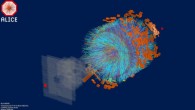
Physicists from the ALICE (A Large Ion Collider Experiment) Collaboration at CERN have gained new insights into the properties of the quark-gluon plasma,...
Astronomers using the Multi Unit Spectroscopic Explorer (MUSE) instrument on ESO’s Very Large Telescope have discovered an unexpected abundance of Lyman-alpha...
Astronomers using the NASA/ESA Hubble Space Telescope have captured a spectacular image of Abell 370, a massive galaxy cluster embedded among nearly thousands...
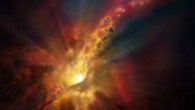
Astronomers using the Atacama Large Millimeter/submillimeter Array (ALMA) have detected a powerful ‘wind’ in SPT-S J231921-5557.9 (SPT2319-55 for short),...
Using the Atacama Large Millimeter/submillimeter Array (ALMA), a team of astronomers revealed that molecular clouds in a galaxy called AzTEC/COSMOS-1,...
A team of astronomers from the United States and the United Kingdom has found evidence that Milky Way’s faintest satellites — including dwarf galaxies...
Astronomers have known that roughly 12 billion years ago, the gas in deep space was much more opaque than it is now in some regions, although the opacity...
A new image from the NASA/ESA Hubble Space Telescope demonstrates the immense effects of gravity; more specifically, it shows the effects of gravitational...
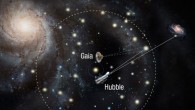
Astronomers have used the NASA/ESA Hubble Space Telescope and ESA’s Gaia space observatory to make the most precise measurements of the expansion rate...
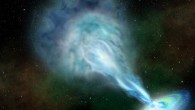
Astronomers using NSF’s Very Long Baseline Array (VLBA) have found a quasar with the brightest radio emission ever observed in the early Universe.
An...
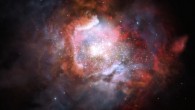
Two independent teams of astronomers have discovered that both starburst galaxies in the early Universe and a star-forming region in a nearby galaxy called...
A duo of astrophysicists is proposing a new model for the invisible material that makes up most of the Universe: it’s possible that a small fraction...
Astronomers using the Multi Unit Spectroscopic Explorer (MUSE) instrument on ESO’s Very Large Telescope (VLT) in Chile have detected six dark galaxies,...
An international team of astronomers has used observations from ESO’s Very Large Telescope (VLT) and the Atacama Large Millimeter/submillimeter Array...