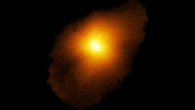
A young starburst galaxy named BOSS-EUVLG1 is by far the most luminous, almost un-obscured star-forming galaxy known at any redshift.
An artist’s impression...
Astronomers using the Atacama Large Millimeter/submillimeter Array (ALMA) have discovered an extremely distant galaxy that looks surprisingly like our...
The Phoenix stellar stream, a thin over-density of stars in the halo of our Milky Way Galaxy originally identified by the Dark Energy Survey, is composed...
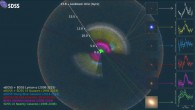
Astrophysicists and cosmologists from the Sloan Digital Sky Survey (SDSS) have released the largest 3D map of the Universe ever created, filling in the...
An international of astronomers has observed an optical afterglow of a short gamma-ray burst, thought to be from the merger of two neutron stars, and localized...
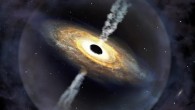
An international team of astronomers has discovered the second most distant quasar ever found. Named Pōniuā`ena and designated J100758.264+211529.207...
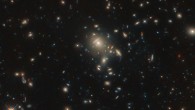
Thanks to the presence of a cosmic lens, the NASA/ESA Hubble Space Telescope got a close-up look at PLCK G045.1+61.1, a starburst galaxy located approximately...
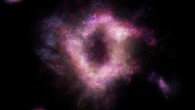
Astronomers have spotted a giant galaxy with a massive star-forming ring that existed 10.8 billion years ago.
An artist’s impression of the collisional...
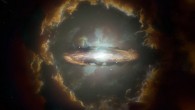
Astronomers using the Atacama Large Millimeter/submillimeter Array (ALMA) have found evidence for the most distant rotationally supported disk galaxy ever...
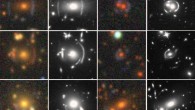
Using data from the Dark Energy Camera Legacy Survey (DECaLS), astronomers have discovered 335 new candidate strong lensing systems.
These two columns...
By combining the power of strong gravitational lensing with the capability of the Atacama Large Millimeter/submillimeter Array (ALMA), a team of astronomers...
In a paper published in the Astrophysical Journal, a team of astronomers in Italy proposes that heavy seeds of supermassive black holes formed via the...
Astronomers using the Large Binocular Telescope have found a blazar 13 billion light-years from Earth, making it officially the most distant blazar ever...
Astronomers using the Multi-Object Spectrograph for Infrared Exploration (MOSFIRE) at the W. M. Keck Observatory have discovered an ultramassive galaxy...
Using high-resolution spectroscopic observations from the High-Resolution Echelle Spectrometer (HIRES) on the 10-m Keck I telescope at the W. M. Keck Observatory,...
A new radio image from the MeerKAT telescope at the South African Radio Astronomy Observatory in Cape Town, South Africa, presents a wide portrait of the...
Astronomers using the Atacama Large Millimeter/submillimeter Array (ALMA) have spotted huge clouds of carbon gas around several young starburst galaxies...