A giant elliptical galaxy called NGC 3640 has engulfed several smaller galaxies in the past, according to an analysis of data from ESO’s VLT Survey Telescope...
Astronomers using ESO’s Visible and Infrared Survey Telescope for Astronomy (VISTA) have created a stunning 80-million-pixel image of the star cluster...
One of these exoplanets, HD 20794d, is likely to be a rocky planet in the habitable zone of its parent star, the G-dwarf HD 20794.
This image shows the...
New data from NASA’s Chandra X-ray Observatory and ESO’s Very Large Telescope provide evidence that outbursts from supermassive black holes can help...
Astronomers have long thought that the upper clouds of Jupiter, which create the planet’s iconic pale brown belts, are made of frozen ammonia. But a...
Using data from ESO’s Very Large Telescope (VLT) and Keck telescope, astronomers have discovered a binary star system in the S star cluster close to...
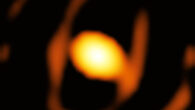
Astronomers using ESO’s Very Large Telescope Interferometer (VLTI) have captured a zoomed-in image of the dust-enshrouded red supergiant star WOH G64.
This...
Astronomers using the VLT Survey Telescope at ESO’s Paranal Observatory in Chile have taked a 283-million-pixel image of the Dark Wolf Nebula.
This image,...
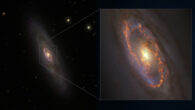
NGC 1386 is a spiral galaxy located 53 million light-years away in the constellation of Eridanus.
This image of NGC 1386 combines data from VST and ALMA....
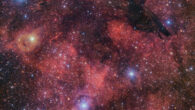
Gum 39 is one of several nebulae in a vast stellar nursery called the Running Chicken Nebula (IC 2944), which is located about 6,500 light-years away in...
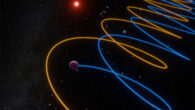
An exoplanet at least half the mass of Venus orbits Barnard’s star, the closest single star to the Sun, once every 3.15 days.
An artist’s impression...
Astronomers using ESO’s VLT Survey Telescope (VST) in Chile have captured a stunning image of the distorted spiral galaxy NGC 3312.
This VST image shows...
Using data from ESO’s Very Large Telescope (VLT) and other telescopes, astronomers have found evidence for an intermediate-mass black hole in IRS 13,...
Hyperluminous infrared galaxies are the rarest and most extreme star-forming systems and found only in the distant Universe.
Stellar, cold-gas and ionized-gas...
Astronomers using the Multi Unit Spectroscopic Explorer (MUSE) instrument on ESO’s Very Large Telescope (VLT) in Chile have imaged 177-341 W, a proplyd...
Astronomers using ESO’s Very Large Telescope (VLT) have produced this beautiful image of the gas cloud Gum 46.
This VLT image shows Gum 46, a nebula...
Large amounts of stars are being born at the center of NGC 4383, a peculiar galaxy located 74 million light-years away in the constellation of Coma Berenices....