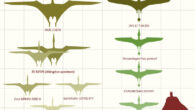
A team of paleontologists has unearthed the fossil remains of a ctenochasmatoid pterosaur from the Kimmeridge Clay Formation in Oxfordshire, central England....
A 3,500-year-old suit of Mycenaean bronze armor from the Greek village of Dendra may have been used in battle, not just for ceremonial purposes as previously...
The 4,000-year-old skeletal remains of a Scandinavian man were found in 1916 on the island of Hitra, Norway.
The Hitra man was around 169 cm tall, fair-haired...
BPP University paleontologist Matthew Baron has identified a previously unknown carnivorous dinosaur from Dorset, England based on fossils collected in...
An international team of archaeologists with the ROOTS Cluster of Excellence has discovered a Late Neolithic settlement near the Tamiš River in the northernmost...
Ichthyotitan severnensis lived in the Triassic seas around 202 million years ago and might have measured more than 25 m (82 feet).
Ichthyotitan severnensis....
Because it is often assumed that fundamental behavioral differences distinguish Neanderthals and Homo sapiens, the ability to structure space within the...
Very large unidentified elongate and rounded fossilized bones of uncertain origin recovered from different Late Triassic localities across Europe have...
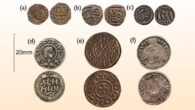
Between 660 and 750 CE, Anglo-Saxon England witnessed a profound revival in trade involving a dramatic surge in the use of silver coins. Scientists have...
Wooden tools rarely survive in the Paleolithic record limiting our understanding of Pleistocene hunter-gather lifeways. With 187 wooden artifacts, the...
More than 7,000 years ago, Neolithic people navigated the Mediterranean Sea using technologically sophisticated boats, according to new research.
The 7,300-year-old...
A new genus and species of spinosaurid dinosaur being named Riojavenatrix lacustris has been discovered by University of the Basque Country paleontologist...
A new genus and species of plesiosaur that lived near the onset of the Early-Middle Jurassic turnover has been identified from two exquisite, three-dimensionally...
The 390-million-year-old forest landscape, archived within the Eifelian Hangman Sandstone Formation of Somerset and Devon in England, is roughly 4 million...
The interaction sheds new light on the dynamics between gray seals (Halichoerus grypus) and white-tailed eagles (Haliaeetus albicilla), according to Clare...
Archaeologists have dated an assemblage of ancient stone tools excavated from the archaeological site of Korolevo on the Tysa River in western Ukraine...
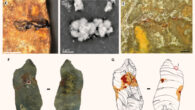
Archaeologists have found traces of ancient ochre-based multicomponent adhesives on 40,000-year-old stone tools from Le Moustier, France.
Photographs,...
A new genus and species of dwarf lambeosaurine hadrosaurid has come to light in Moroccan rocks dating to the Late Cretaceous epoch, some 68 million years...
A team of archaeologists from Germany has discovered a submerged Stone Age megastructure in the Western Baltic Sea at a water depth of about 21 m. The...