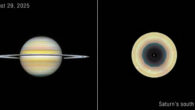
For almost five decades, Saturn’s north pole has been famous for hosting a bizarre, six-sided jet stream known as the hexagon, a feature first spotted...
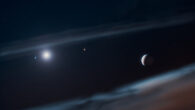
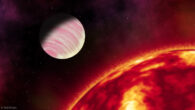
Astronomers using ESO’s Very Large Telescope (VLT) have discovered a gas giant around a brown dwarf in the stellar system CD-35 2722. The discovery blurs...
Using the upgraded GRAVITY+ instrument on ESO’s Very Large Telescope Interferometer (VLTI), astronomers have measured the ratio of carbon isotopes in...
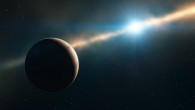
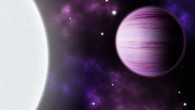
Astronomers using the NASA/ESA/CSA James Webb Space Telescope have analyzed the atmosphere of a massive exoplanet orbiting the white dwarf WD 1856+534....
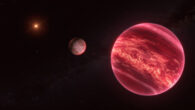
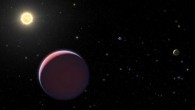
Two newly discovered exoplanets, TOI-791b and TOI-791c, are as large as Jupiter but have densities lower than cotton candy, giving astronomers a rare glimpse...
HD 80606b has one of the most extreme orbits of any known exoplanet and the NASA/ESA/CSA James Webb Space Telescope just caught it getting flash-fried...
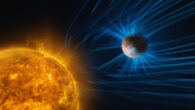
By tracking fierce winds racing through the atmospheres of seven ultra-hot Jupiters, astronomers have uncovered the strongest evidence yet that magnetic...
Using spectral data from the Near-Infrared Spectrograph (NIRSpec) onboard the NASA/ESA/CSA James Webb Space Telescope, astronomers analyzed the atmosphere...
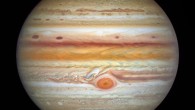
Using data from NASA’s Juno spacecraft, planetary scientists have produced the most precise measurements of Jupiter’s size in half a century and found...
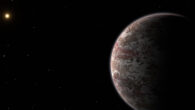
Using the NASA/ESA/CSA James Webb Space Telescope, astronomers have detected water-ice clouds swirling through the atmosphere of Epsilon Indi Ab, a cold...
The Jovian system has four large moons, including the largest moon in the Solar System, Ganymede, whereas the Saturnian system is dominated by one giant...
Using the Near-Infrared Spectrograph (NIRSpec) onboard the NASA/ESA/CSA James Webb Space Telescope, astronomers have characterized the atmosphere of TOI-5205b,...
Using the Immersion Grating Infrared Spectrometer (IGRINS) on the Gemini South telescope at the International Gemini Observatory, astronomers have directly...
A new analysis of isotopic signatures across planets and meteorite parent bodies suggests our home world formed entirely from inner solar system material,...
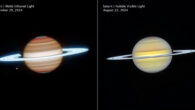
By combining infrared observations from the NASA/ESA/CSA James Webb Space Telescope with visible-light imagery from the NASA/ESA Hubble Space Telescope,...
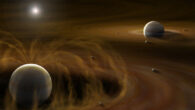
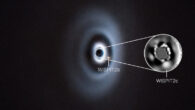
Using ESO’s Very Large Telescope (VLT) and VLT Interferometer (VLTI) in Chile, astronomers have directly observed two gas giants emerging from the planet-forming...
Kepler-51 is a young G-dwarf star hosting three super-puffs and one low-mass non-transiting exoplanet. Kepler-51d, the coolest transiting planet in this...
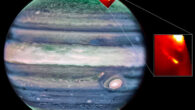
The NASA/ESA/CSA James Webb Space Telescope conducted a clockwise scan around the entire limb of Jupiter, chasing aurora as it rotated into view. This...