In their hunt for elusive exomoon candidates, astronomers have looked at 70 cool gas giants found by NASA’s Kepler space telescope. They’ve found only...
Using data from NASA’s Transiting Exoplanet Survey Satellite (TESS) and several ground-based facilities, astronomers have discovered a long-period sub-Neptune...
A team of professional astronomers and citizen scientists from the Backyard Worlds: Planet 9 project has discovered a planetary-mass object co-moving with...
Named b Centauri (AB)b (or b Centauri b), the newfound exoplanet is estimated to be only 15 million years old and 10 times the mass of Jupiter, according...
Using photometric data from NASA’s Kepler/K2 mission, astronomers have identified 747 unique planet candidates and 57 multiplanet systems; of these candidates,...
Using data from NASA’s Transiting Exoplanet Survey Satellite (TESS) and several ground-based telescopes, astronomers have discovered and confirmed a...
Juno launched on August 5, 2011 and successfully entered Jupiter’s orbit on July 4, 2016. During each of the spacecraft’s 37 passes of Jupiter to date,...
Using the Immersion GRating INfrared Spectrometer (IGRINS) at the Gemini South Observatory on Cerro Pachon, Chile, astronomers have measured carbon-to-hydrogen...
The discovery of a super-Jupiter exoplanet around the M-type dwarf star 2MASS J04372171+2651014 challenges models of planet formation by either core accretion...
Using a technique called gravitational microlensing, which occurs when a star close to Earth momentarily aligns with a more distant star, astronomers have...
Using high-resolution spectra obtained with GRACES at the Gemini North Observatory, astronomers have detected ionized calcium in the atmosphere of the...
Astronomers have discovered a highly-irradiated gas giant exoplanet in close-in, highly misaligned orbit around a bright star called TOI-1518.
An artist’s...
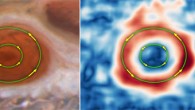
Using data from the WFC3/UVIS instrument on board the NASA/ESA Hubble Space Telescope, a team of astronomers has measured the horizontal winds in Jupiter’s...
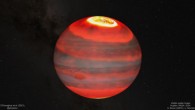
The upper atmosphere of Jupiter is hotter than expected from the amount of sunlight that it receives: the average temperature should be about minus 73...
Astronomers with the COol Companions ON Ultrawide orbiTS (COCONUTS) program have directly imaged a massive exoplanet orbiting the low-mass red dwarf L...