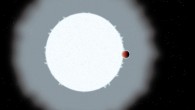
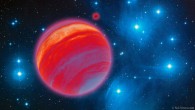
Using the Keck Planet Imager and Characterizer (KPIC) on the Keck II telescope at the W.M. Keck Observatory, astronomers have obtained and analyzed the...
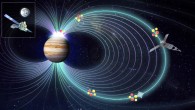
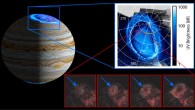
The rapidly rotating, strong magnetic field of Jupiter provides a natural lab that is key to understanding the dynamics of high-energy plasmas. Spectacular...
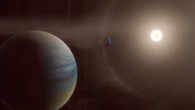
Astronomers using NASA’s Transiting Exoplanet Survey Satellite (TESS) have discovered a transiting hot-Jupiter exoplanet around a slightly evolved star...
Professional astronomers and citizen scientists from the NASA-funded Planet Hunters TESS project have discovered a two-planet system around the bright...
Astronomers using NASA’s Transiting Exoplanet Survey Satellite (TESS) have discovered a temperate, Neptune-sized planet orbiting the M-dwarf star TOI-1231.
An...
The newfound circumbinary planet, named TIC 172900988b, is slightly larger than Jupiter and transits both of its host stars, according to a paper to be...
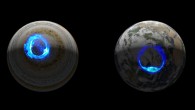
Three images of Jupiter from the 8-m Frederick C. Gillett Gemini North telescope at the Gemini Observatory and the NASA/ESA Hubble Space Telescope show...
Astronomers using NASA’s Transiting Exoplanet Survey Satellite have discovered a sub-Neptune exoplanet orbiting TOI-220, a bright and old K-type dwarf...
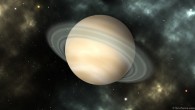
Detailed measurements from the Grand Finale phase of NASA’s Cassini mission revealed distinctive features of Saturn’s magnetic field. These features...
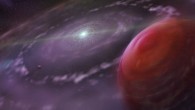
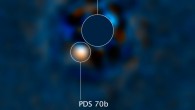
Astronomers using the NASA/ESA Hubble Space Telescope have imaged a Jupiter-sized, still-forming planet around the orange dwarf star PDS 70. This is the...
Dark matter with masses below 1 GeV can scatter, become captured, deposit annihilation energy, and increase the heat flow within extrasolar gas giants,...
Astronomers using the Spectro-Polarimetric High-contrast Exoplanet Research (SPHERE) instrument on ESO’s Very Large Telescope have discovered and directly...
Kepler-34, Kepler-35, Kepler-38, Kepler-64 and Kepler-413 — multiple star systems located between 2,764 and 5,933 light-years away in the constellations...
Planetary scientists using data from the Ultraviolet Spectrograph (UVS) aboard NASA’s Juno spacecraft have discovered expanding emission circles of ultraviolet...
Using data from NASA’s Transiting Exoplanet Survey Satellite (TESS) and the HARPS-N spectrograph at the 3.6-m Telescopio Nazionale Galileo, astronomers...
Using data from NASA’s Transiting Exoplanet Survey Satellite (TESS) and several ground-based telescopes, astronomers have discovered and confirmed a...
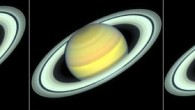
Astronomers using the NASA/ESA Hubble Space Telescope observed Saturn, the second largest planet in our Solar System, in 2018, 2019, and 2020, just after...
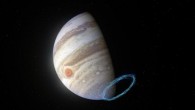
Dawn storms consist of short-lived but intense brightening and broadening of Jupiter’s main auroral oval near where the atmosphere emerges from darkness...