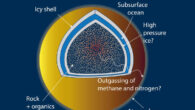
Heating of complex organic matter in the presence of water may be an important source of Titan’s abundant atmospheric nitrogen and methane gases, according...
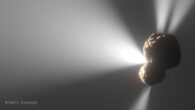
Centaurs are former trans-Neptunian objects that have been moved inside Neptune’s orbit by subtle gravitational influences of the planets in the last...
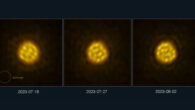
These giant, hot bubbles of gas on the surface of R Doradus are approximately 75 times the size of our Sun, according to a paper published in the journal...
Chemists at the Leibniz Institute for Tropospheric Research have provided experimental evidence that sulfurous acid (H2SO3), once formed in the gas phase,...
Using the Atacama Large Millimeter/submillimeter Array (ALMA) and the Subaru Telescope, astronomers have discovered a pair of merging gas-rich galaxies...
Despite recent progress, the question of what regulates the star formation efficiency in galaxies remains one of the most debated problems in astrophysics....
One-third of Mars’ surface has shallow-buried water, but it is currently too cold for use by life. Proposals to warm Mars using greenhouse gases require...
Hyperluminous infrared galaxies are the rarest and most extreme star-forming systems and found only in the distant Universe.
Stellar, cold-gas and ionized-gas...
The five artificial greenhouse gases identified by University of California, Riverside astrobiologist Edward Schwieterman and his colleagues would be detectable...
Large amounts of stars are being born at the center of NGC 4383, a peculiar galaxy located 74 million light-years away in the constellation of Coma Berenices....
NGC 604 is similar to familiar starbirth regions in our Milky Way Galaxy, such as the Orion Nebula, but it is much larger in extent and contains many more...
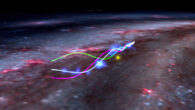
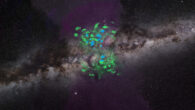
Our Sun lies within 300 parsecs (around 1,000 light-years) of the 2,700-parsec- (around 9,000-light-year-) long sinusoidal chain of dense gas clouds known...
Using new 21-cm radio observations made with NSF’s Green Bank Telescope, astronomers have discovered over 250 neutral gaseous clouds being blasted out...
Using the NASA/ESA Hubble Space Telescope, astronomers have taken a detailed image of part of a 250,000-light-year-long bridge of stars and gas that stretches...
Using advanced transmission electron microscopy (TEM) methods, physicists at the University of Nottingham have successfully trapped atoms of krypton inside...
Odd radio circles (ORCs), a class of extragalactic astronomical sources discovered in 2019, are in fact shells formed by outflowing galactic winds, possibly...