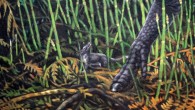
A team of researchers from the American Museum of Natural History, Siena College and the Bell Museum at the University of Minnesota, St. Paul, has discovered...
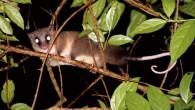
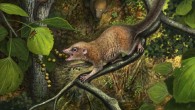
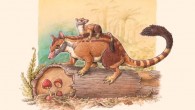
The end-Cretaceous mass extinction 66 million years ago was characterized by a worldwide ecological catastrophe and rapid species turnover. Arboreal (tree-dwelling)...
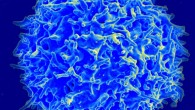
Biologists have analyzed T cells from the gray short-tailed opossum (Monodelphis domestica) and uncovered a previously unknown lineage, called γµ T cells,...
Congruus kitcheneri, an extinct species of kangaroo that lived in Australia between 2.6 million and 12,000 years ago, was adapted for climbing trees,...
Researchers in Australia have examined thylacine (Thylacinus cynocephalus) and gray wolf (Canis lupus) skulls of different ages, stages and sizes, from...
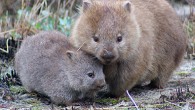
The bare-nosed wombat (Vombatus ursinus) is an herbivorous Australian marsupial, renowned for its cubic feces. However, the ability of the wombat’s intestine...
Dr. Laura Chornogubsky, a paleontologist in the Museo Argentino de Ciencias Naturales ‘Bernardino Rivadavia’ and CONICET, has described one new genus...
Kangaroos, marsupial mammals that have never been domesticated, can intentionally communicate with humans, according to new research led by the University...
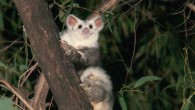
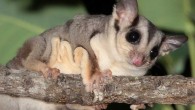
The greater glider (Petauroides volans), a large, nocturnal gliding marsupial endemic to Australia, isn’t one species, but rather three distinct ones.
Petauroides...
Until its extinction, the thylacine (Thylacinus cynocephalus) was the largest living carnivorous marsupial, but little data exist regarding its body mass,...
A research team led by Charles Darwin University biologists has identified and raised two additional species within what is currently designated as the...
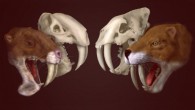
Thylacosmilus atrox, an extinct marsupial that roamed South America between 9 and 3 million years ago (Neogene period), was not the ecological analogue...
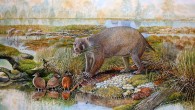
Paleontologists have identified a giant wombat-like marsupial that lived 25 million years ago (Oligocene epoch) in what is now Australia. Named Mukupirna...
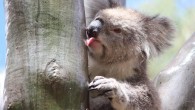
A team of Australian scientists and wildlife ecologists has captured koala drinking behavior in the wild for the first time.
Old female koala showing natural...
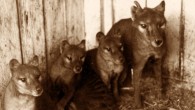
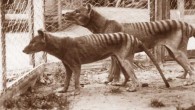
The Tasmanian tiger (Thylacinus cynocephalus), also known as the thylacine, was a carnivorous marsupial found throughout most of Tasmania before European...
Paleontologists have uncovered a new species of marsupial that lived during the Cretaceous period above the Arctic Circle, the farthest north marsupials...
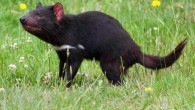
The Tasmanian devil (Sarcophilus harrisii), the world’s largest living carnivorous marsupial, is threatened with extinction by a horizontally transmitted...
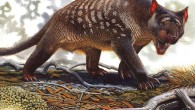
New evidence indicates the primary cause of the extinction of one of Australia’s top predators, the marsupial lion (Thylacoleo carnifex), around 40,000...
The Koala Genome Consortium, a research group that includes 54 scientists from 29 different institutions across seven countries, has produced the first...
An international team of scientists led by Museums Victoria and the University of Melbourne has scanned all known joey specimens of the Tasmanian tiger...