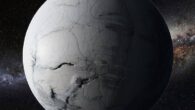
A new analysis of exquisitely preserved laminated rocks (varves) from the Port Askaig Formation on the Garvellach Islands, Scotland, shows that climate...
Polar vortices are present in planetary atmospheres, from the Earth-like rocky planets to Jupiter- and Saturn-like gas giants. However, not much is known...
When NASA’s Voyager 2 spacecraft flew by Uranus in 1986, it provided scientists’ first close glimpse of this ice-giant planet. Alongside the discovery...
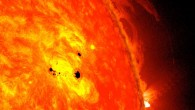
Sunspots have been observed for over four centuries and the magnetic nature of sunspot cycles has been known for about a century. However, some of its...
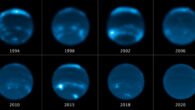
Neptune is the most distant planet in the Solar System, an ice-giant that boasts an active and chaotic atmosphere. Using archival near-infrared observations...
On July 11, 2020, NASA’s Parker Solar Probe made its third flyby of Venus. During 7 min around the closest approach, one of the spacecraft’s scientific...
A team of researchers from the Department of Aeronautics and Astronautics at the University of Washington proposes a new model of plasma motion that would...
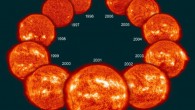
Pioneering new research from the University of Exeter, UK, has revealed when the 11-year solar cycle is in its ‘weaker’ phase, there are warm spells...
A study led by University of Montreal researchers has confirmed that our Sun is indeed a solar-type star. Published in the journal Science, the findings...