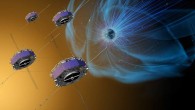
The four spacecraft of NASA’s Magnetospheric Multiscale Mission (MMS) have flown through the heart of a magnetic process that controls Earth’s space...
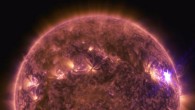
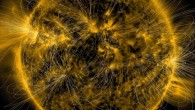
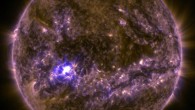
On April 17, 2016, an active region on the Sun released an M6.7 class solar flare, captured here by NASA’s Solar Dynamics Observatory (SDO).
Solar flares...
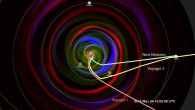
The Solar Wind Around Pluto (SWAP) instrument on NASA’s New Horizons spacecraft has recorded significant changes in how the solar wind behaves far from...
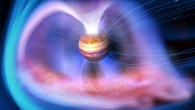
According to a study led by University College London researcher William Dunn, the solar wind is causing intense X-ray bursts over Jupiter’s polar regions.
Solar...
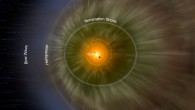
Using data from NASA’s Interstellar Boundary Explorer (IBEX), researchers have accurately determined the strength and direction of the magnetic field...
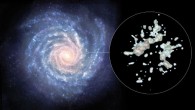
Astronomers using data from ESA’s Hipparcos space astrometry mission have produced a 3D visualization of all of O and B type stars within 1,630 light...
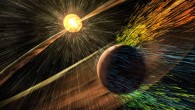
Thanks to NASA’s Mars Atmosphere and Volatile Evolution (MAVEN) orbiter, scientists have learned more about what happened to the Martian climate since...
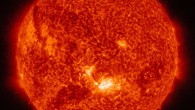
This new image of a mid-level solar flare was captured by NASA’s Solar Dynamics Observatory (SDO) at 8:13 p.m. EDT on October 1, 2015. The image is a...
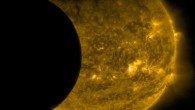
NASA’s SDO (Solar Dynamics Observatory) spacecraft captured this image of Earth and the Moon transiting the Sun together on September 13, 2015.
This...
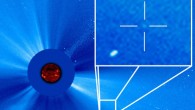
On Sunday, September 13, the NASA/ESA Solar and Heliospheric Observatory (SOHO) discovered its 3,000th comet.
The dot in the cross-hairs is a comet streaming...
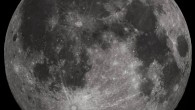
While planetary researchers have speculated on the presence of the noble gas neon in the Moon’s atmosphere (called a surface boundary exosphere) for...
ESA’s Rosetta orbiter yesterday witnessed 67P/Churyumov-Gerasimenko making its closest approach to the Sun. The comet and the spacecraft were 186 million...
Using the HARPS planet-hunting instrument on the 3.6-m telescope at ESO’s La Silla Observatory, Chile, astronomers have discovered a Jupiter-mass exoplanet...
Active regions of the Sun are highlighted in this composite image combining observations from a fleet of sun-monitoring satellites: NASA’s NuSTAR (Nuclear...
A new measurement and modeling tool could give more than 24 hours’ notice of coronal mass ejections that could be harmful to systems on Earth.
New tool...