In 2003, Hubble provided evidence of a massive exoplanet around a very old star. Such stars possess only small amounts of heavier elements that are the...
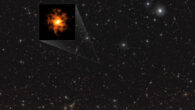
Nicknamed the Firefly Sparkle, the newly-discovered galaxy existed approximately 600 million years after the Big Bang and consisted of a least 10 star...
New observations from the NASA/ESA/CSA James Webb Space Telescope confirms previous measurements by the NASA/ESA Hubble Space Telescope of distances between...
Astronomers using the MeerKAT Pulsar Timing Array, an international experiment that uses the MeerKAT Radio Telescope in South Africa, have uncovered further...
Primordial black holes have been theorized for decades and could even be ever-elusive dark matter. Still, no primordial black hole has ever been observed....
Astronomers using the Dark Energy Spectroscopic Instrument (DESI), a state-of-the-art instrument mounted on NSF’s Nicholas U. Mayall 4-m telescope at...
In 1961, American astrophysicist and astrobiologist Dr. Frank Drake devised an equation in which several factors are multiplied together to estimate the...
The standard model predicted that the NASA/ESA/CSA James Webb Space Telescope would see dim signals from small, primitive galaxies. But data are not confirming...
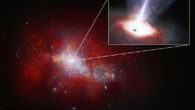
Named LID-568, this 7.2-million-solar-mass black hole appears to be feeding on matter at a rate 40 times its Eddington limit and is seen as it existed...
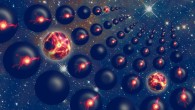
According to the prevailing inflationary universe theory, at the very beginning of the Big Bang, a mysterious energy drove an exponential expansion of...
ESA astronomers have released a 208-gigapixel mosaic of images taken by Euclid, a mission launched in 2023 to study why the Universe is expanding at an...
REBELS-25 existed as early as 700 million years after Big Bang, according to a paper published in the Monthly Notices of the Royal Astronomical Society.
This...
The newly-developed map of the local Universe is based on the motions of 56,000 galaxies, according to a team of astrophysicists from the Leibniz Institute...
Primordial black holes are one of the strongest candidates for the Universe’s dark matter. In this scenario, their abundance would be large enough for...
It’s 7 billion years ago, and the Universe’s heyday of star formation is beginning to slow. What might our Milky Way Galaxy have looked like at that...
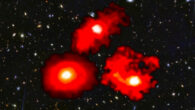
Using the Atacama Large Millimeter/submillimeter Array (ALMA) and the Subaru Telescope, astronomers have discovered a pair of merging gas-rich galaxies...
In a paper published today in the Astronomical Journal, astronomers analyzed the evolution of massive galaxies at redshifts of 4-8 selected from the JWST...