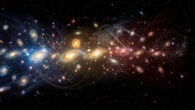
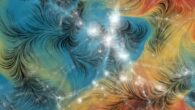
The newly-discovered galaxy filament spans at least 50 million light-years and resides 140 million light-years away. The galaxies are orbiting around the...
In his new book ‘A Brief History of the Philosophy of Time,’ Wake Forest University’s Professor Adrian Bardon proposes that our sense of the passage...
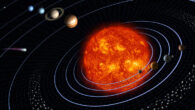
To determine the motion of the Solar System, Bielefeld University astrophysicist Lukas Böhme and his colleagues analyzed the distribution of radio galaxies.
An...
New research from Yonsei University in Seoul, Korea, casts doubt on the long-standing theory that dark energy is driving distant galaxies away increasingly...
A team of physicists from Canada, the United States, the United Kingdom and Italy has mathematically shown that our Universe is built on a type of understanding...
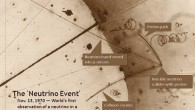
In both NOvA (NuMI Off-axis νe Appearance experiment) and T2K experiments, neutrinos are fired from particle accelerators and detected after traveling...
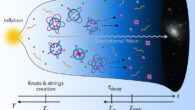
Knots emerge in various fields of mathematics and physics today. A team of physicists from Japan and Germany suggests that, during the early Universe,...
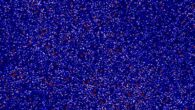
Using the Murchison Widefield Array (MWA) telescope at CSIRO’s Murchison Radio-Astronomy Observatory, astronomers are searching for the elusive Epoch...
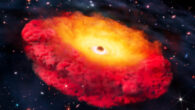
The newly-discovered supermassive black hole sits in the center of a ‘little red dot’ galaxy called CAPERS-LRD-z9 and is seen just 500 million years...
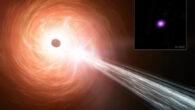
A supermassive black hole in the center of the radio quasar RACS J032021.44-352104.1 (RACS J0320-35 for short) is growing at one of the fastest rates ever...
In his new paper, Professor Jonathan Tan, an astrophysicist at the University of Virginia and the Chalmers University of Technology, proposes that Population...
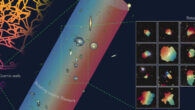
Astronomers using the NASA/ESA/CSA James Webb Space Telescope have observed the Hubble Ultra Deep Field (HUDF), an area of deep space with nearly 10,000...
Low-density amorphous ice is one of the most common solid materials in the Universe and a key material for understanding the many famous anomalies of liquid...
As part of the CRISTAL (CII Resolved ISM in STar-forming galaxies with ALMA) survey, astronomers peered back to when the Universe was only about one billion...
Present-day disk galaxies often exhibit distinct thin and thick disks. The formation mechanisms of the two disks and the timing of their onset remain open...
The Vera C. Rubin Observatory is a major new scientific facility jointly funded by NSF and the U.S. DoE’s Office of Science. The new images are a small...
A new theory by University of Alaska Fairbanks scientist Gunther Kletetschka argues that time comes in three dimensions rather than just the single one...
The first generation of stars (Population III) must have formed from the unenriched gas that permeated the infant Universe. These stars produced the first...
Astronomers have used Fast Radio Bursts (FRBs) to show that more than three-quarters of the Universe’s ordinary matter has been hiding in the thin gas...
Physicists from the Muon g-2 experiment have released their third measurement of the muon magnetic anomaly. The final result agrees with their published...