For more than four and a half millennia, the Khufu Pyramid has stood on the Giza plateau, enduring dozens of earthquakes without serious structural damage. New research led by Egypt’s National Research Institute of Astronomy and Geophysics offers a quantitative explanation for this remarkable durability. It shows that the structure’s natural vibration frequencies differ sharply from those of the surrounding ground — a mismatch that may have helped the monument avoid destructive resonance during earthquakes.
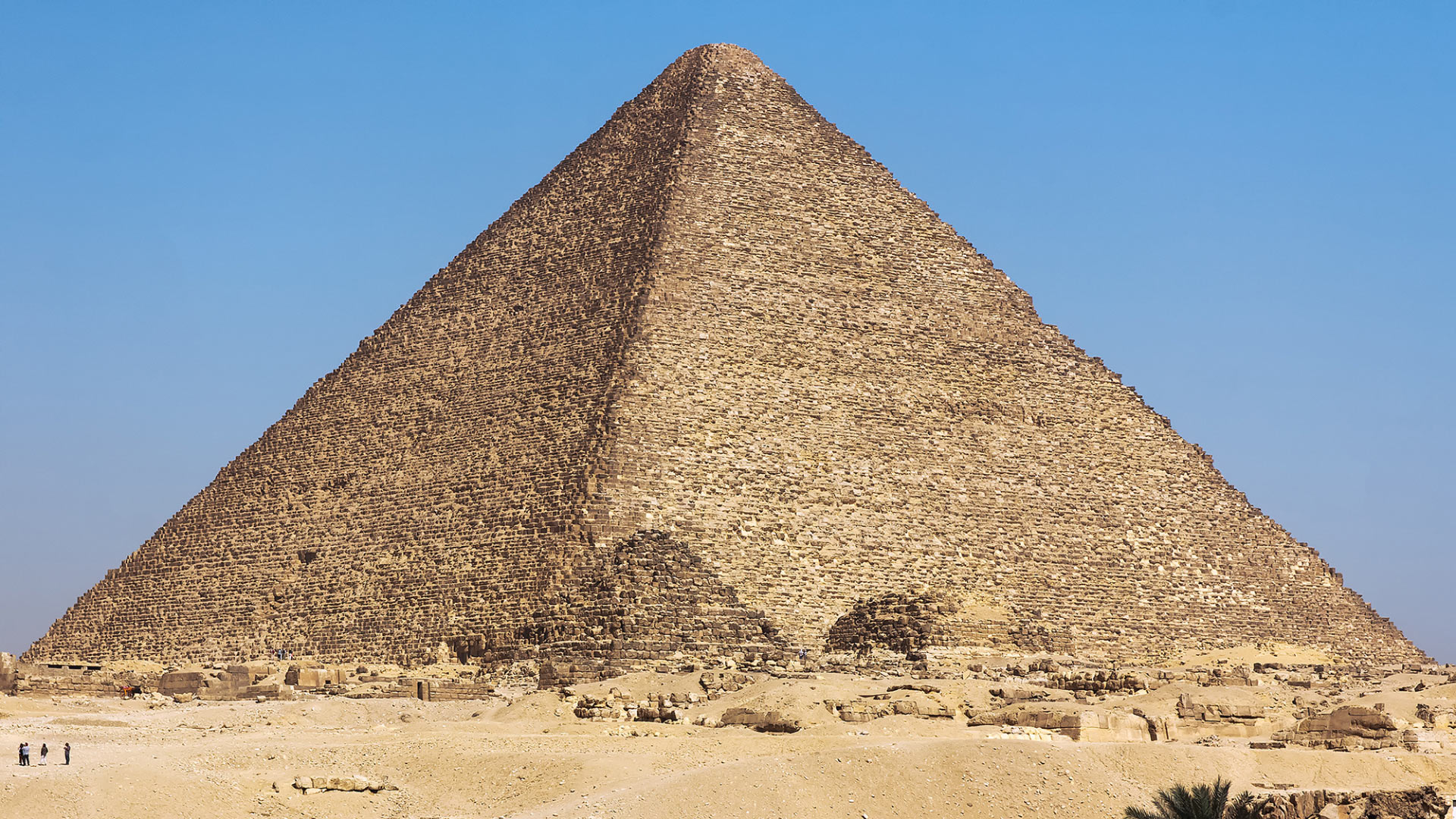
The Khufu Pyramid. Image credit: Douwe C. van der Zee / CC BY-SA 4.0.
The Great Pyramid, also known as the Khufu Pyramid or the Pyramid of Cheops, was built by the pharaoh Khufu (Cheops) around 2600 BCE over a period of about 26 years, making it the oldest of the Seven Wonders of the Ancient World.
Originally standing nearly 147 m tall, it was the world’s tallest human-made structure for more than 3,800 years before being surpassed in 1311 CE by Lincoln Cathedral in England.
Its current height of 137 m reflects the loss of the original smooth limestone casing over the centuries.
Since its construction, the ancient monument has survived numerous earthquakes — including one in 1847 with an estimated magnitude of 6.8, and another in 1992 with a magnitude of 5.8 — without suffering major damage externally or internally.
However, there is currently little evidence to support theories explaining the structure’s resilience.
“The Khufu Pyramid was the oldest pyramid constructed in the northwestern part of the Giza plateau in Cairo during the Old Kingdom,” said senior author Dr. Asem Salama and colleagues from Egypt and Japan.
“The pyramid was originally constructed to a height of 146.59 m, with a base length of approximately 230.33 m per side and a slope angle of 51 degrees.”
“However, current measurements indicate that the present height is about 137 m, reflecting the loss of the original casing stones and apex over time.”
“The pyramid’s structure consists of a core and a casing of horizontal stones, with supporting blocks interspersed throughout.”
“The Khufu pyramid is estimated to contain around 2.3 million stone blocks, each carefully positioned to achieve its monumental scale and stability.”
“Internally, the pyramid features eight principal elements: the main entrance with descending passage, the entrance created by Caliph al-Ma’mun’s workmen, the Subterranean Chamber, the Grand Gallery, the Queen’s Chamber, the King’s Chamber, the relieving chambers, and the shafts.”
“This intricate arrangement highlights the advanced engineering and architectural planning characteristic of Old Kingdom pyramid construction.”
In their new research, the authors recorded seismic noise at 37 locations, including the King’s Chamber, Queen’s Chamber, pressure-relieving chambers, construction blocks, and in the surrounding soil.
Most sections of the pyramid shared a remarkably consistent fundamental frequency between 2 and 2.6 Hertz, while the surrounding soil vibrated at roughly 0.6 Hertz.
That separation likely reduced the risk that earthquakes would amplify shaking within the structure itself.
The researchers also found that vibration amplification generally increased with height inside the pyramid but dropped in the pressure-relieving chambers above the King’s Chamber, suggesting those spaces may help dissipate seismic stress.
Still, they cautioned against overstating the findings: while the frequency mismatch may explain part of the pyramid’s durability, there is no direct evidence that ancient Egyptian builders intentionally engineered the monument for seismic protection.
“Any suggestion of intentional seismic optimization by ancient Egyptian architects remains purely speculative and cannot be substantiated by geophysical measurements alone,” they said.
The team’s findings were published on May 21, 2026 in the journal Scientific Reports.
_____
M. ELGabry et al. 2026. Architectural and geotechnical aspects affecting earthquake resilience for the antique Egyptian Khufu pyramid. Sci Rep 16, 14032; doi: 10.1038/s41598-026-49962-6