Paleontologists have described a new species of bipedal shuvosaurid archosaur from New Mexico, shedding light on a group of creatures that roamed North America during the Triassic period, more than 200 million years ago.
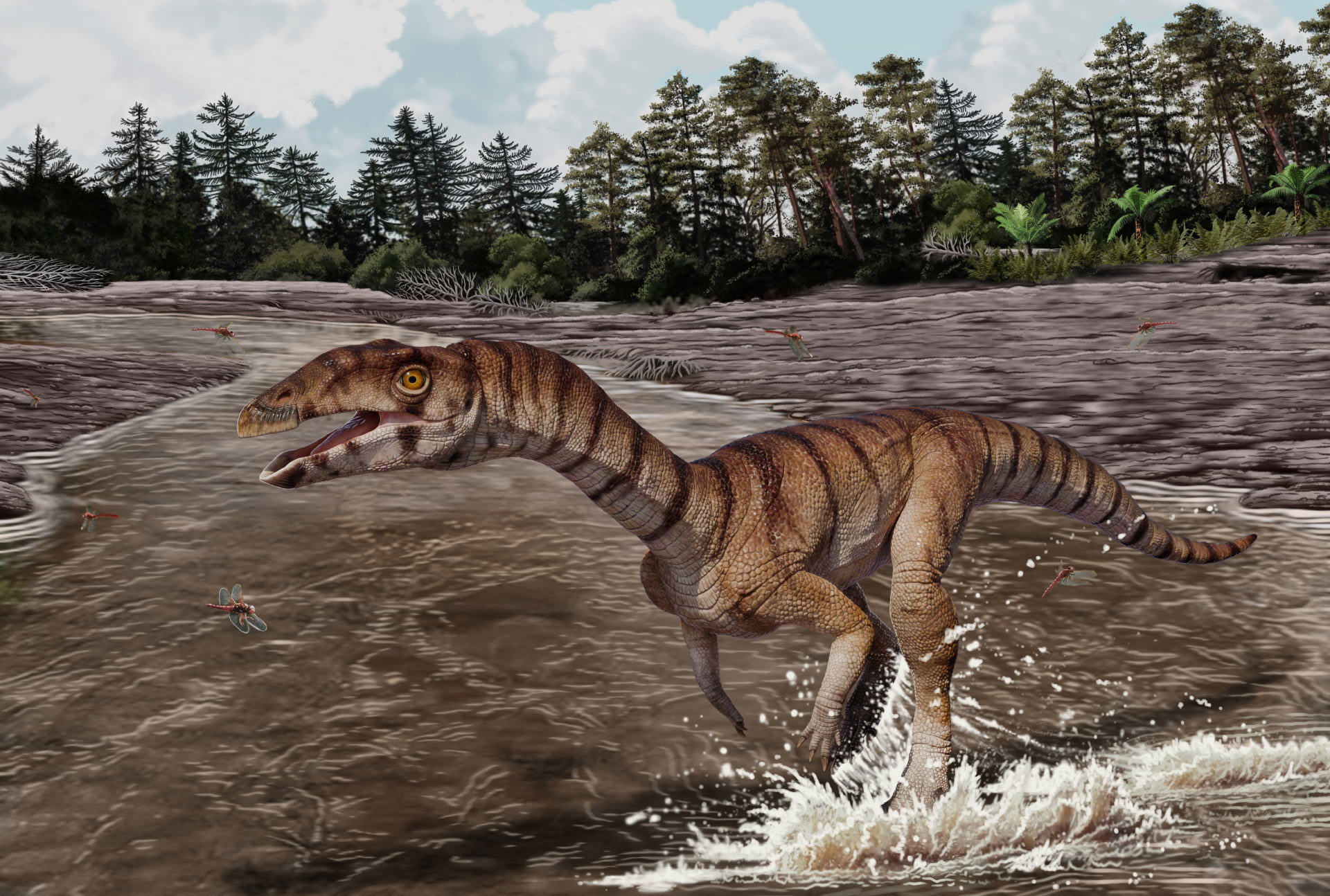
Labrujasuchus expectatus navigated the world on two legs with tiny arms and a toothless mouth tipped in a beak. Image credit: Jorge Gonzalez / NHMLAC Dinosaur Institute.
Labrujasuchus expectatus is the newest identified member of Shuvosauridae, a group of ancient crocodile relatives with body plans resembling bipedal, small-armed theropod dinosaurs.
“Shuvosauridae is an unusual clade of Triassic poposauroid pseudosuchians from western North America and Argentina,” said Dr. Alan Turner of Stony Brook University and colleagues.
“Gracile, bipedal, and edentulous, these pseudosuchian archosaurs appear generally convergent with ornithomimid theropod dinosaurs from the Cretaceous period.”
“There are currently three recognized shuvosaurid species: Shuvosaurus inexpectatus from the Cooper Canyon Formation of Texas, Effigia okeeffeae from the Coelophysis Quarry of the uppermost Chinle Formation of northern New Mexico; and Sillosuchus longicervix from the lower Ischigualasto Formation of San Juan province, western Argentina.”
Labrujasuchus expectatus fills a gap in the fossil timeline between Shuvosaurus inexpectatus and Effigia okeeffeae.
Estimated to be roughly 212 million years old, the fossil was found in the Hayden Quarry of northern New Mexico, the United States, located within the Petrified Forest Member of the Chinle Formation.
The material included an associated partial skeleton and other fossilized remains.
According to the paleontologists, Labrujasuchus expectatus differed only subtly from its relatives, reinforcing a pattern of remarkable skeletal conservatism within the group.
“The minimal anatomical differences between the diagnostic skeletons of these species indicates that this morphological similarity was maintained within Shuvosauridae for at least 10 million years in western North America,” they said.
“Labrujasuchus expectatus fits conformably with the hypothesis of morphological conservatism and within the currently known stratigraphic interval of North American shuvosaurids.”
The discovery also reinforces the idea that shuvosaurids were largely endemic to western North America, a pattern that sets them apart from many other unusual Triassic reptile groups.
“In our phylogenetic analysis, it falls in a clade with the other two North American shuvosaurids, supporting an endemic clade of small, bipedal, toothless forms in the American Southwest,” the researchers concluded.
The team’s paper was published May 26 in the Journal of Vertebrate Paleontology.
_____
Alan H. Turner et al. A new shuvosaurid (Archosauria, Poposauroidea) from the Late Triassic (Norian) Hayden Quarry of New Mexico, U.S.A. Journal of Vertebrate Paleontology, published online May 26, 2026; doi: 10.1080/02724634.2026.2618182