Astronomers using the Atacama Large Millimeter/submillimeter Array (ALMA) have detected hydrogen cyanide (nitrogen-bearing organic molecule commonly seen in comets) as well as unusually high levels of methanol (organic molecule tied to prebiotic chemistry) in the interstellar comet 3I/ATLAS.
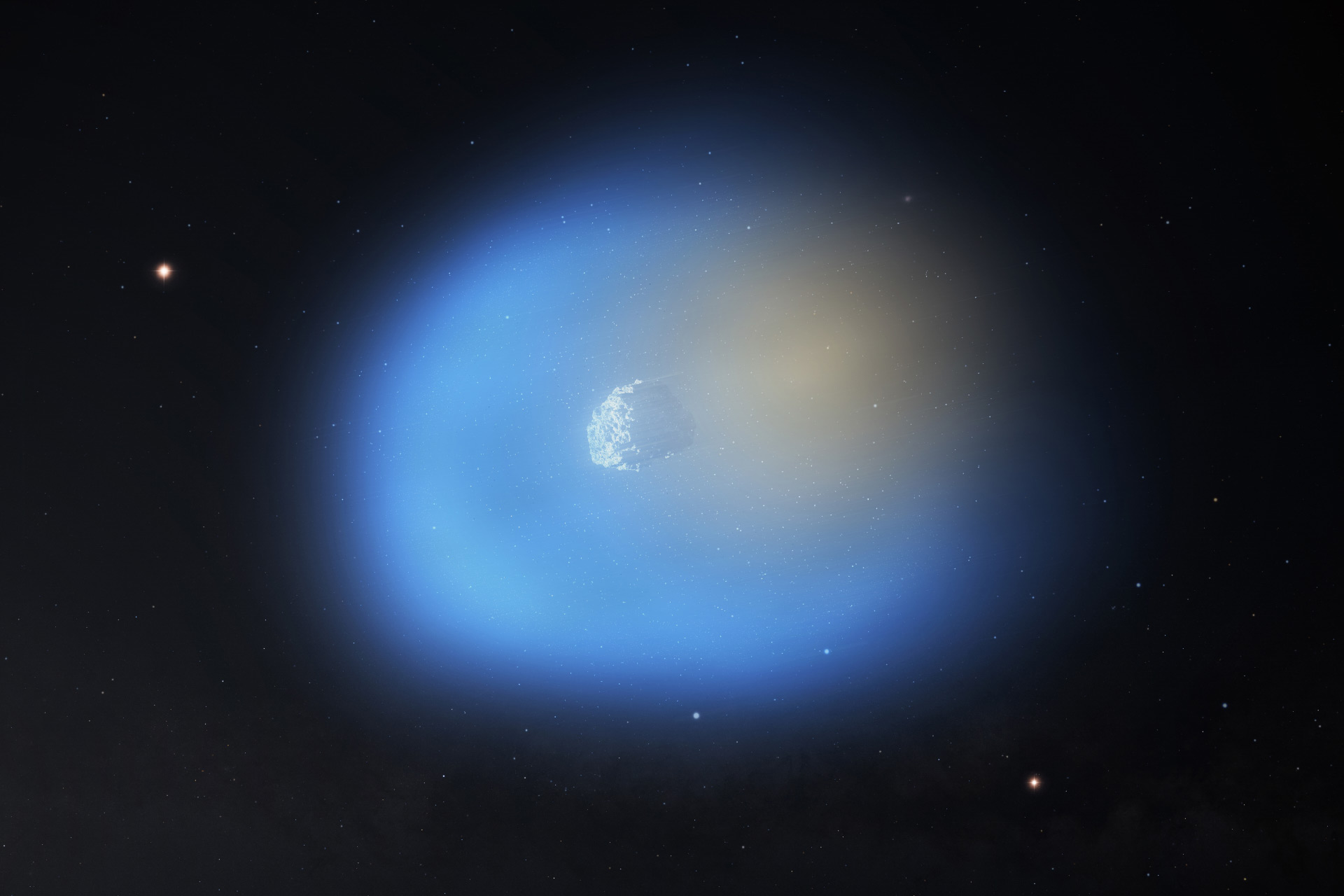
An artist’s impression of 3I/ATLAS is shown as it passes near the Sun, illuminating one side of the comet; on the side of the comet closer to the Sun, the methanol gas is shown in blue, with icy dust grains still present in the gas; on the dark side of the comet, the hydrogen cyanide is shown in orange. Image credit: NSF / AUI / NRAO / M.Weiss.
“Observing 3I/ATLAS is like taking a fingerprint from another solar system,” said American University Professor Nathan Roth.
“The details reveal what it’s made of, and it’s bursting with methanol in a way we just don’t usually see in comets in our own Solar System.”
Using ALMA’s Atacama Compact Array in Chile, Professor Roth and his colleagues observed 3I/ATLAS as it approached our Sun.
As sunlight warmed its icy surface, the interstellar visitor released gas and dust, forming a coma around its core.
By analyzing the coma, the astronomers revealed the chemical fingerprints of the material it is composed of.
They focused on the faint submillimeter fingerprints of two molecules: methanol and hydrogen cyanide.
The ALMA data reveal that 3I/ATLAS is heavily enriched in methanol compared to hydrogen cyanide, far beyond what is typically seen in comets born in our own Solar System.
On two observing dates, the researchers measured methanol‑to‑hydrogen cyanide ratios of about 70 and 120, placing the object among the most methanol‑rich solar system comets ever studied.
These measurements imply that the icy material from 3I/ATLAS was formed by — or experienced — very different conditions than those that shape most comets in our own Solar System.
ALMA’s high resolution also allowed the team to see how different molecules move away from the comet, revealing surprising differences between methanol and hydrogen cyanide.
Hydrogen cyanide appears to come, for the most part, directly from the comet’s core, or nucleus, which is typical for comets in our Solar System.
Methanol, on the other hand, appears to come from both the nucleus and from ice particles in the coma.
These tiny, icy grains act like mini-comets: as the object moves closer to the Sun, where ice turns into gas, they also release methanol.
Similar behavior has been observed in some solar system comets, but this is the first time the physics of such detailed outgassing has been traced in an interstellar object.
“The derived methanol‑to‑hydrogen cyanide ratios in 3I/ATLAS are among the most enriched values measured in any comet, surpassed only by anomalous solar system comet C/2016 R2 (Pan-STARRS),” the authors said.
The findings appear in the Astrophysical Journal.
_____
Nathan X. Roth et al. 2026. CH3OH and HCN in Interstellar Comet 3I/ATLAS Mapped with the ALMA Atacama Compact Array: Distinct Outgassing Behaviors and a Remarkably High CH3OH/HCN Production Rate Ratio. ApJL 999, L32; doi: 10.3847/2041-8213/ae433b