A new ‘agnostic biosignature’ method searches for patterns across exoplanets, suggesting alien life could be detected by how it spreads and reshapes entire planetary systems.
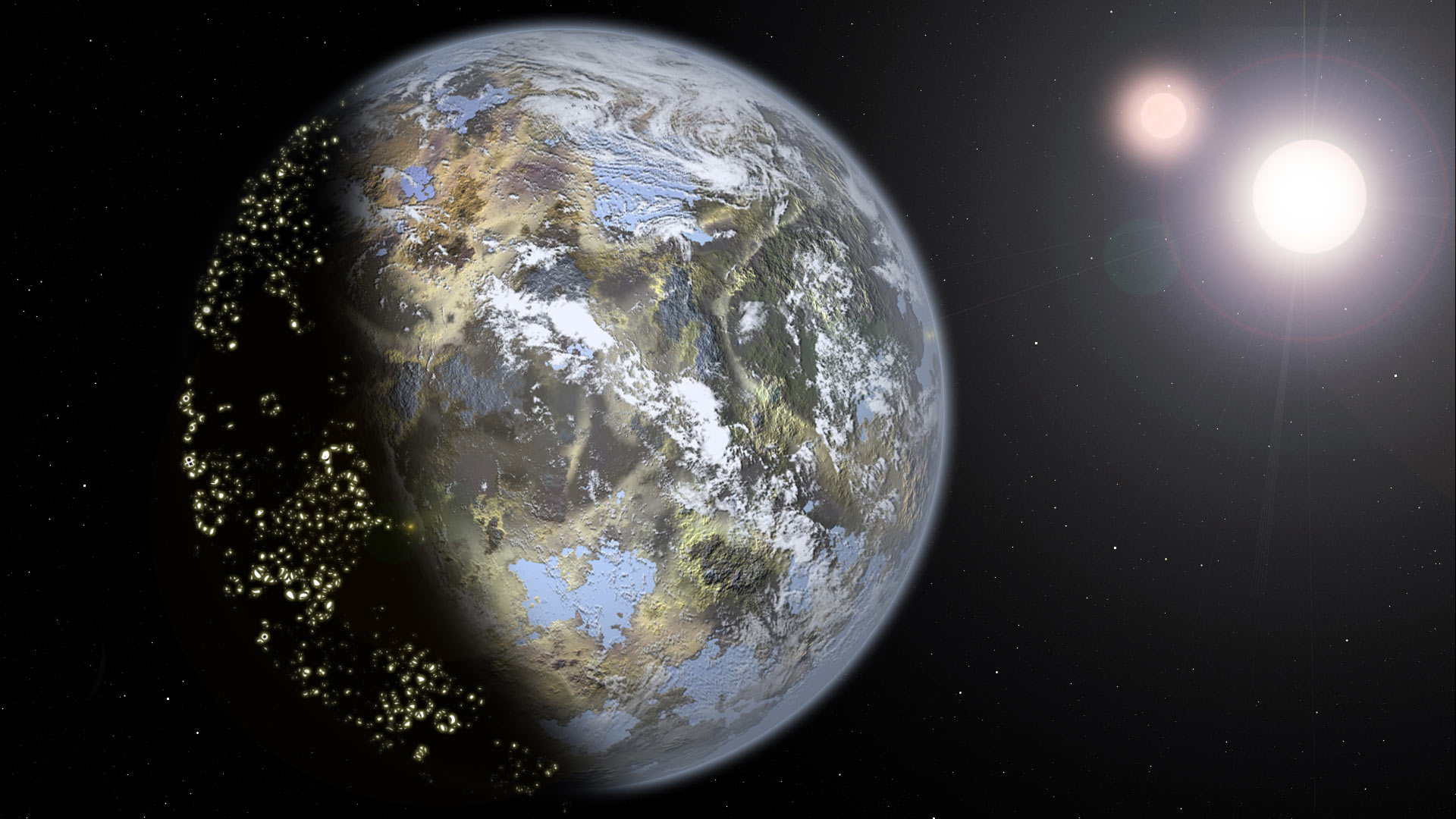
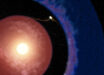
Harrison B. Smith & Lana Sinapayen used an agent-based model to show that if life can spread between star systems and affect the observable properties of a planet, then a robust signature of life (with very few false positives) can emerge, defined by correlations between planet characteristics and their locations. Image credit: Sci.News.
The search for a second instance of life is one of the greatest problems of modern science.
Outside of creating an artificial origin of life on Earth, the primary targets for the search for life are planets inside or outside our Solar System.
Realistically, there are just a few locations to search for alien life within our home planetary system.
Outside the Solar System, opportunities are nearly unlimited, but there’s a catch: it is difficult to attribute, with certainty, features of exoplanets to extraterrestrial life.
Simple spectral biosignatures are susceptible to false positives; technosignatures reduce this susceptibility at the expense of strong assumptions about potential underlying life and its technologies.
“We considered a fundamentally different idea: instead of searching for life on individual planets, what if life could be detected through its collective effects across many planets?” said Dr. Harrison Smith from the Institute of Science Tokyo and Dr. Lana Sinapayen from the National Institute for Basic Biology.
In their new paper published in the Astrophysical Journal, the authors present an ‘agnostic biosignature’ — a new method that does not rely on knowing in detail what life consists of or how it functions.
Instead, it is based on two broad assumptions: that life can spread between planets (for example, through panspermia), and that it can modify planetary environments over time.
Using an agent-based simulation, the researchers modeled how life might spread across star systems and alter planetary characteristics.
They discovered that if life extends and impacts planetary environments, it produces detectable statistical correlations between planet locations and their observable traits.
Crucially, these correlations appear even without pinpointing a particular biosignature on any individual planet.
Beyond detecting the presence of life, the scientists also developed a method to identify which planets are most likely to host it.
By clustering planets based on their observable characteristics and spatial relationships, they were able to isolate groups of planets with a high probability of having been influenced by life.
This approach prioritises reliability over completeness: it minimises false positives, even if it misses some life-bearing planets.
Such a strategy is especially useful for guiding follow-up observations with limited telescope time.
“By focusing on how life spreads and interacts with environments, we can search for it without needing a perfect definition or a single definitive signal,” Dr. Smith said.
“Even if life elsewhere is fundamentally different from life on Earth, its large-scale effects, such as spreading and modifying planets, may still leave detectable traces. That’s what makes this approach compelling,” Dr. Sinapayen added.
_____
Harrison B. Smith & Lana Sinapayen. 2026. An Agnostic Biosignature Based on Modeling Panspermia and Terraforming. ApJ 1001, 102; doi: 10.3847/1538-4357/ae4ee3