Echidna fossils in Australia are rare and unevenly distributed across time and geography. In a new paper published in The Alcheringa, an Australasian Journal of Palaeontology, paleontologists described a partial skull of the Owen’s giant echidna (Megalibgwilia owenii) from southeastern Australia. Recovered around 120 years ago from Foul Air Cave in the Buchan Caves Reserve in East Gippsland, the specimen represents the first confirmed evidence of the extinct species in the state of Victoria, where it had previously been notably absent from the fossil record.
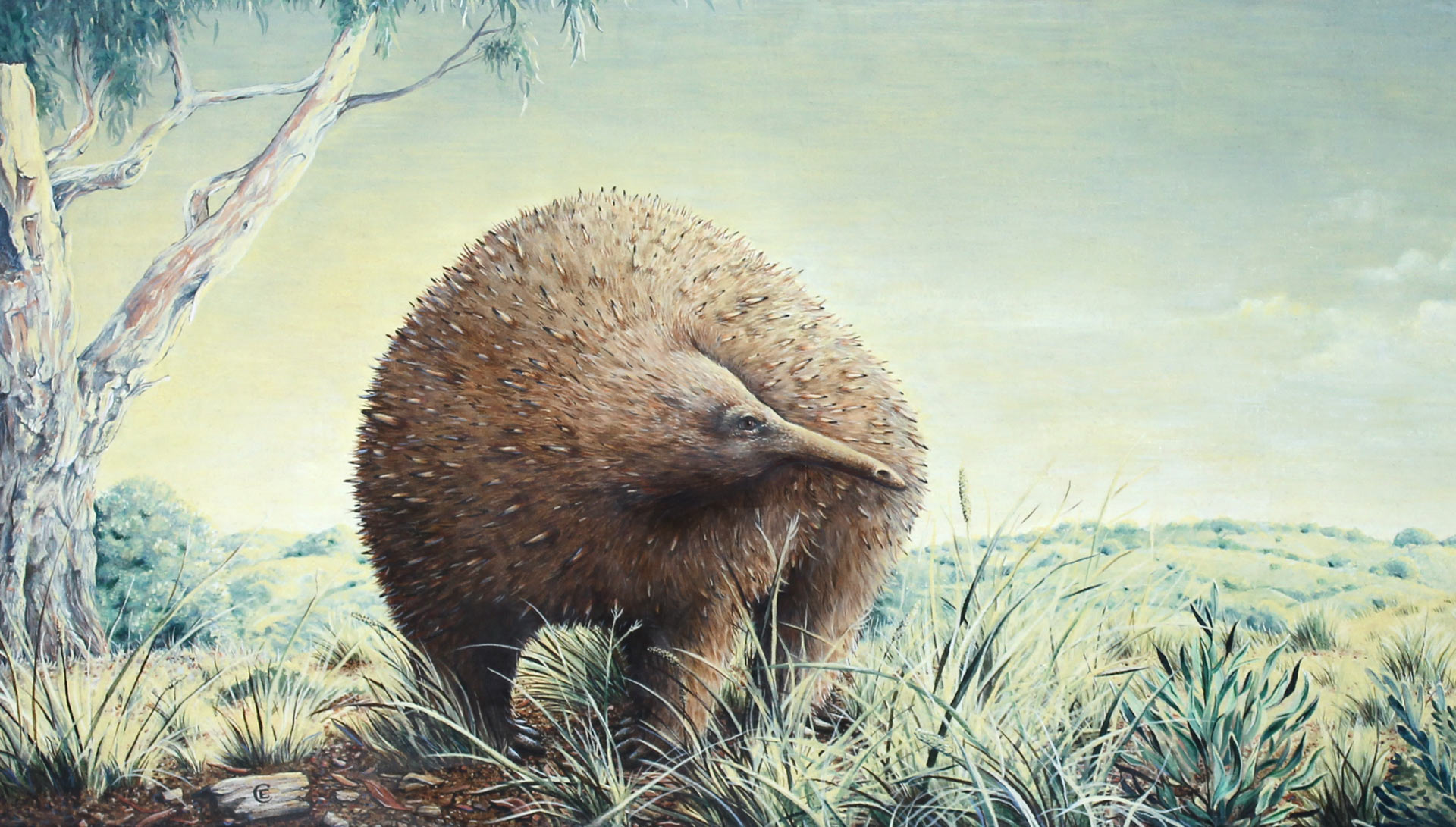
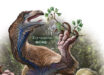
Life reconstruction of the Owen’s giant echidna (Megalibgwilia owenii). Image credit: Chris Edser.
First described in detail in the 1990s, Megalibgwilia owenii grew up to 1 m long and weighed in at 15 kg.
The absence of this species in Victoria had stood in contrast to its known presence across the continent from Western Australia into Tasmania and southern New South Wales.
The newly-described specimen helps resolve that discrepancy, suggesting the species’ range was more continuous than previously documented.
The fossil is a fragmentary skull that was found not during fieldwork, but in Museums Victoria’s Palaeontology Collection.
Dr. Tim Ziegler, collection manager of vertebrate paleontology at Museums Victoria Research Institute, first sighted the specimen in 2021 and used historical archives to show it had been retrieved in a 1907 expedition to Foul Air Cave by museum officer and naturalist Frank Spry.
“Museum collections preserve the link between science, heritage and people,” Dr. Ziegler said.
“Over a century ago, Spry along with scientists and locals investigated Buchan’s caves with little more than ropes and kerosene lamps, and they inspired us to carry on their work.”
According to Dr. Ziegler and Deakin University student Jeremy Lockett, the find underscores the importance of revisiting historical collections, which can yield new insights even decades after specimens are first recovered.
Further surveys of museum collections and fossil sites will be needed to better understand the diversity and distribution of ancient echidnas during the Quaternary period.
“Previous research by Museums Victoria has shown the Buchan Caves preserve an exceptional record of Australia’s unique megafauna, including the short-faced kangaroo Simosthenurus occidentalis and the giant marsupial Palorchestes azael,” Dr. Ziegler said.
“The next amazing discovery could come from inside the museum, from continued fieldwork, or the keen eyes of a citizen scientist. I can’t wait to find out.”
_____
Tim Ziegler & Jeremy Lockett. The first Victorian record of Owen’s Giant Echidna Megalibgwilia owenii from Buchan Caves in East Gippsland, Australia. The Alcheringa, published online April 13, 2026; doi: 10.1080/03115518.2026.2643598