By studying almost 900 parrots living with humans, a team of researchers from the University of Northern Colorado, the University of Vienna, the Acoustics Research Institute at the Austrian Academy of Sciences, and the University of Pittsburgh at Johnstown found evidence that some birds don’t just mimic speech, they may assign and use names to identify specific individuals.
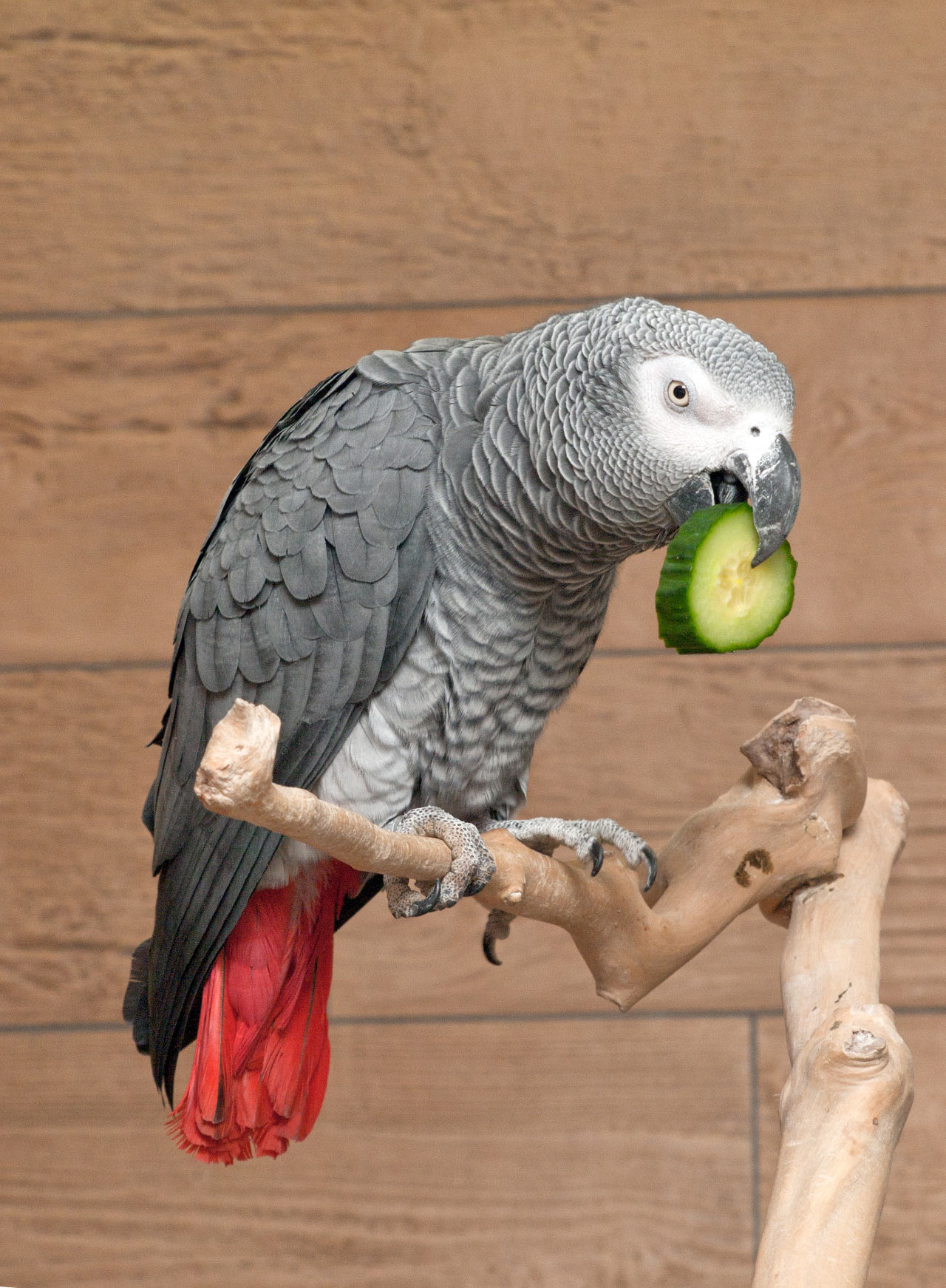
The African gray parrot (Psittacus erithacus) named John eating cucumber. Image credit: Papooga.
Scientists and the public alike have long wondered whether animals can use proper names for themselves and one another.
Compelling evidence shows that many animals can recognize and respond to names given by humans, while others can invent and use individual vocal signatures.
However, no previous study has provided evidence that a diverse group of animal subjects can produce and appropriately use names recognized as such under human linguistic conventions.
“Although many animals respond to human language, only a small number of species can learn to produce language-like sounds or use those sounds appropriately,” said University of Northern Colorado’s Professor Lauryn Benedict and colleagues.
“In particular, parrots are excellent at learning vocalizations, including human words, and can correctly apply words as labels.”
“This capacity for vocal production learning allows researchers to examine whether and how animals use vocal labels, rather than just respond to them, which provides a richer picture of the cognitive aspects of word use and labeling.”
In the current study, the authors analyzed data on over 889 captive parrots from the ManyParrots project, a network of researchers who study parrot vocal learning and cognition by collecting survey data and audio recordings.
For a subset of those birds, the survey respondents provided additional context that allowed the team to better understand how the birds were using names.
Nearly half of the survey takers included examples of parrots using names.
Of those 413 clips, 88 seemed to be birds using names as labels for people and animals.
The researchers also found strong evidence that some birds applied names not only to a particular category, such as people, but to a single individual.
On the other hand, many of the birds also used these labels in ways that people typically wouldn’t.
For instance, parrots sometimes said their own name just so they could get some attention.
The research suggests that parrots do have the cognitive and vocal skills to use names in different ways, from communicating with people to even talking about someone who isn’t there.
The variation across species and even across individuals of the same species, however, leaves room for plenty of questions about how, when and why animals do or don’t use these skills to call out another creature by name.
“Our results indicate that parrots often learned names from their humans and used them in a variety of contexts, some of which are consistent with the ability to cognitively associate a name with an individual,” the scientists said.
“All birds in our data set used human-derived names, leaving open questions about whether and how they might create names themselves.”
“The results clearly demonstrate, however, that animals can learn and use proper names in appropriate social situations.”
“Further work should be done in controlled settings to better understand the cognitive underpinnings of this behavior in parrots and beyond.”
“We expect that the ability to label individuals is present in wild animals as well as captive ones.”
“We hope that future work will find accurate ways to identify animal naming via methods that do not depend on human language.”
The study appears online this month in the journal PLoS ONE.
_____
L. Benedict et al. 2026. Name use by companion parrots. PLoS One 21 (4): e0346830; doi: 10.1371/journal.pone.0346830