Astronomers using the Dark Energy Spectroscopic Instrument (DESI) on NSF’s Nicholas U. Mayall 4-m telescope have produced the largest high-resolution 3D map of the Universe, tracing the positions of more than 47 million galaxies and quasars.
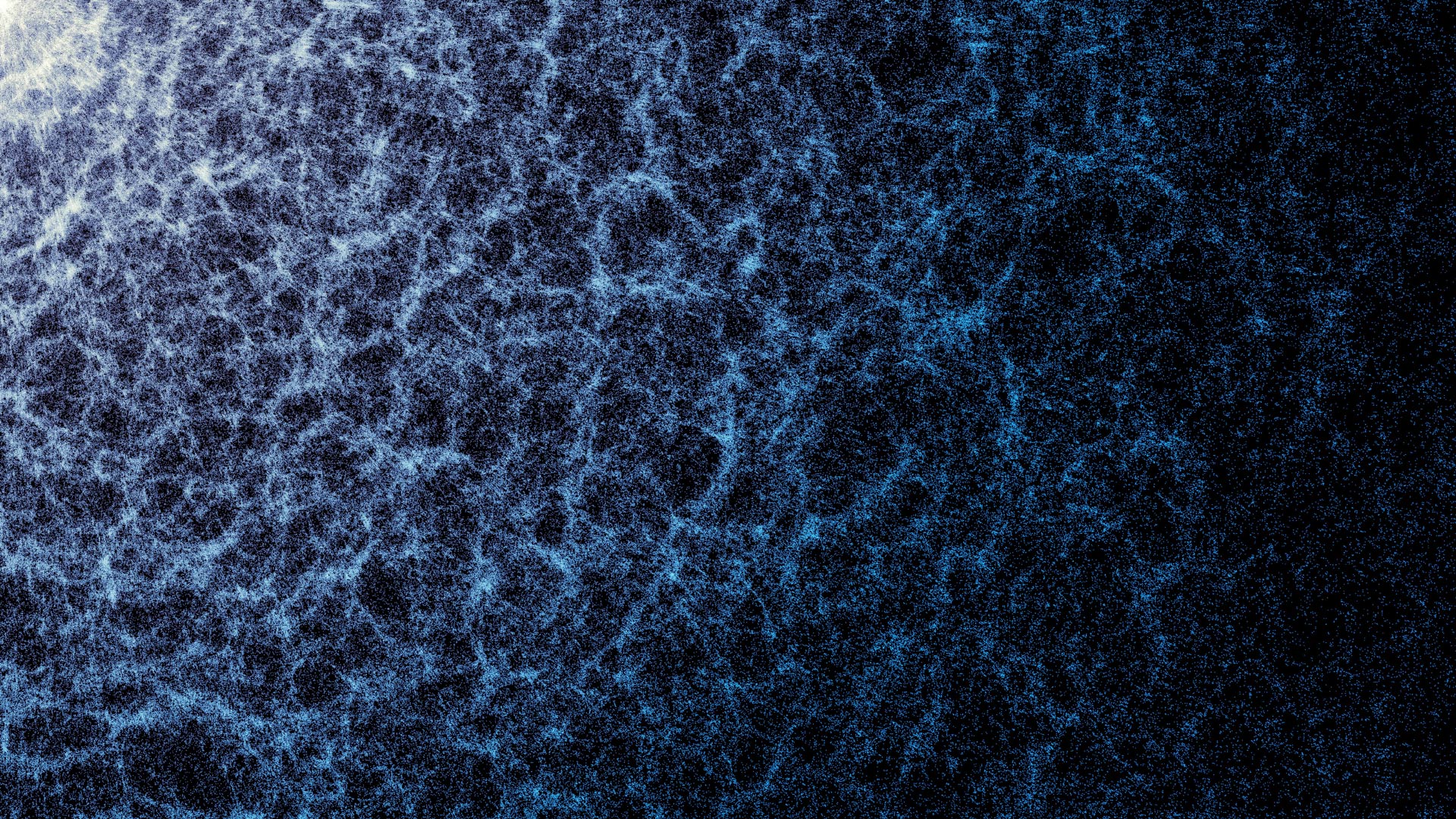
A small portion of DESI’s year-five map in which the large-scale structure of the Universe, created by gravity, is visible; each dot represents a galaxy; the denser areas indicate regions where galaxies and galaxy clusters have clumped together to form the strands of the cosmic web; also seen are large voids between the filaments. Image credit: DESI Collaboration / DESI Member Institutions / DOE / KPNO / NOIRLab / NSF / AURA / R. Proctor / M. Zamani, NSF’s NOIRLab.
Managed by Berkeley Lab amd operated with funding from the DOE Office of Science, DESI’s quest to understand dark energy is a global endeavor.
By comparing how galaxies clustered in the past with their distribution today, astronomers can trace dark energy’s influence over 11 billion years of cosmic history.
DESI began collecting data in May 2021. Since then, the instrument has far surpassed the collaboration’s original goals.
The plan was to capture light from 34 million galaxies and over the five-year sky survey. DESI instead observed more than 47 million galaxies and quasars, as well as 20 million stars.
DESI has now measured cosmological data for six times as many galaxies and quasars as all previous measurements combined.
The collaboration will immediately begin processing the completed dataset, with the first dark energy results from the full five-year survey expected in 2027.
In the meantime, the DESI team continues to analyze the survey’s first three years of data, refining dark energy measurements and producing additional results on the structure and evolution of the Universe, with several papers planned later this year.
“It’s impossible to capture everything that went into making DESI such a successful experiment,” said Dr. Stephanie Juneau, NSF’s NOIRLab representative for DESI.
“From instrument builders and software engineers to technicians, observatory staff, and scientists — including many early-career researchers — it truly took a village.”
“Ultimately, we are doing this for all humanity, to better understand our Universe and its eventual fate.”
“After finding hints that dark energy might deviate from a constant, potentially altering that fate, this moment feels like sitting on the edge of my seat as we analyze the new map to see whether those hints will be confirmed.”
“I’m also very intrigued by the many other discoveries that await in this new dataset.”
“DESI has truly exceeded all expectations, delivering an unprecedented 3D map of the Universe that will revolutionize our understanding of dark energy,” said Dr. Kathy Turner, program manager for the cosmic frontier in the Office of High Energy Physics at the Department of Energy.
“From its inception, we envisioned a project that would push the boundaries of cosmology, and to see it come to such a spectacularly successful completion for its initial survey, ahead of schedule and with such rich data, is incredibly rewarding.”
“The dedication and ingenuity of the entire DESI collaboration have made this world-leading science a reality, and I am immensely proud of the groundbreaking results we are already seeing and the discoveries yet to come as we continue to explore the mysteries of our cosmos.”
“DESI’s five-year survey has been spectacularly successful,” said Dr. Michael Levi, DESI director and a scientist at Berkeley Lab.
“The instrument performed better than anticipated. The results have been incredibly exciting. And the size and scope of the map, and how quickly we’ve been able to execute, is phenomenal.”
“We’re going to celebrate completion of the original survey and then get started on the work of churning through the data, because we’re all curious about what new surprises are waiting for us.”