Paleontologists in Brazil have identified a new genus and species of hyperodapedontine rhynchosaur — an extinct lineage of beaked, herbivorous reptiles — based on a partial skull and lower jaws recovered from Triassic rocks. Named Isodapedon varzealis, the species appears to represent a distinct branch within a group that was once thought to be less diverse.
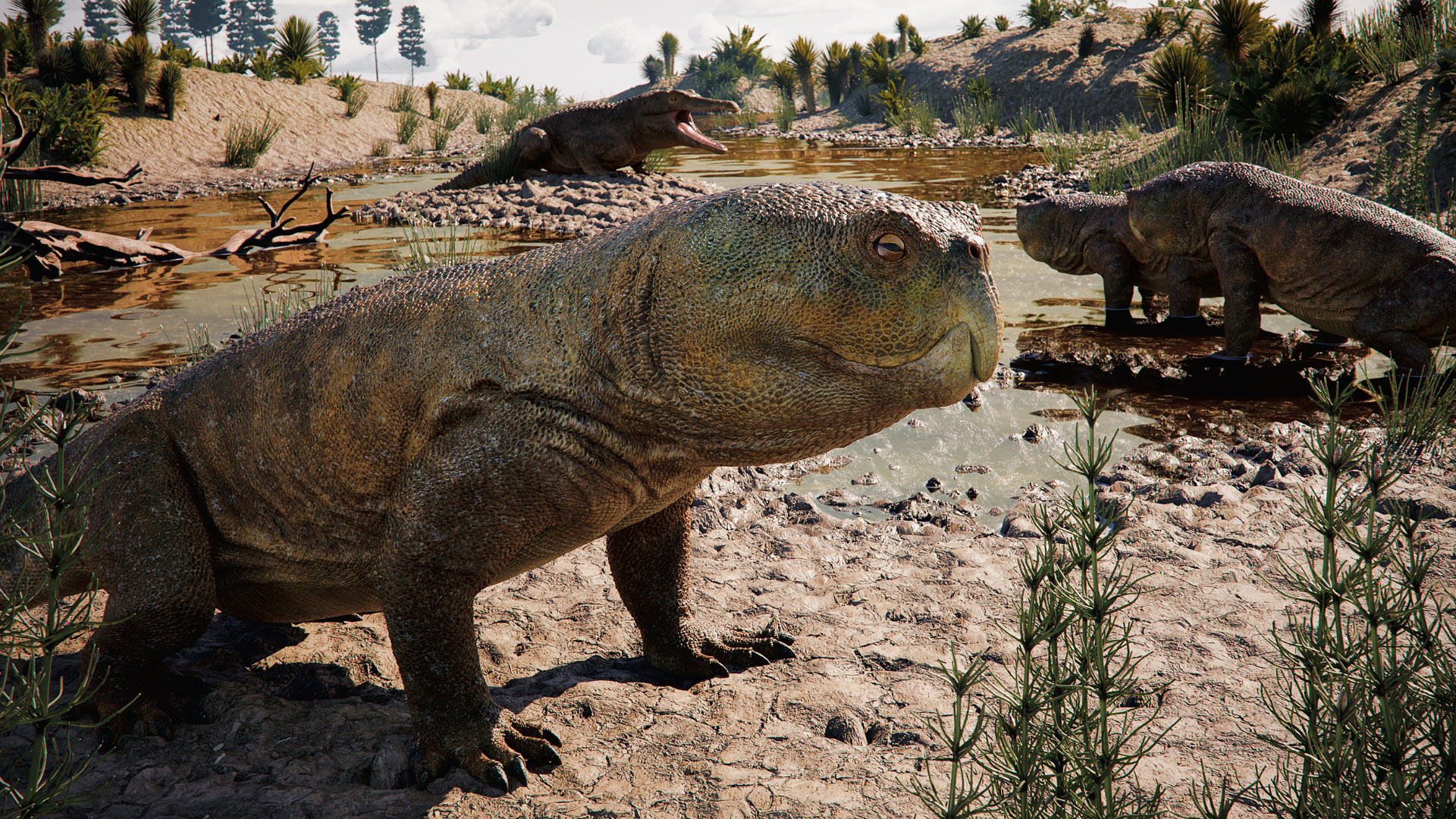
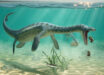
An artistic representation of a Late Triassic landscape of southern Brazil depicting individuals of Isodapedon varzealis in the foreground and a proterochampsid in the background. Image credit: Caio Fantini.
Rhynchosaurs were among the most abundant plant-eaters of their time, spreading across much of the supercontinent Pangea and in some places making up the vast majority of fossilized vertebrates.
Their specialized feeding apparatus — including a toothless beak and rows of grinding teeth — allowed them to process tough vegetation and dominate terrestrial ecosystems.
“Rhynchosauria, an early diverging clade within Archosauromorpha, is represented by several species distributed mainly during the Middle and Late Triassic, though their origin dates back to the Early Triassic,” said Universidade Federal de Santa Maria paleontologist Jeung Hee Schiefelbein and colleagues.
“Rhynchosaurs spanned nearly the entirety of Pangea, and their fossil record extends across several present-day regions, including Brazil, Argentina, Canada, the United States, Zimbabwe, Tanzania, South Africa, Madagascar, India, England and Scotland.”
“By the Late Triassic, rhynchosaurs achieved a nearly global distribution, playing a significant role as primary consumers in terrestrial ecosystems.”
“Owing to their abundance, especially in Late Triassic units, rhynchosaurs are also vital biostratigraphic markers, with rhynchosaurs making up to 90% of the vertebrate fossils in some outcrops.”
The holotype specimen of Isodapedon varzealis was unearthed at the Várzea do Agudo site in the Brazilian state of Rio Grande do Sul.
The fossil dates back around 230 million years to the Carnian age of the Triassic period.
The upper jaw of Isodapedon varzealis features symmetrical tooth-bearing areas — an unusual trait among its relatives — along with a unique configuration of the lower jaw that suggests it fed differently from other known rhynchosaurs.
A phylogenetic analysis indicates that the species lies outside previously recognized South American members of its subgroup, known as hyperodapedontines.
The findings challenge the traditional classification of these reptiles and supports a narrower definition of the well-known genus Hyperodapedon, limiting it to its original type species.
The results also point to a broader and more complex evolutionary radiation of rhynchosaurs than previously appreciated.
Closely related forms appear to have spread widely across southwestern Gondwana — the southern portion of Pangea — while maintaining relatively conservative body plans.
“Isodapedon varzealis’ unique combination of craniomandibular characters, including symmetrical maxillary tooth-bearing areas and autapomorphic dentary features, distinguishes it from contemporaneous species such as Macrocephalosaurus mariensis and Hyperodapedon sp.,” the researchers said.
“These differences probably reflect divergent ecological strategies within a diverse herbivorous guild, which could indicate niche partitioning during a time of dynamic environmental and floral changes associated with the Carnian Pluvial Episode.”
“Moreover, its affinities with early diverging hyperodapedontines from Argentina and possibly Zimbabwe point to a broad, morphologically conservative radiation across southwestern Gondwana, highlighting ecological stability before the emergence of more derived and geographically restricted lineages.”
A paper describing the discovery was published April 15 in the journal Royal Society Open Science.
_____
Jeung Hee Schiefelbein et al. 2026. A new hyperodapedontine rhynchosaur from a cynodont-dominated site (Upper Triassic) of southern Brazil. R Soc Open Sci 13 (4): 260176; doi: 10.1098/rsos.260176