When most people picture a giant rodent, they think of the capybara (Hydrochoerus hydrochaeris), or of the enormous extinct rodents that roamed South America within the last 10 million years. New finds from southern Thailand suggest that rodents were getting big much earlier, and on the other side of the world.
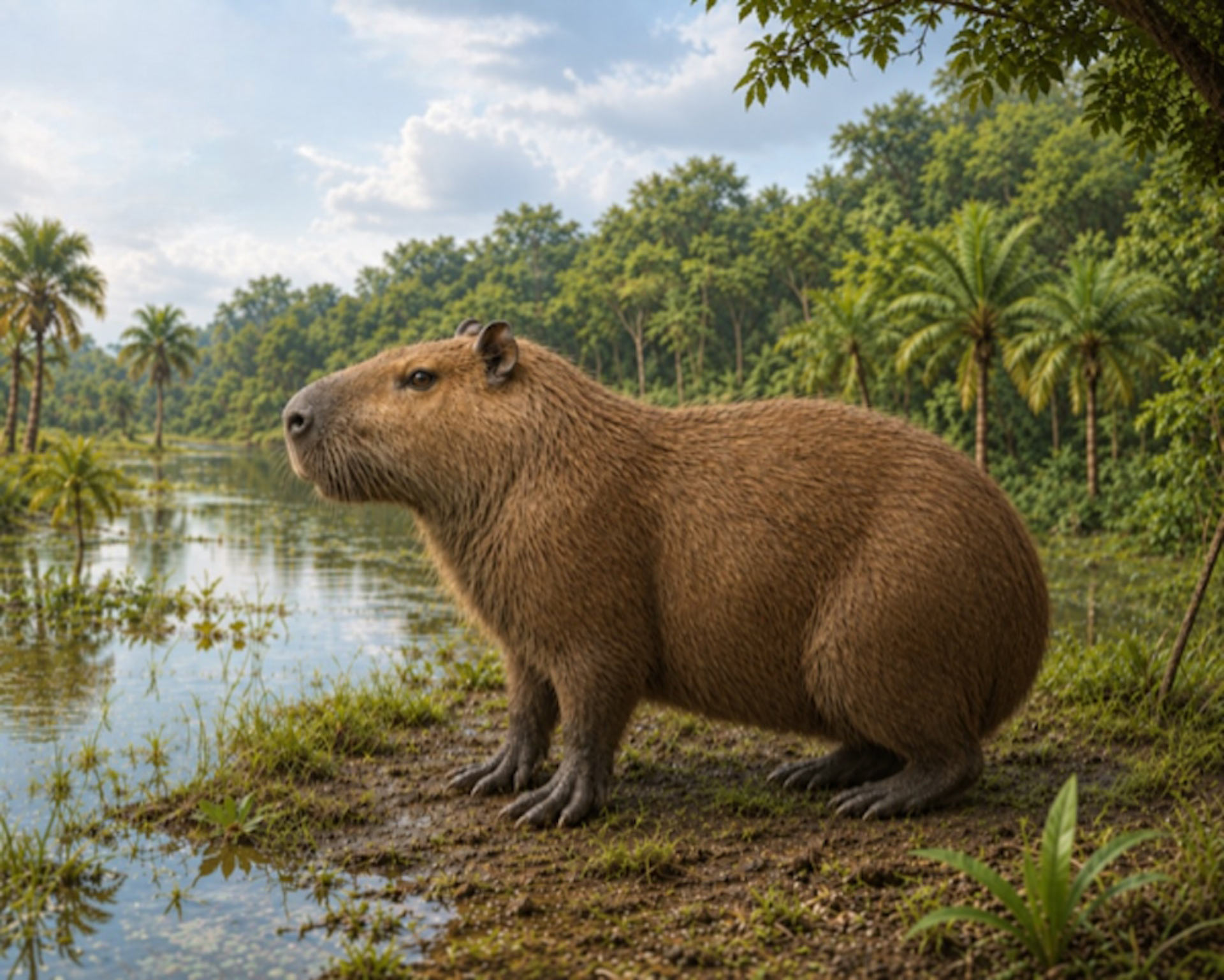
Hypothetical reconstruction of Yakamys sirindhornae. Image credit: Yaowalak Chaimanee.
“Today, the largest living rodent is the capybara, but very large rodents are not restricted to recent ecosystems,” said McGill University’s Professor Virginie Millien, co-author of a paper published in the journal Scientific Reports.
“Giant rodents evolved repeatedly during the later history of the group, mostly in South America.
“Our discovery suggests that Southeast Asia also played an important role in the early evolutionary history of large-bodied rodents.”
In the paper, Professor Millien and colleagues described a new rodent species from the Late Eocene, between about 35 and 34 million years ago.
Named Yakamys sirindhornae, the animal is known from just two fossils: a single lower molar and a fragment of a lower incisor.
Both were found in a clay layer within a coal seam at the Krabi lignite mine in Thailand’s Krabi province.
The molar measures about 11.6 mm long and 11.3 mm wide; the largest previously known Asian relatives had molars less than half that size.
The paleontologists estimated that Yakamys sirindhornae weighed roughly 30 kg — about the size of a large dog.
“This is only a ballpark figure, as there is substantial uncertainty associated with fossil body-mass estimation,” Professor Millien said.
The researchers placed the new species in the Ischyromyidae, an early rodent family, based on its tooth shape and on the microscopic structure of its incisor enamel.
Despite the incisor’s size, its enamel is remarkably thin, about 235 micrometers.
Before this discovery, one of the few documented examples of a very large early rodent was Manitsha tanka, an ischyromyid from the Oligocene of South Dakota.
The researchers estimate that the two animals had similarly large body masses, yet their molars differ markedly in shape and size, which suggests that large ischyromyids did not share a single tooth design.
The find suggests that big body size evolved in rodents well before the giants of South America, such as Josephoartigasia monesi, which lived in the Plio-Pleistocene and was estimated at about 350 kg in later studies.
“Because the fossil material is limited, it is difficult to determine exactly how Yakamys sirindhornae evolved,” Professor Millien said.
“Further discoveries will be important for understanding the animal’s biology, ecology and evolutionary history.”
_____
Y. Chaimanee et al. 2026. A giant Eocene ischyromyid from Southeast Asia reveals the early evolution of rodent gigantism. Sci Rep 16, 34523; doi: 10.1038/s41598-026-76711-6