Water is made of two hydrogen atoms and one oxygen atom, hence its H2O formula. In typical water molecules, though, those hydrogen atoms have just one proton at their core. In cometary water, a high ratio of its water molecules contain deuterium (D), a form of hydrogen with the standard issue proton plus a neutron. With more than 30 times deuterated water or semi-heavy water (HDO) seen in solar system comets, 3I/ATLAS preserves evidence of radically different conditions in its birthplace billions of years ago.
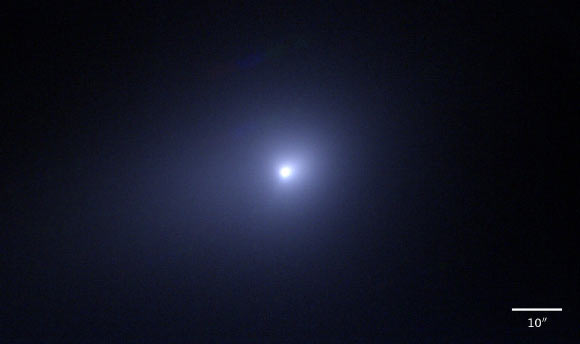
This image from the Subaru Telescope shows the interstellar comet 3I/ATLAS. Image credit: NAOJ.
Among the vast diversity of chemical compounds, water stands out as an essential molecule for life and astrophysical processes.
From an astrobiology perspective, water is a key solvent for the emergence of life on Earth and is traced throughout the Universe as a potential signpost of extrasolar habitable environments.
In the context of star and planet formation, water in the gas phase acts as an efficient coolant, allowing molecular clouds to collapse into forming stars.
In frozen form, water coats dust grains, allowing them to stick together more efficiently and enabling the rapid growth of planetary cores.
Water has been detected in both the gas and ice phases throughout our Galaxy and in high-redshift galaxies.
These detections span molecular clouds, protostar systems, prestellar cores, protoplanetary disks and solar system bodies, including comets, meteorites, active asteroids, planets and satellites.
Current studies aim to connect the path of water across these diverse environments to understand its origin and evolution in forming planetary systems.
The deuterium-to-hydrogen (D/H) ratio in water provides a powerful chemical tracer of where water formed, the physical conditions under which it originated and how it was subsequently processed.
“Our new observations with the Atacama Large Millimeter/submillimeter Array (ALMA) show that the conditions that led to the formation of our Solar System are much different from how planetary systems evolved in different parts of our Galaxy,” said Luis E. Salazar Manzano, a Ph.D. student at the University of Michigan.
“Most instruments can’t point toward the Sun, but radio telescopes like ALMA can,” added Dr. Teresa Paneque-Carreño, also from the University of Michigan.
“We were able to observe the comet within days after perihelion, just as it peeked out from its transit behind the Sun.”
“This gave us a constraint on these molecules that’s not possible using other instruments.”
The ALMA observations of 3I/ATLAS’s water D/H ratio revealed them to be more than 30 times that which is found in comets that formed within our own Solar System, and over 40 times the ratio found in Earth’s oceans.
“We now know that the cloud of gas that formed the star and other planets in the system where 3I/ATLAS came from was likely very cold and had very different conditions than the environment that created our Solar System and local comets,” Salazar Manzano said.
Furthermore, this discovery offers a uniquely fundamental insight that is unmatched by the discoveries of other, more complex molecules in interstellar comets because the abundances of deuterium and hydrogen were set in the Big Bang itself.
“The chemical processes that lead to the enhancement of deuterated water are really sensitive to temperature and usually require environments colder than about 30 K (minus 243 degrees Celsius, or minus 406 degrees Fahrenheit),” Salazar Manzano said.
The comet’s water deuterium-to-hydrogen ratio was enhanced with respect to Big Bang values by 3I/ATLAS’s home system as it formed and preserved through its interstellar journey.
The interstellar comet must have formed in a system far colder than our own Solar System’s history, and under very specific radiation conditions, before it was ejected into interstellar space.
“Each interstellar comet brings a little bit of its history, its fossils, from elsewhere,” Dr. Paneque-Carreño said.
“We don’t know exactly where, but with instruments like ALMA we can begin to understand the conditions of that place and compare them to our own.”
The team’s results were published April 23 in the journal Nature Astronomy.
_____
L.E. Salazar Manzano et al. Water D/H in 3I/ATLAS as a probe of formation conditions in another planetary system. Nat Astron, published online April 23, 2026; doi: 10.1038/s41550-026-02850-5