The Dark Energy Camera, a powerful 570-megapixel camera mounted on NSF’s Víctor M. Blanco 4-m telescope at Cerro Tololo Inter-American Observatory in Chile, a Program of NSF’s NOIRLab, has captured the iconic Sombrero Galaxy in unprecedented detail, exposing faint stellar streams and a glowing halo that hints at a turbulent past shaped by galactic mergers.
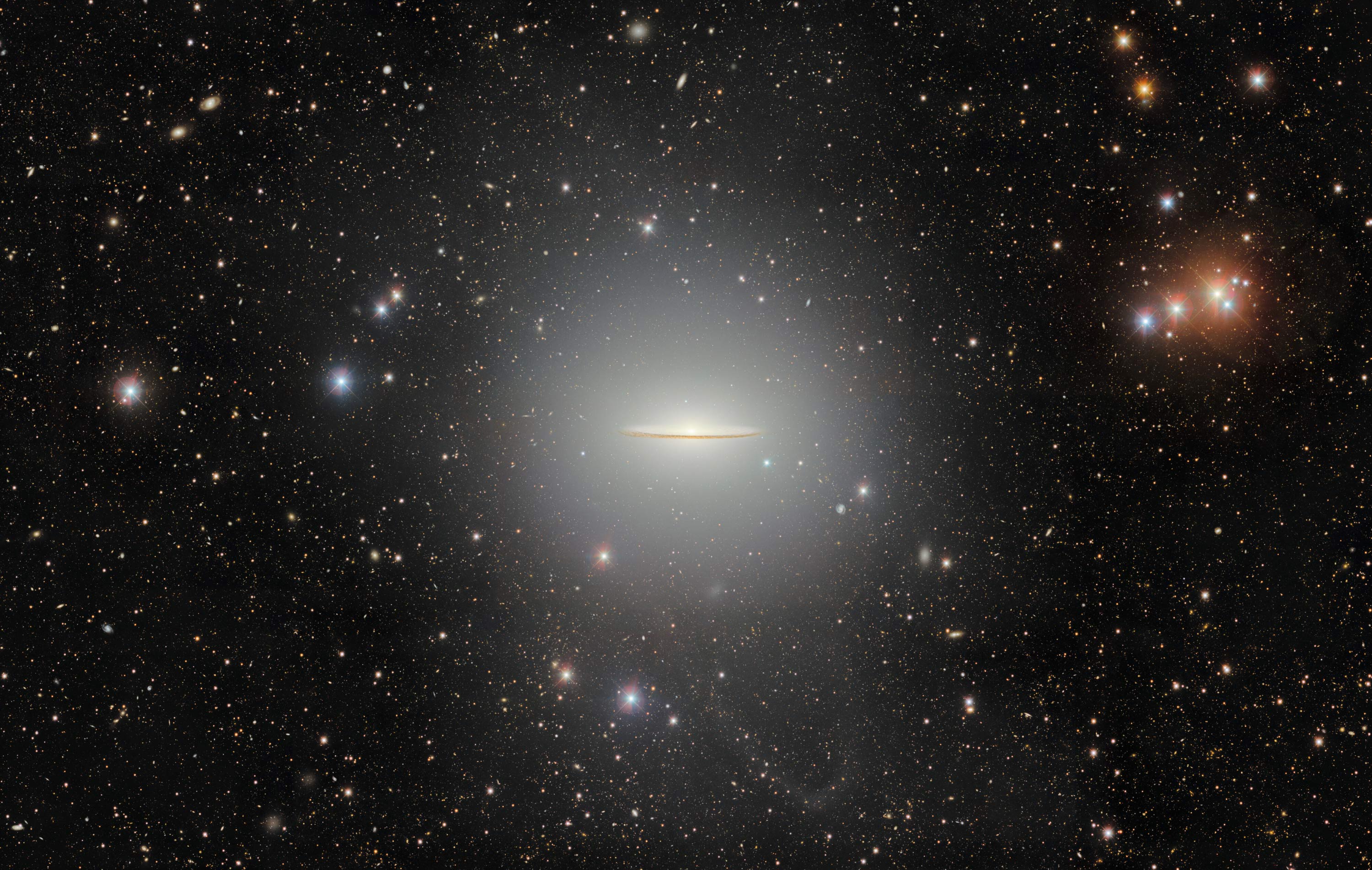
This DECam image shows the Sombrero Galaxy, a popular target for amateur observing and astronomical research. Image credit: CTIO / NOIRLab / DOE / NSF / AURA / T.A. Rector, University of Alaska Anchorage & NSF’s NOIRLab / D. de Martin & M. Zamani, NSF’s NOIRLab.
The Sombrero Galaxy lies about 28 million light-years from Earth in the constellation of Virgo.
Also cataloged as Messier 104, M104 or NGC 4594, this galaxy was first identified by the French astronomer Pierre Méchain on May 11, 1781.
Spanning roughly 49,000 light-years (about half the diameter of the Milky Way Galaxy), the Sombrero stands out for its unusual structure.
It blends features of the Universe’s two dominant galaxy types, the spirals and the ellipticals, combining a prominent disk and spiral arms with an unusually large, bright central bulge, giving it a hybrid appearance.
We see the Sombrero edge-on, at an angle of 6 degrees south of its plane. Its dark dust lane dominates the view.
“The Sombrero Galaxy is a galactic masterpiece that captivates scientists and astronomy enthusiasts alike,” said NOIRLab astronomers in a statement.
“Its intricate system of globular star clusters lends insight into stellar populations, and astronomers are intrigued by the supermassive black hole at its center.”
“Its distinctive visual features and relative brightness make it a favorite among amateur astronomers.”
“The fascinating story of its discovery, involving three esteemed astronomers, has earned it a spot on one of the most important lists of deep sky objects.”
“Today, it stands as one of the most iconic galaxies in the night sky.”
The new image of the Sombrero Galaxy was captured with the 570-megapixel DECam instrument.
“The incredible resolution of DECam reveals the Sombrero Galaxy’s striking features,” the astronomers said.
“At its core is an intensely bright nucleus, which is surrounded by a swarm of around 2,000 globular star clusters.”
“A thin, dark band of cold dust and hydrogen gas traces the perimeter of the disk, where most of the galaxy’s star formation takes place.”
“Also visible in this image is the galaxy’s enormous glowing halo, which appears to stretch over three times the width of the Sombrero itself.”
“This may be the first time the halo has been captured with this level of detail and at this large a scale.”
“DECam’s incredible sensitivity also captured a sweeping stellar stream extending from the south side of the galaxy,” they added.
“The halo and the stellar stream are populated with stars that have been torn from their home galaxies, hinting at a past galactic merger between the Sombrero and a smaller satellite galaxy.”