New fossils from the Namba Formation of South Australia reveal that 25 million years ago, Obdurodon insignis — a larger, tooth-bearing ancestor of the modern platypus (Ornithorhynchus anatinus) — thrived in lush inland lakes alongside freshwater dolphins and other now-lost species.
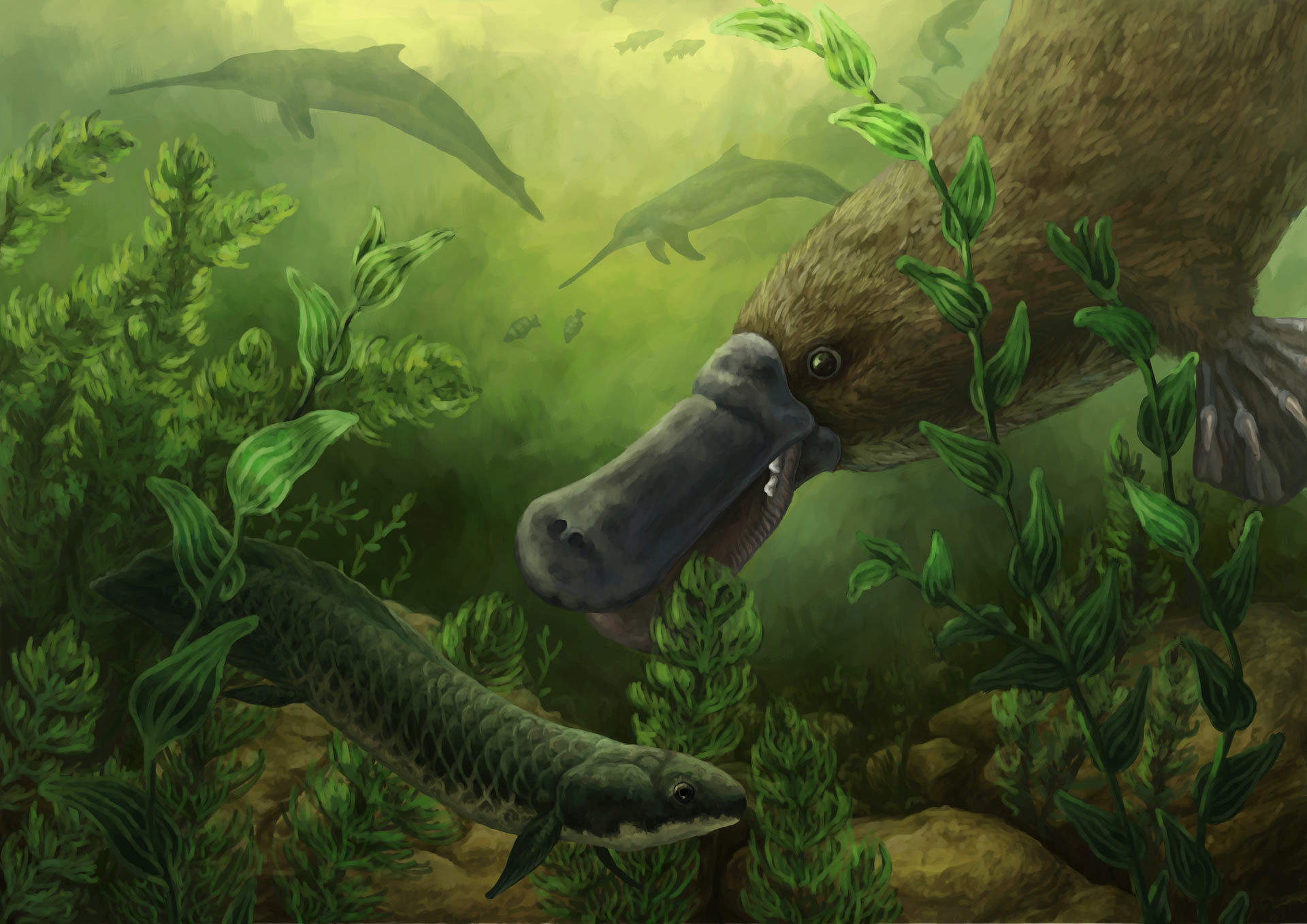
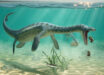
An artist’s impression of fossil platypus and environs circa 25 million years ago. Image credit: Gen Conway, Flinders University Palaeontology Lab.
“Platypuses are extremely rare in the fossil record and are often restricted to teeth, so it’s exciting find new material and learn more about these unique mammals” said Dr. Aaron Camens, a paleontologist at Flinders University.
First described in 1975, Obdurodon insignis lived during the Late Oligocene about 25 million years ago in extensive permanent lakes, slow-flowing rivers and forested lowlands of central Australia.
The species mainly differed from modern platypus by having well-formed teeth: molars and premolars.
The modern platypus has vestigial teeth on hatching but soon loses them and only has small horny pads to chew its food with when adult.
Previously, Obdurodon insignis was known only by one and a half molar teeth, a jaw fragment and a pelvis fragment.
However, one of the few well-preserved fossils, of a closely related younger (17-14 million years old) species called Obdurodon dicksoni, gave some clues.
Identified in 1992, the animal had a skull similar but slightly bigger than that of the modern platypus, had teeth and a stronger bite.
“The new material of Obdurodon insignis includes the first premolar, an important tooth in front of the molars,” Dr. Camens said.
“This shows Obdurodon insignis had large pointed front teeth which, with its large robust molar teeth, could easily have crushed animals with shells or exoskeletons like yabbies.”
“The other rare find was the discovery of a partial scapulocoracoid, or bone that supports the arm or front limb,” added Dr. Trevor Worthy, also from Flinders University.
“This reveals a very similar forelimb structure to modern platypus, indicating it could swim just as well as its modern descendant.”
“These fossils show that 25 million years ago Obdurodon insignis was very similar to the modern platypus. It differed mainly by being slightly larger and having teeth.”
According to the team, the forests of 25 million years ago supported diverse communities of arboreal or tree-dwelling mammals, such as koalas and many types of possums.
Below, on the ground, sheep-sized marsupials browsed, with many other animals at their feet.
These included familiar-looking skinks, frogs and small carnivorous marsupials.
In the trees, lived numerous birds including the previously-described giant eagle Archaehierax.
The ancient lake supported many kinds of lungfish and other smaller fish.
Feeding on the fish, or plants and small invertebrates in the lake or along its shores, were several species of waterfowl, cormorants and flamingos.
Little known, is that a small dolphin also lived in these freshwater ecosystems. Its teeth and bones also have been found at several places where the rocks expose this ancient community.
“This is the setting that the ancient, toothed platypus lived in before its bones settled to the floor of the lake 25 million years ago,” said Dr. Gen Conway, also from Flinders University.
The results appear this month in the journal Australian Zoologist.
_____
Trevor H. Worthy et al. 2026. New material of the toothed platypus Obdurodon insignis (Monotremata: Ornithorhynchidae) from the Late Oligocene Pinpa Local Fauna at Billeroo Creek, South Australia. Australian Zoologist 45 (1): AZ26011; doi: 10.1071/AZ26011