Astronomers have discovered a rocky exoplanet about twice Earth’s size just 25 light-years away, orbiting in the habitable zone of its parent star, Gliese 3378.
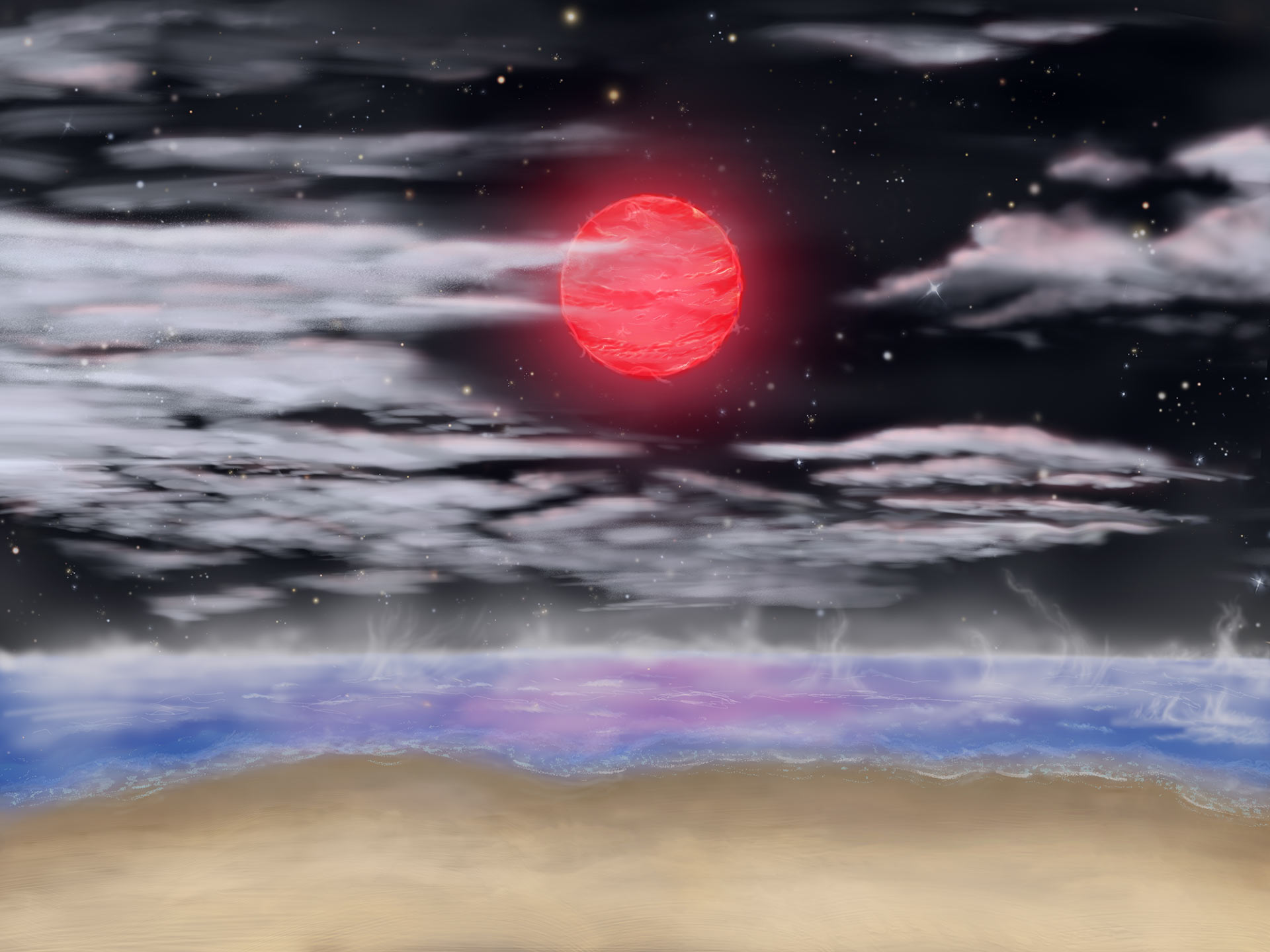
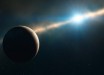
An artist’s conception of the view from the surface of Gliese 3378b. Image credit: Nikolai Berman / UC Irvine.
Gliese 3378, also known as GJ 3378, LHS 1805 or TIC 322347050, is a red dwarf star located 25 light-years away in the northern constellation of Camelopardalis.
The newfound planet, Gliese 3378b, has a mass about 2.3 times that of Earth and an orbital period of 21.45 days.
It sits inside its host star’s habitable zone — the ‘goldilocks’ region around a star where a planet receives just the right amount of solar radiation such that water can exist in a liquid state on a planet’s surface.
“About 70% of stars in our galaxy are red dwarfs, so they represent the standard,” said Dr. Michael Endl, an astronomer at the University of Texas, Austin.
“It’s really important that we understand the planet population around these stars.”
“This one’s exciting,” said Dr. Paul Robertson, an astronomer at the University of California, Irvine.
“It’s one of our closest cosmic neighbors. 25 light-years sounds like a long way, but the Milky Way is about 100,000 light-years across, so in that respect it’s our next-door neighbor.”
To learn about Gliese 3378b, Dr. Endl, Dr. Robertson and their colleagues used the Habitable-zone Planet Finder instrument on the Hobby-Eberly Telescope at McDonald Observatory in Texas, and the NEID Spectrometer on the WIYN Telescope at Kitt Peak National Observatory in Arizona.
“This super-Earth gets about 90% of the radiation from its host star as Earth gets from the Sun, so it’s right in the sweet spot,” Dr. Robertson said.
One lingering mystery is the nature of Gliese 3378b’s atmosphere — or if it even has an atmosphere.
The planet sits right on the edge of what researchers call the cosmic shoreline — the region around a star where, if a planet sits outside it, solar radiation can strip its atmosphere away.
An example from our own Solar System is Mars, which astronomers think may’ve had an atmosphere like Earth’s at one time before solar radiation destroyed it.
“If you scale the Earth down to the size of an apple, its atmosphere would be about as thick as the skin of the apple,” Dr. Robertson said.
“That’s just enough to maintain the kinds of surface pressures where you can have liquid water.”
“It’s enough that there’ll be breathable air, and it provides maybe a little bit of protection from the harsh radiation environment of space.”
The discovery of Gliese 3378b adds another candidate to the list of exoplanets that may be hospitable to life.
“If a planet in the habitable zone has a proper atmosphere, we can justify further research looking for biosignatures, liquid water or other signs of life that require both an atmosphere and the right amount of heating from the host star,” said Gogod James, a student at the University of California, Irvine.
The findings appear in the Astrophysical Journal.
_____
Paul Robertson et al. 2026. A Revised Mass and Period for the Habitable Zone super-Earth GJ 3378b: A Planet Straddling the Cosmic Shoreline. ApJ 1005, 32; doi: 10.3847/1538-4357/ae732b