For decades, physicists have puzzled over a deceptively simple question: how does a proton carry its baryon number, the quantum property that marks it as matter rather than antimatter? According to a new paper by researchers with the STAR Collaboration at the Relativistic Heavy Ion Collider, the baryon number appears to be carried not by the proton’s three quarks alone, but by the web of gluons that binds those quarks together — a structure known as a baryon junction.
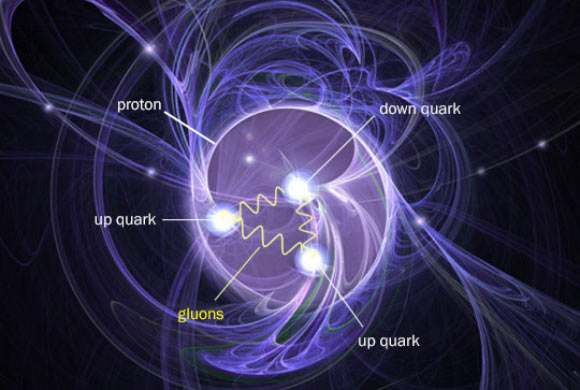
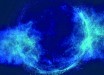
Quark and gluons inside a proton. Image credit: Brookhaven National Laboratory.
The conventional picture holds that a proton is essentially three quarks, each contributing to its properties.
However, increasingly precise experiments have revealed that it is a far more complex system, with many of its defining properties emerging from the interactions between quarks and the gluons that bind them together.
One of the biggest remaining mysteries is how the proton carries its baryon number.
“Baryon quantum number is found to be conserved since baryogenesis in the early Universe,” the STAR physicists said.
“Conventionally, each fractionally charged valence quark is understood to carry one-third of a baryon number.”
“An alternative hypothesis posits that baryon number is instead carried by a baryon junction — a nonperturbative, Y-shaped gluonic configuration.”
To adjudicate between the two ideas, the researchers studied particle collisions involving photons, gold nuclei and heavy ions at the Relativistic Heavy Ion Collider (RHIC).
Across the experiments, the baryon number traveled farther and differently than would be expected if it rode along with the quarks alone, consistently favoring the gluon-junction model over the traditional picture.
“Using data collected from different types of particle collisions at RHIC, our results suggest that the baryon number is not simply carried by individual quarks,” said Professor Zhangbu Xu, a physicist at Kent State University and Brookhaven Lab.
“Our findings strongly support the idea that baryon number is more favorably carried and transported by gluons, the particles that hold quarks together, when arranged in this special configuration.”
“Our research challenges the long-held idea that baryon number is simply divided among and carried by the three quarks,” said Dr. Rongrong Ma, a physicist at Brookhaven Lab.
“This new understanding reshapes how we think about the structure of matter and deepens our knowledge of the most fundamental element that is responsible for the universe in its current form.”
The team’s paper was published in the journal Science.
_____
STAR Collaboration. 2026. Tracking the baryon number with nuclear collisions. Science 393 (6812): 727-731; doi: 10.1126/science.ads5962