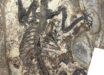
Urokodia aequalis, an early Cambrian marine predator from the Chengjiang biota of China, preserves the earliest known evidence of chelicerae — the pincer-like structures that later evolved into the fangs of spiders and the pincers of scorpions.
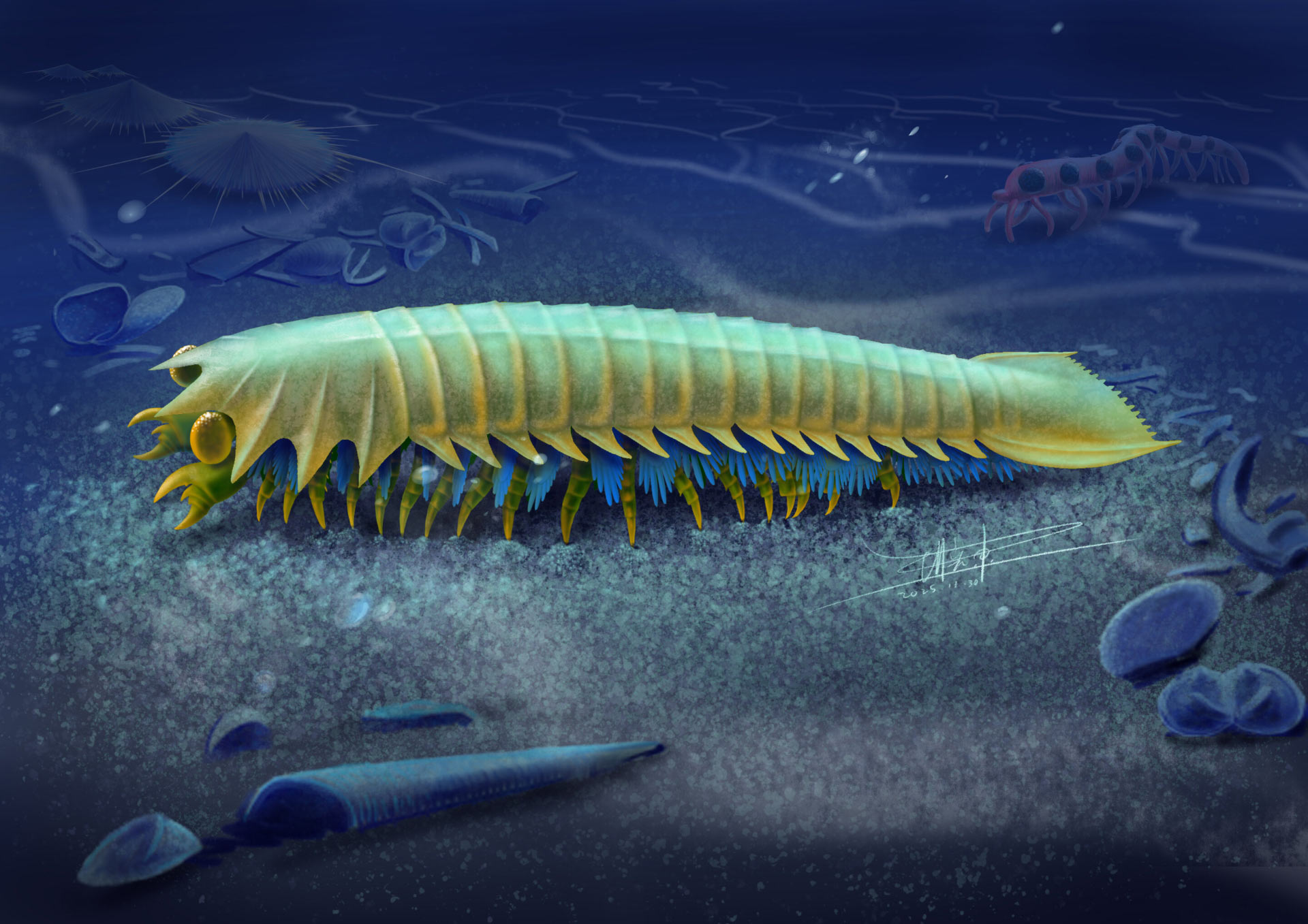
An artist’s impression of Urokodia aequalis, a marine predator that lived in the Cambrian seas around 518 million years ago. Image credit: Xiaodong Wang.
Spiders, along with scorpions and ticks, form part of a group of invertebrates known as chelicerates, currently comprising over 100,000 described species.
They have jointed limbs and external skeletons but are particularly noted for the specialized limbs called chelicerae at the front of the animal which are used as pincers or fangs for stabbing prey.
The earliest fossil record of chelicerates does not come from terrestrial environments but from marine creatures that lived more than 500 million years ago in the Cambrian seas.
In new research, paleontologists focused on one such marine animal, Urokodia aequalis, from the famous Chengjiang fossil site of Yunnan province in China.
This creature was quite small at around 2-3 cm long with large eyes protruding on stalks from the front, a segmented skeleton and jointed limbs strung from the underside of its slender body.
“Urokodia aequalis was part of an ancient ecosystem of over 200 different types of animals living in the seas over 500 million years ago,” said University of Leicester’s Professor Mark Williams.
“These spectacularly preserved fossils provide real insights into how life was evolving on our planet at the very dawn of animals.”
Using X-ray tomography, Professor Williams and his colleagues were able to peer into the rock encasing the Urokodia aequalis specimens and found that much of the creature’s soft tissue was still preserved.
The scans revealed two small, pincer-like limbs behind the animal’s eyes, an early version of the chelicerae that would evolve into the fangs of spiders and the pincers of scorpions.
“We were using X-ray tomography analysis of these fossils to reveal their soft anatomy buried in the rocks for hundreds of millions of years, when suddenly we noticed the pincer-like limbs at the front of the animal,” said Professor Yu Liu, a paleontologist at Yunnan University and the University of Leicester.
“We knew immediately that this was a very exciting fossil and indeed a distant ancestor of living chelicerates like scorpions and spiders.”
Urokodia aequalis also had features on its legs resembling book gills, the breathing structures still found in horseshoe crabs today.
The find pushes back the fossil record for this feature and offers a rare, detailed look at how one of evolution’s most successful hunting adaptations first took shape in the ancient seas.
“Urokodia aequalis has a seven-segmented head with a sclerotized hypostome, pincer-like appendages and biramous trunk appendages with overlapping exite flaps,” the paleontologists said.
“Its pincer-like appendages represent a bridge structure between the appearance of multisegmented appendages and true chelicerae, and its trunk appendages support a megacheiran origin of book gills.”
The findings appear today in the journal Nature.
_____
Y. Liu et al. Urokodia sheds light on the origin of chelicerae and book gills of Chelicerata. Nature, published online July 1, 2026; doi: 10.1038/s41586-026-10713-2