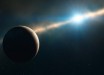
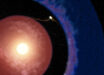
Just 1.4 billion years after the Big Bang, MXDFz4.4 — a galaxy 100 times smaller than the Milky Way — was blasting ionizing light through the neutral hydrogen that once shrouded everything, giving astronomers their closest-ever look at cosmic reionization in action.
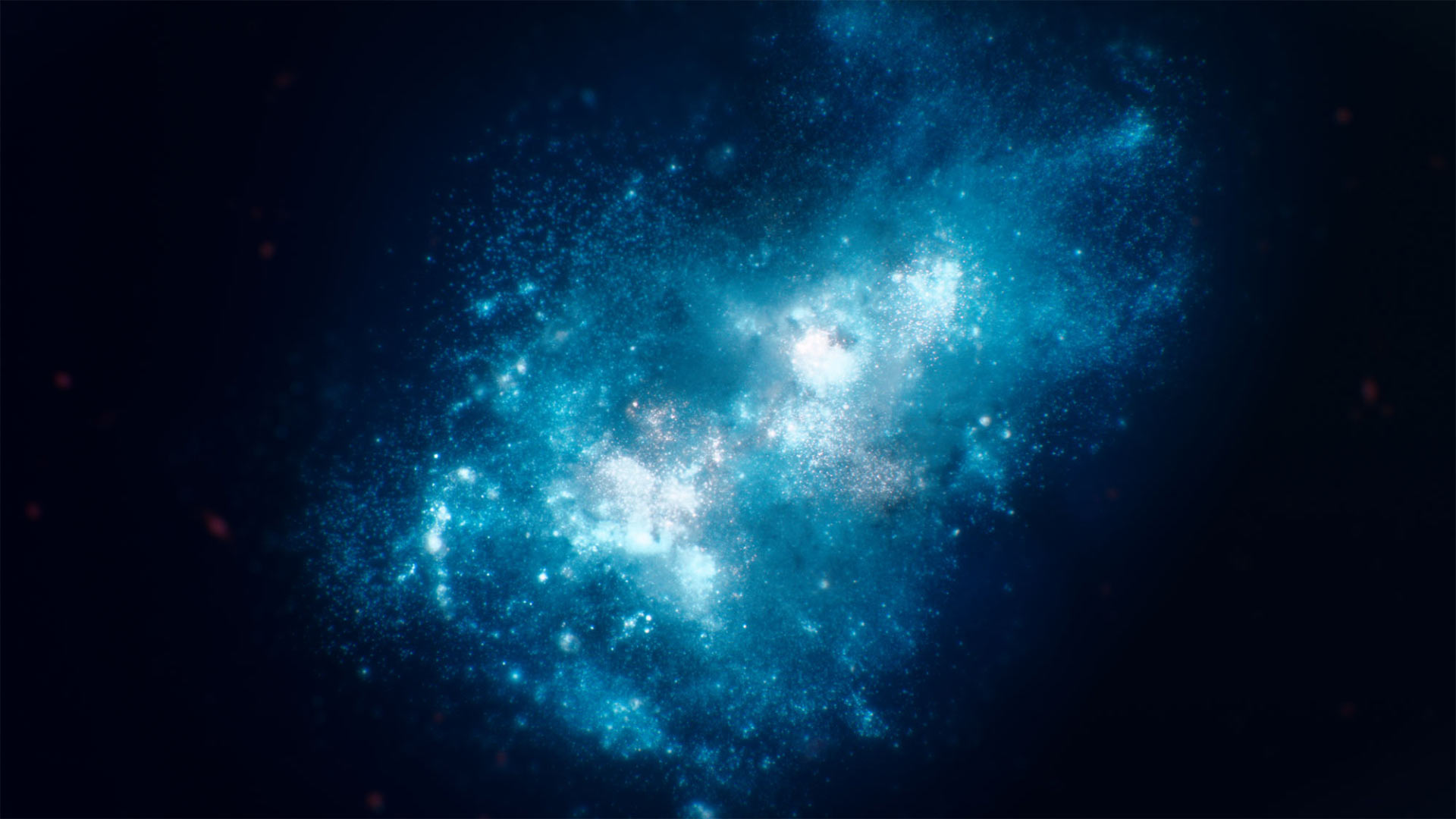
This illustration portrays galaxy MXDFz4.4 when it existed 1.4 billion years after the Big Bang. Image credit: NASA / ESA / Leah Hustak, STScI.
MXDFz4.4 existed at the end of the Epoch of Reionization, a transformative period in our Universe.
During roughly the first billion years after the Big Bang, the gas between stars and galaxies was opaque to energetic ultraviolet light.
As time wore on, gas everywhere became transparent or ionized. The changeover was not like an on/off switch, but likely took hundreds of millions of years.
“Observing a galaxy like this was thought to be impossible,” said Dr. Ilias Goovaerts, a postdoctoral fellow at the Space Telescope Science Institute.
“Researchers expected the ‘fog’ or neutral hydrogen that filled the early Universe would be too thick and obscure our view of its ionizing light.”
“Hubble not only spotted that light, but it also helped reveal incredible details about the galaxy’s characteristics.”
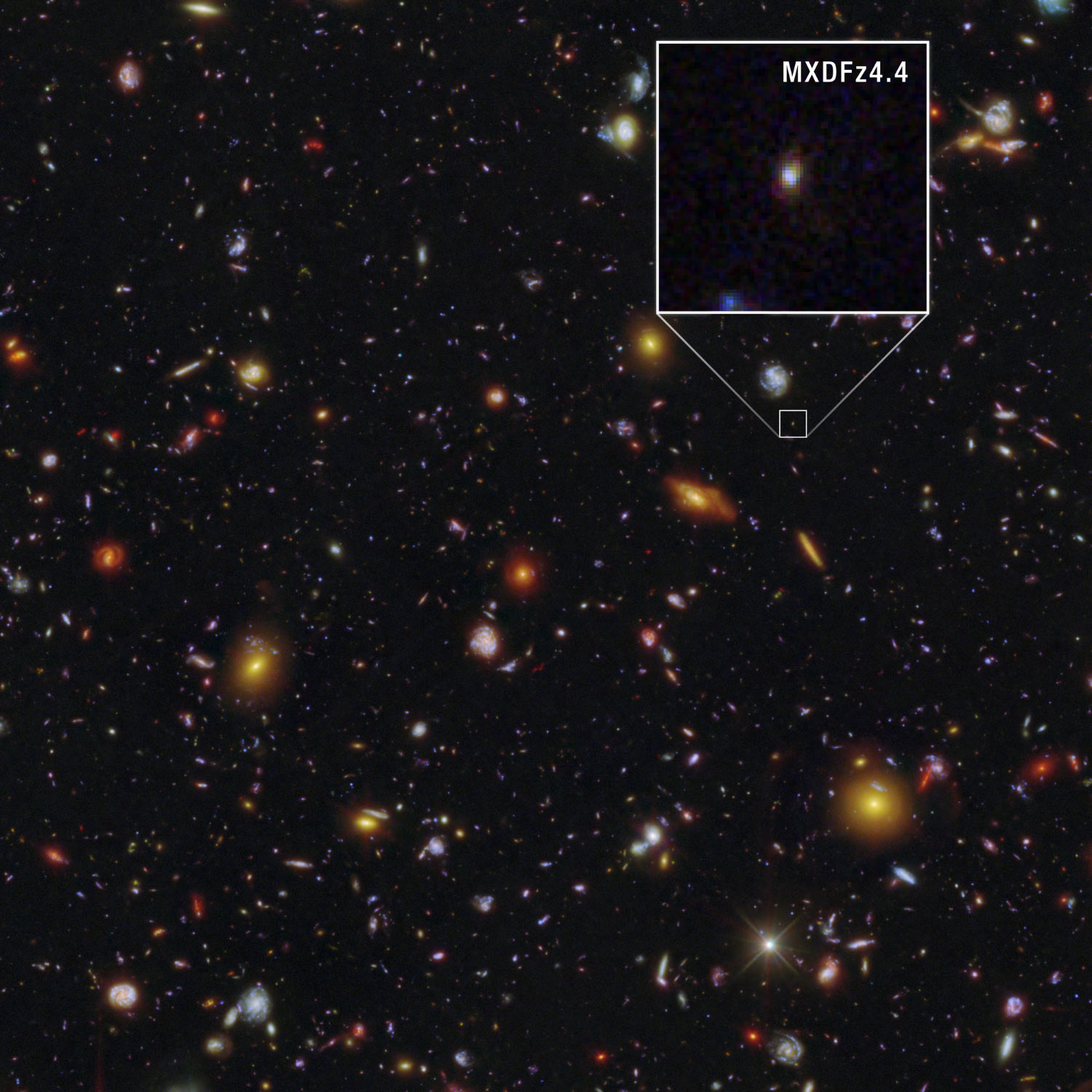
Detailed visible-light images from Hubble reveal that several bursts of younger stars cleared the space in and around MXDFz4.4. Image credit: NASA / ESA / CSA / STScI / Ilias Goovaerts, STScI / Marc Rafelski, STScI & JHU / Anton Koekemoer, STScI / Alyssa Pagan, STScI.
“Astronomers have found many galaxies that existed at this point in the history of the Universe, but we haven’t detected ionizing photons from any of them, making MXDFz4.4 one of a kind,” said Dr. Marc Rafelski, also from the Space Telescope Science Institute.
Hubble’s long exposures, pulled from several existing surveys, revealed that MXDFz4.4’s young, massive stars are the source of the ultraviolet light, which cleared the surrounding space.
These stars formed in bursts within the last few million years of the galaxy’s existence and are crammed together.
Amplifying this crowding effect, MXDFz4.4 is about 100 times smaller than our Milky Way Galaxy, but is forming stars 10 times faster.
“A lot of young, hot, massive stars in a small space do a better job of blasting through opaque gas,” Dr. Goovaerts said.
The team’s paper was published on June 23, 2026 in the Astrophysical Journal.
_____
Ilias Goovaerts et al. 2026. MXDFz4.4: A LyC Emitter 250 Myr after the Epoch of Reionization and a First Test of Lyα Morphology as a Tracer of LyC Escape at High Redshift. ApJ 1005, 34; doi: 10.3847/1538-4357/ae75b0