According to an international group of scientists led by Dr Nate Stephenson of the US Geological Survey, most of tropical and temperate tree species grow more quickly and sequester more carbon as they grow older.
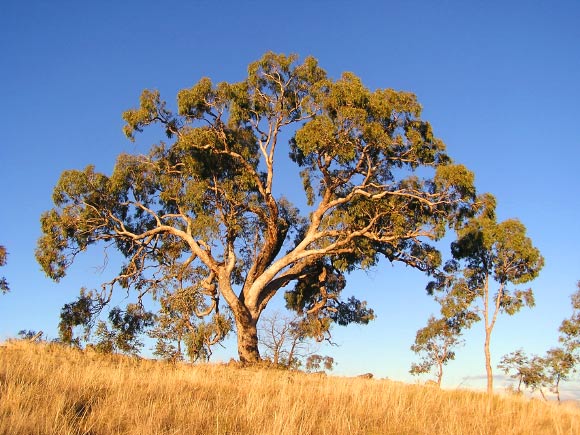
Eucalyptus bridgesiana tree.
The report, published in the journal Nature, is based on repeated measurements of 673,046 individual trees belonging to 403 species, some going back more than 80 years.
“Rather than slowing down or ceasing growth and carbon uptake, as we previously assumed, most of the oldest trees in forests around the world actually grow faster, taking up more carbon. A large tree may put on weight equivalent to an entire small tree in a year,” said co-author Dr Richard Condit from the Smithsonian Tropical Research Institute.
“This report would not have been possible without long-term records of individual tree growth. It was remarkable how we were able to examine this question on a global level, thanks to the sustained efforts of many programs and individuals,” added co-author Dr Mark Harmon of Oregon State University.
“Extraordinary growth of some species, such as Australian mountain ash – also known as eucalyptus – (Eucalyptus regnans), and the coast redwood (Sequoia sempervirens) is not limited to a few species,” Dr Stephenson said.
“Rather, rapid growth in giant trees is the global norm and can exceed 600 kg per year in the largest individuals. In human terms, it is as if our growth just keeps accelerating after adolescence, instead of slowing down. By that measure, humans could weigh half a ton by middle age, and well over a ton at retirement.”
While the findings apply to individual trees, it may not hold true for stands of trees. As they age, some trees in a stand will die, resulting in fewer individuals in a given area over time.
The report includes studies from the Pacific Northwest. One team of scientists worked in forest plots – some created as early as the 1930s – at the H.J. Andrews Experimental Forest east of Eugene and Mount Rainier National Park. Researchers measured growth in Douglas-fir, western hemlock, Sitka spruce, western red cedar and silver fir.
Under the auspices of the Smithsonian Institution’s Center for Tropical Forest Science, another team in Africa established a forest research site in Cameroon in 1996. They measured growth in about 495 tree species.
In 1980, the first large-scale tree plot was established in Panama in an effort to understand why tropical forests were so diverse. More than 250,000 trees with trunk diameters greater than 1 cm were identified and measured within a 50-hectare area.
______
Stephenson NL et al. Rate of tree carbon accumulation increases continuously with tree size. Nature, published online January 15, 2014; doi: 10.1038/nature12914