Most people know about lightning and the havoc it wreaks on forests. They do not know about the weak electrical glow, called a corona, that is thought to form on tree leaves under thunderstorms. Using an ultraviolet-sensitive instrument, Pennsylvania State University researchers have now directly observed and measured this electrical phenomenon on sweetgum, loblolly pine and other tree species under thunderstorms in several U.S. states.
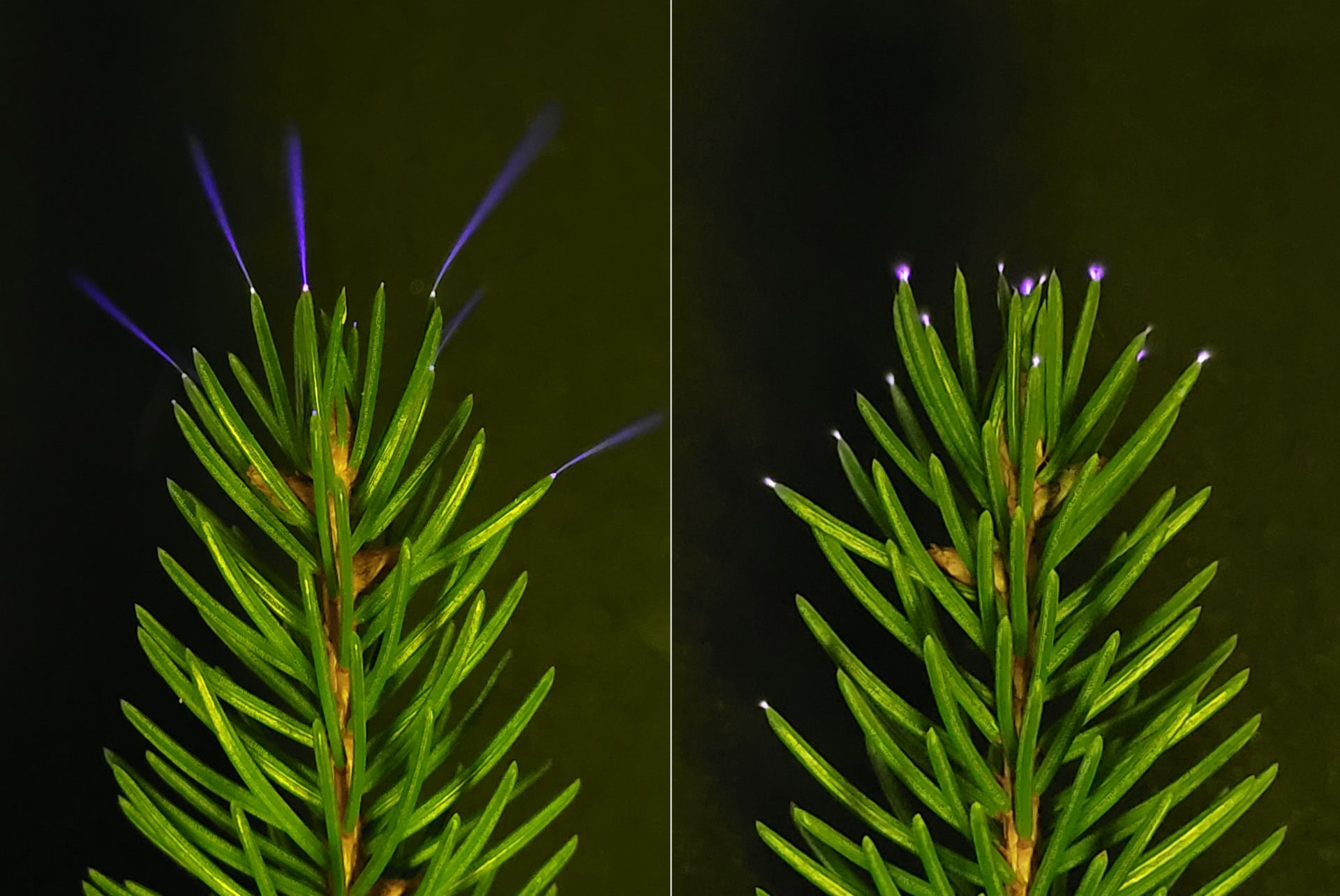
Coronae glow on the tips of spruce needles, induced by charged metal plates in a laboratory. Image credit: William Brune.
For as long as thunderstorms have rolled across the planet’s forests, cloud-to-ground lightning has commanded attention: splitting trunks, igniting wildfires and briefly turning night into day.
But scientists are now focusing on a far subtler electrical phenomenon that forms on the tips of leaves during thunderstorms.
Unlike lightning, which superheats the air to tens of thousands of degrees, coronae are weak electrical discharges, with temperatures only slightly above the surrounding air.
Yet these understated sparks produce extreme amounts of hydroxyl, the atmosphere’s main oxidizer, damage tree leaves, and potentially contribute charged particles to the thunderstorm cloud base.
“These things actually happen; we’ve seen them; we know they exist now,” said Dr. Patrick McFarland, a meteorologist at the Pennsylvania State University.
“To finally have concrete evidence of that…is what I think is the most fun.”
“In the laboratory, if you turn off all the lights, close the door and block the windows, you can just barely see the coronae. They look like a blue glow,” he added.
For their research, Dr. McFarland and his colleagues developed a multi-component mobile instrument capable of measuring coronae on treetops and atmospheric properties that can influence their formation.
The main component was a 25-cm diameter telescope that focuses the UV radiation onto a solar-blind UV camera sensitive to wavelengths between 255 and 273 nm.
The scientists were able to observe coronae on sweetgum and pine trees during a thunderstorm in North Carolina.
“Coronae hopped among leaves and sometimes followed a branch as it swayed in the wind,” they noted.
The authors made similar observations on other tree species under four other thunderstorms from Florida to Pennsylvania.
“Our observations indicate that corona shimmer on the swath of trees beneath a thunderstorm,” they said.
“These coronae can alter air quality in forests, subtly damage leaves, and possibly give charge to overhead thunderstorms.”
The study was published online February 12 in the journal Geophysical Research Letters.
_____
P.J. McFarland et al. 2026. Corona Discharges Glow on Trees under Thunderstorms. Geophysical Research Letters 53 (4): e2025GL119591; doi: 10.1029/2025GL119591